

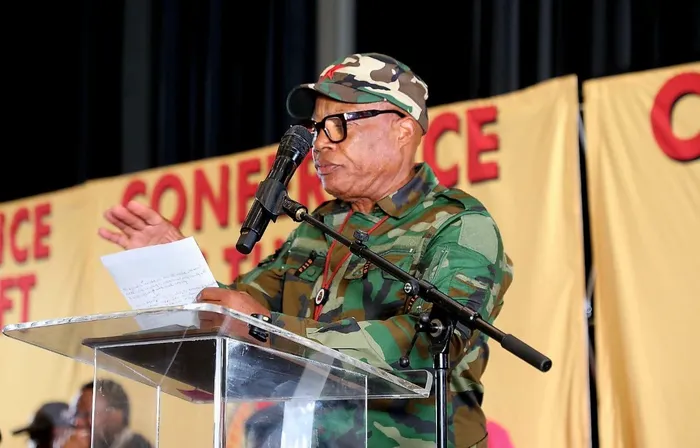
MK Party deputy president Tony Yengeni called for unity among leftist groups and said the DA and FF Plus were working against the progress made since the end of apartheid.
Image: Timothy Bernard/Independent Newspapers
MK Party second deputy president Tony Yengeni has called for unity among leftist groups and accused the DA and FF Plus of protecting colonial-era privilege and trying to reverse the gains of democracy.
He was speaking at the South African Communist Party’s (SACP) Conference of the Left in Boksburg, Ekurhuleni, on Friday.
The three-day conference aims to strengthen coordination, unity in action, political education and organised struggle among leftist and working-class formations, according to the SACP.
Although the ANC confirmed it had been invited to the conference, the party rejected the gathering, saying there was “nothing leftist” about it.
Yengeni said the MK Party was proud to be associated with the conference.
“We commit that we will do everything to build and cement unity. Unity in action and solidarity amongst the black majority.”
“This conference carries on its shoulders the restoration and continuation of the historical mission of our revolutionary struggle to unite the black majority to take over political power and govern this country and achieve all the noble dreams and aspirations of our people.”
He said when they visited EFF leader Julius Malema’s home two months ago in Limpopo with party leader and former President Jacob Zuma to convey condolences to Malema’s family, Zuma indeed conveyed condolences but also said something more.
“He said, whilst we are here to convey our condolences but more importantly I want to say the time has come for the black majority to come together, unite and take over political power.”
“The reason why we are here comrades is corresponding to that command by our President to go out and forge unity amongst all progressive forces in this country with the sole purpose of taking over political power.”
He said the reason they were at the conference was “not because we love each other”.
“We are here for a reason and the reason is assuming political power so that we can use that political power to liberate our people. And therefore the first order of business in this conference should and must be to ensure that this Left Conference emerges as a solid, powerful and united left country.”
Yengeni said the conference must conclude by establishing a revolutionary council to run the affairs of the conference.
“The left council must be subordinated and report to the Left Conference meaning that this Left Conference becomes the supreme body of this Left platform which meets once or twice a year when and where it deems necessary.”
“The left revolutionary council must be guided by a set of principles and those principles must include the national current demand of the black majority to bring back our land to its rightful owners and restore the dignity of our people and its traditional leadership.”
He said the second guiding principle of the left formation must be economic freedom.
“To ensure that our economy serves primarily the aspirations of the black majority. The black majority must own the economy. The black majority must own the banks, the mines, the farms and the factories.”
“The black majority must be put at the centre of the economy and not at the periphery. This left platform must be guided by democratic, non-racial, anti-colonial and anti-imperialist political efforts.”
“Let me repeat to comrades that this Left platform must together work towards assuming political state power and use that state power to destroy the efficacy of apartheid and racism and form a powerful state that will intervene decisively in the service of the majority.”
He said all state organs, without exception, must be restructured to serve the people.
“Parliament should become in reality an organ of people's power and sovereignty. Representatives of Parliament should be elected democratically by the people to change policies and law in order to serve the interests of those that have nothing.”
“The decisions of Parliament should be final and no other organ of state should be above Parliament. Parliament must become that final arbiter and decision maker that represents the final sovereignty of our people.”
He said the security of citizens was supreme and the integrity of the country’s borders must be guaranteed by the state.
“A war must be waged by the people and the state against crime and corruption to ensure the safety and security of our people. All must be equal before the law. The law must serve all people equally.”
“No one and no one, no matter how high in status, must be above the law. The law must always serve the people and not the other way round.”
“We must live in peace with our neighbours and seek to cooperate and build strong economic relations and trade in the entire African continent.”
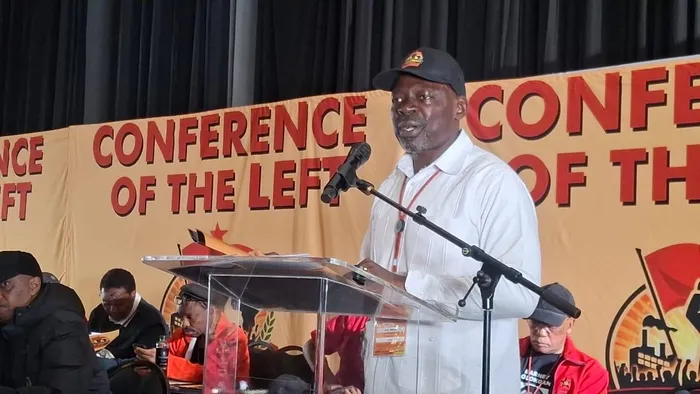
Speaking at the SACP’s Conference of the Left at Boksbrug on Friday, the general secretary of the communist party Solly Mapaila said unity among leftist parties was critical.
Image: Timothy Bernard/Independent Newspapers
According to Yengeni, the unity of African people across the continent was paramount.
“The unity of the African continent and other continents against war, aggression and tyranny for economic development, peace and solidarity is of great urgency and importance.”
“Out of these guidelines, comrades, must emerge a programme of action that we are going to pursue and implement together. We are not arbitrary personaries. We must act guided by clear, progressive and revolutionary principles.”
He said the left formations must represent the historic aspirations of the oppressed and exploited masses of South Africa.
“It must end unapologetically on the side of the poorest of the poor. The working class, the rural masses, the unemployed, women, youth, progressive sections of our middle strata and its primary mission must be total social, economic, political and cultural emancipation of the black majority.”
According to Yengeni, being progressive meant not only commitment to local struggles, but unwavering solidarity with progressive African, continental and international forces.
“Resisting terrorism, neocolonialism, domination and capitalist exploitation.”
He said the liberation of South Africa could never be divorced from the liberation and development of Africa as a whole.
“In our country, the Democratic Alliance and the Freedom Front Plus, together with their counterparts, represent the most relational sections of our society. Forces rooted in the defence of colonial privilege, white monopoly culture and neo-liberal domination.”
“Their political projects seek to weaken, fragment and ultimately reverse the gains of our liberation struggle. Their agenda is deeply intertwined with the interests of international capital and imperialist networks, which continuously mobilise and protect to legitimise them,” he told delegates.
Yengeni, who is a member of the steering committee for the conference, said the South African economy remained fundamentally colonial and neo-colonial in character.
“The wealth of the country continues to be concentrated in the hands of a tiny minority, while the black majority remains dispossessed and marginalised.”
“The left front therefore advances the strategic objective of restructuring the economy so that it serves the interests of the majority and not private monopolies of foreign capital.”
“For genuine economic liberation to occur, the land and the mineral wealth must give way to the ownership and control of the people, led by the black majority. The historical injustice of land dispossession can never be resolved through cosmetic reforms or market-driven solutions.”
He said the dignity, authority and historical role of traditional leadership must also be restored and protected.
“Traditional leaders remain custodians of the land, culture, customs and spiritual heritage of African people. And they must occupy a respected place within the democratic and developmental architecture of our society. The left front affirms that real democracy cannot be reduced to elections every five years,” he added.
SACP general secretary Solly Mapaila, chairperson of the steering committee for the conference, said the conference could not become another forum for abstract declarations or rhetorical posturing.
“It must emerge as a serious instrument for political coordination, ideological clarity, and practical working-class mobilisation.”
He said their task was not merely to manage the crisis of capitalism or make capitalism more humane.
“Our task is to organise for its defeat. That requires principled unity of the forces of the left, not unity built on ambiguity, not unity built on avoiding difficult political questions, and certainly not unity reduced intellectual convenience of various organisations.”
According to Mapaila, unity among leftist forces was critical.
“We cannot allow this fragmentation to continue. Therefore, we require unity forged through struggle rooted in shared understanding that class struggle remains the decisive motto of history, that the liberation of the working class can only be achieved by organised power of the working class itself, and that no meaningful social transformation can occur without confronting entrenched capitalist power relations and societal power relations at every level, whether it's economic, political, and ideological.”
“Therefore, this places special responsibility on this conference. We are not just merely custodians of a process.”
“We are the builders of a political direction, reorganisation of the working class for a new revolution. We want to reorganise the working class for a new revolution in this country.”
He said there was no turning back.
“In this regard, the only way we can come out of this capitalist morass, as well as the crisis that it has created for the working people, is through a coordinated left.”
He said the working class did not need another layer of procedures.
“It does not need endless consultations that produce no movement. It needs leadership capable of translating analysis into organisation. It needs leadership that is able to translate this organisation into stride, into concrete tasks in our communities.”
“Therefore, we're required to build coordinated solidarity with worker struggles, as well as the strides of the working class at every level,” Mapaila added.
The Unemployment People’s Assembly (UPA), which advocates for unemployed people, said the Conference of the Left was taking place at a decisive moment in the country’s history.
“South Africa continues to confront deepening unemployment, poverty, inequality, hunger, homelessness, and economic exclusion affecting millions of our people - particularly the working class, the unemployed, women, youth, informal traders, and marginalized communities,” said the organisation’s general secretary, Raymond Maseko.
He said the unemployed remained the forgotten victims of an economic system that continued to concentrate wealth in the hands of a few while the majority struggled for survival and dignity.
“We therefore regard this conference not merely as a political gathering, but as an urgent platform for rebuilding progressive unity, advancing people-centred alternatives, and restoring the revolutionary mission of genuine economic, political and social transformation.”
South Africa’s unemployment rate rose to 32.7% in the first quarter of 2026, up from 31.4% in the previous quarter.
Maseko said the progressive movement carried a historic responsibility to unite around a common programme aimed at defending the poor, protecting workers, advancing economic justice, and confronting the structural roots of unemployment and exploitation.
“History will judge this generation not by speeches alone, but by its ability to build principled unity in action.”
“The people of South Africa are yearning for ethical leadership, revolutionary honesty, and a coherent programme capable of confronting corporate domination, corruption, state capture, economic injustice, and the suffering of the poor,” he said.
Among those attending the conference were representatives from the MK Party, EFF, Cosatu, Pan Africanist Congress, AZAPO, United Africans Transformation, NUMSA and SANCO.
simon.majadibodu@iol.co.za
IOL Politics