

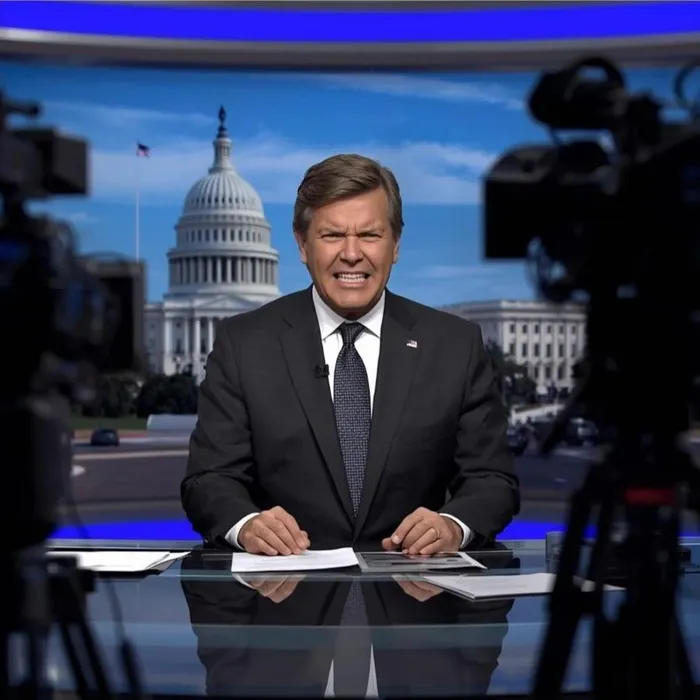
Decades after Edward Said's 'Covering Islam,' Western media continues to shape perceptions of the Muslim world through loaded language, creating a narrative that justifies military action against Muslims as inevitable.
Image: IOL Graphics / Canva AI
Decades ago, Professor Edward Said published a book called “Covering Islam”. In it, he warned that Western media does not simply report on the Muslim world, it constructs it. Using loaded language, a rotating cast of “experts” on various media platforms and the sheer power of repetition, the media manufactures a reality where military action against Muslims becomes not just acceptable, but inevitable. In the western mindset, telling lies repeatedly, inevitably becomes the truth.
Said wrote these words in 1981. Today, as the United States and Israel wage war on Iran, his work reads less like academic theory and more like a prophecy fulfilled. We are now witnessing something Said could not have fully anticipated: the transformation of major American news outlets into full-blown echo chambers for the USA government and its proxies, including Israel. The line between independent journalism and state propaganda has not just blurred, it has, in many cases, been erased. And nowhere is this more visible than in the coordinated machinery linking the White House, the Pentagon and networks like Fox News.
The facts are that this century of military actions reveals a consistent pattern: Western interventions in Muslim-majority nations, (read: Algeria, Libya, Lebanon, Syria, Palestine, Iraq, Iran and Afghanistan) whether overt invasions, covert coups, or proxy wars, have often been justified by immediate threats or noble-sounding goals like "democracy promotion" or “freeing women” or "counterterrorism." Yet the long-term consequences have repeatedly included instability, massive civilian death, the rise of ever more radical movements (some created and funded by the CIA) and the resultant failed states.
Said’s central insight, as a Professor of Literature, was about words. He argued that some terms like “fundamentalist, terrorist, regime and mullahs” were not neutral descriptions. They were weapons. They stripped Muslims of their humanity, erased political context and framed conflicts as battles between western civilisation and barbarism. On Fox News, for example, at any hour of the day you will probably hear the same vocabulary on repeat. Iran is not a country with legitimate national security concerns; it is a “terror state” run by “bloodthirsty thugs”. Its leaders are not political figures; they are “mullahs” (an archaic term designed to make them sound medieval and irrational). This is not journalism. It is a call to arms. An ideology that seeks currently to legitimise the Epstein regime. Fearing that ethics, values and demonstrable human consciousness would scuttle the “white is right” project.
| Keyword | Said's Analysis in 'Covering Islam' | Current Media Usage |
| Regime | Used to delegitimise governments. Said notes it’s almost exclusively applied to non-Western, particularly Muslim, governments, implying they are illegitimate, dictatorial and not representative of their people. | The term "Iranian regime" is standard in Western media, contrasting with the more neutral "Iranian government". It delegitimises the state and implies a ruling body opposed to its people's will, paving the way for a narrative of necessary confrontation or regime change. The same term is rarely used for Israel, which is typically called a "government" or "state". |
| Terrorist / Terrorism | Said argues this is the most powerful and reductive label. It strips any political, national, or social context from an act of violence. By calling someone a "terrorist," the media places them outside the realm of legitimate politics, making them a "mad dog" or "fanatic" to be destroyed, not understood. | This label delegitimises Palestinian resistance. Hamas is universally called a "terrorist organisation"; a term used to criminalise all armed resistance to occupation while rarely being applied to state violence. IDF actions are framed as “self-defence”, or "counter-terrorism," never "state terrorism". |
| Fundamentalist | Said calls this a "quasi-theological" term used as a substitute for serious analysis. It ignores all expressions of Islamic politics and social activism into a threatening category. It implies a return to a "medieval" past and an inherent hostility to western modalities. | Though partially superseded by terms like "Radical Islam" or "Islamist," this label still frames opponents, whether Iran's clerics or Hamas, as driven by irrational religious fervour, making political grievances over land and rights seem irrelevant. |
| Axis of Evil | A term coined by President George W. Bush in 2002, after the book's first edition, but it perfectly embodies the process Said describes. It's a piece of literary-political fiction that lumped together Iran, Iraq and North Korea, creating a single, monolithic threat out of disparate nations. | Though the phrase itself has faded, its conceptual framework endures. Western media presents the "Axis of Resistance" (Iran, Syria, Hezbollah, Hamas, North Korea) as a coordinated "evil" network bent on Israel's destruction; framing the conflict not as separate geopolitical issues but as a unified, existential threat. |
| Mullahs | Said highlights the use of this term as a specific tool for "othering" Iran. By using an archaic and culturally loaded term ("mullahs" instead of "clerics" or "religious leaders"), the media portrays Iran's leadership as backwards, superstitious, and out of touch with modernity. It dehumanises them, making them seem more like caricatures than legitimate political figures. | This term is still the default in much of the Western media when referring to Iran's leadership. The phrase "the mullahs in Tehran" is a shorthand that evokes everything the West is not: anti-modern, anti-Western and irrational. It serves to delegitimise the entire Iranian state, suggesting that it is run by a group of medieval priests. |
Said understood that when you reduce a nation to a set of threatening adjectives, you prepare the public to accept its destruction. If Iranians are “barbarians” and their leaders are “mad mullahs,” then bombing them is not a war crime; it becomes a moral duty.
But the situation today is worse than Said described. It is not merely that the media is biased; it is that the media has been structurally captured by the very interests it is meant to scrutinise. I have written before about media ownership and its consequences. In recent weeks, the corporate landscape of American media has shifted dramatically.
When one of the largest donors (Larry Ellison) to a foreign military owns a sizeable shareholding American news networks. The conflict of interest is not subtle. Then there is the revolving door between the government and the airwaves. When War Secretary Pete Hegseth holds a press briefing 9he is facing multiple civil lawsuits), he no longer simply answers questions. He dictates what “patriotic journalism” should look like. He has removed most news outlets from their regular spaces in the Pentagon press room, replacing them with outlets that align with the Trump administration’s narrative.
At a recent briefing, Hegseth attacked CNN by name for reporting on Iran’s military capabilities, calling the story “ridiculous” and offering his own edits for what headlines “should” say. The message could not be clearer: report the war the way we want, or we will find someone who will.
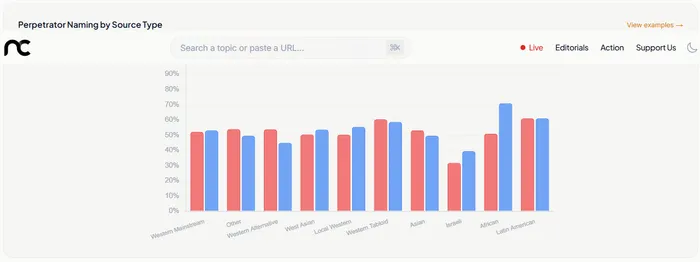
How Western Media Sanitised the US-Israeli War on Iran.
Image: NewsCord
The most insidious part of the strategy isn’t direct censorship; it’s creating what media scholars call a “chilling effect”. This refers to a climate of fear that pushes news organisations to censor themselves. The mechanism is simple. FCC (Federal Communications Commission) Chairman Brendan Carr has warned broadcasters they could lose their licenses for airing “fake news,” even citing a presidential complaint about war coverage as grounds for review. The threat itself sends the message: fall in line or face consequences.
The pattern becomes clear in how the war is covered. On one side, outlets like Fox News frame it as both a technological triumph and a moral mission, relying on a familiar rotation of retired generals and aggressive analysts. On the other, more critical reporting is quickly attacked while calls for “true national journalism” reinforced pressure on the media. The result is a skewed information landscape: Iranian casualties are downplayed, while official narratives are amplified, even when later proven false. When 174 schoolgirls were killed in a strike on a school in Minab, the BBC led with nine dead in Israel and relegated the children to a footnote. Meanwhile, the administration’s claims, including the assertion that Ayatollah Mojtaba Khamenei was dead or in a coma, were amplified and repeated, even when they were later proven false. No apology had been offered. None of this is to say all American media has become a propaganda arm. Independent outlets like Drop Site News and Al Jazeera provide on-the-ground reporting and context that challenge official narratives.
Edward Said taught that media does not simply reflect reality; it creates it. For decades, Western media has created a reality where Muslims are inherently threatening, where their deaths are less important and where their resistance is always terrorism and American/Israeli violence always self-defence. The slaughter of Palestinians is a latest example.
The bombs falling on Iran emerge from a language; constructed, repeated and enforced ad nauseam by an echo chamber spanning the White House, the Pentagon and major networks. Words that shape the opinions and views of a gullible, somewhat uneducated public. If we want to stop the wars, we must first stop the words. Refuse the language of "mullahs" and "barbarians." When the USA government asks its citizens to "get on board" with a war, it is not asking for patriotism. It is asking for silence. Said's call at the time for journalism that interrogates power is more urgent now than ever.
Edward Said would recognise this machinery immediately. He saw it in 1979, when media coverage reduced Iran's revolution against authoritarian rule to a drama of "angry crowds" and "Islam out of control". Today, the pattern is the same: history simplified into "evil versus good"; Iranian strikes as "aggression", USA and Israeli strikes as "self-defence". The story always begins at the moment of Muslim violence; because Western media chooses this the starting point that makes the West the victim. His warning is valid today: when a nation is portrayed as irrational and threatening, diplomacy becomes impossible. Military force becomes "common sense" and the American public consents to wars it barely understands.
The bombs falling on Iran do not emerge from a vacuum. They emerge from a language; constructed, repeated and enforced by an echo chamber spanning the White House, the Pentagon and major networks. To stop the wars, the words need to be stopped and refused.
Edward Said's call for journalism that interrogates power, is more urgent than ever. The echo chamber is loud. But the truth, however muffled, is still speaking. The question is whether we are willing to listen.
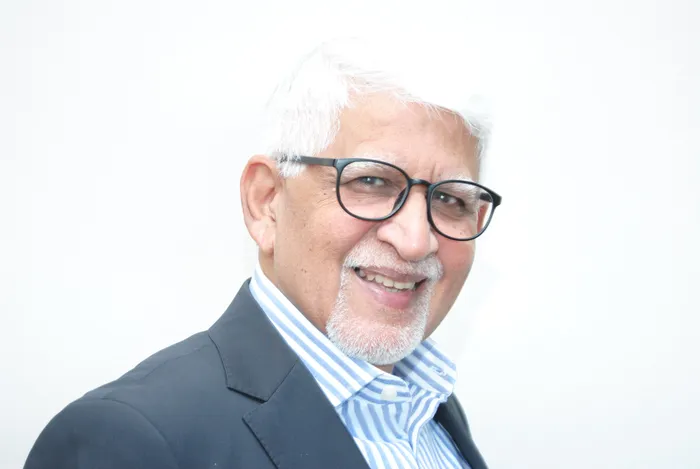
Decades after Edward Said's 'Covering Islam,' Western media continues to shape perceptions of the Muslim world through loaded language, creating a narrative that justifies military action against Muslims as inevitable.
Image: Supplied