

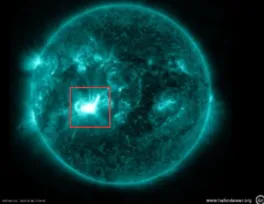
Understanding the impact of the G4 geomagnetic storm in South Africa.
Image: South African National Space Agency (Sansa)
South Africa is experiencing a severe geomagnetic storm, a space weather event caused by activity on the Sun that can interfere with communication, navigation and power systems, the South African National Space Agency (SANSA) has confirmed.
Geomagnetic storms occur when charged particles from the Sun collide with Earth's magnetic field.
While they are rarely felt by people directly, their impact affects technology such as radio communications, GPS navigation, aviation systems and electricity networks.
Sansa said the current storm has already reached a high level. "The expected geomagnetic storm has arrived at G4/Severe conditions," the agency said.
The storm is expected to continue on Tuesday, with conditions changing throughout the day.
"The geomagnetic storm is expected to continue throughout Tuesday, with G1 to G3 conditions and a possibility of further G4/Severe storm levels," Sansa said.
The storm was triggered by a powerful solar eruption over the weekend. Sansa explained that "geomagnetic storm conditions are expected to increase over the next 24 hours with the arrival of an Earth-directed coronal mass ejection (CME)".
A CME is a large cloud of charged particles released from the Sun that can disturb Earth's magnetic field.
Sansa said the solar flare that caused the CME did not directly affect Africa.
"The African region was not affected by the high-frequency radio blackout on Sunday as it was observed during nighttime, mostly out of the flare’s impact range," the agency said.
Solar flares are sudden bursts of energy from the Sun and are ranked from weak to very powerful. The flare responsible for the current storm was classified as an X-class event, the strongest category.
Sansa said geomagnetic storms are measured on a global G-scale ranging from G1 (minor) to G5 (extreme).
Although most people will not notice any direct effects, industries that rely on navigation and communication systems, including aviation and drone operators, are advised to monitor space weather conditions closely as the storm continues.
IOL News