

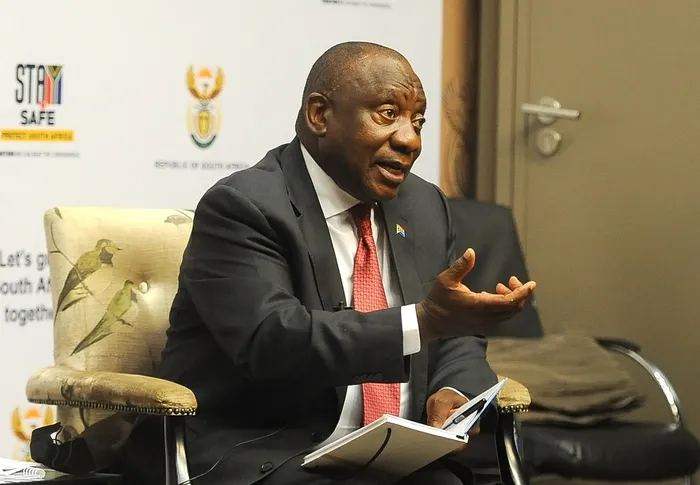
The Human Sciences Research Council’s report reveals that nearly half of employed adults in South Africa reported instances of rule-bending to benefit friends or family, and over half observed corruption related to financial gain or bribery within their work environment. Pictured is South African President Cyril Ramaphosa.
Image: Phando Jikelo / Parliament RSA
The perceptions of weak law enforcement and poor whistle-blower protection undermine public willingness to fight corruption, despite a growing appetite among South Africans to confront and combat corruption.
This was revealed by Dr Steven Gordon, chief research specialist at the Human Sciences Research Council (HSRC), following the recent release of their report titled, ‘Corruption and Behaviour Change: Tracking Social Norms and Values in South Africa’.
The study looked at how South Africans can be encouraged to adopt an anti-corruption mindset and work with authorities to fight corruption.
It was found that many adults reported living in communities where public officials engage in bribery, nepotism, and sexual extortion, and these issues disproportionately affect economically disadvantaged communities.
According to the report, the proportion of adults who expressed an appetite for taking action in the fight against corruption increased between 2023 and 2025. The share of the public who said they would report corruption if they experienced or witnessed it grew by 7 percentage points. In 2025, roughly three-fifths of adults said they would be either likely (33%) or very likely (26%) to report.
It highlighted that one of the main reasons people do not want to report corruption is a lack of trust in the legal system and law enforcement agencies.
“When asked why people did not report corruption, the most common reasons included lack of punishment for offenders, inadequate protection for whistle-blowers, and corruption within reporting structures themselves. It is clear from our data that perceptions of weak enforcement and poor whistle-blower protection undermine public confidence and discourage reporting, both of which are essential for meaningful citizen participation in the fight against corruption,” read the report.
It also highlighted that socio-economic status again plays a role, with economically advantaged individuals tending to report lower levels of workplace corruption.
“We found that many people, including those currently working, believed that their profession was characterised by corrupt behaviour. Nearly half of employed adults reported instances of rule-bending to benefit friends or family, and over half observed corruption related to financial gain or bribery within their work environment. Public sector workers reported higher levels of corrupt practices than their private-sector counterparts,” read the report.
Gordon said the study reveals that corruption is a dire issue in ‘our’ nation, with many adults reporting bribery, nepotism, and sexual extortion in the public service and in their workplaces.
“What is concerning is that economically disadvantaged communities appear to be disproportionately affected. The good news is that there is a growing appetite among South Africans to confront and combat corruption. However, perceptions of weak law enforcement and poor whistle-blower protection undermine public willingness to fight corruption.”
To empower people to combat the cancer of corruption in our nation, we need to strengthen protection for whistle-blowers, publicise successful anti-corruption actions, and promote anonymous tip-off hotlines, he stated.
“Policy makers must recognise the role of economic disadvantage and design economic interventions that take these inequalities into account, when looking to fight corruption,” Gordon said.
Devoshum Moodley-Veera, an integrity and anti-corruption activist and a member of ACCERUS at Stellenbosch University, said the HSRC report paints a grim picture, which she described as a ‘stagnant state in the fight against corruption’.
“This longitudinal study reveals a country that, although it has implemented and advocated for the fight against corruption, in reality, we are not winning this fight. All levels of society are entrenched with corruption and other forms of violence against human dignity. This report not only reveals key forms of malfeasance that the country is facing but also the increase and different forms of corruption,” Moodley-Veera stated.
“In my opinion, South Africa has not implemented robust measures to address such forms of corruption. For example, sextortion and unethical conduct by professionals, and the poor self-management of professional bodies when addressing unethical or criminal conduct by professionals, are experienced daily. The high levels of unemployment have driven individuals to dishonesty in curriculum vitae, falsifying qualifications, paying bribes to secure jobs, paying through sexual favours, and the list is endless.”
The HSRC report, she said, is in alignment with the Auditor-General of South Africa’s reports, as consequence management is non-existent.
“Perpetrators are untouched, whereas those who expose corruption, for example, whistle-blowers, witnesses, civil society organisations, media, and activists, are targeted and silenced with gag orders or assassinated. Although the statistics reveal that individuals are afraid to expose malfeasance due to the fear of retaliation and safety, most whistle-blowers either remain anonymous or receive settlement amounts and sign off on non-disclosure agreements to remain silent. This would skew the results and provide an inaccurate reflection of reporting,” Moodley-Veera said.
gcwalisile.khanyile@inl.co.za