

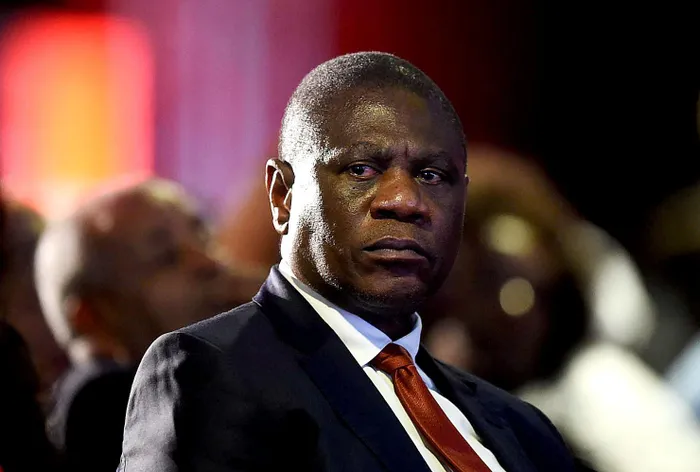
Deputy President Paul Mashatile says the second session of the National Dialogue could wait for the local elections.
Image: Itumeleng English/Independent Newspapers
Despite the government’s promise to conclude the National Dialogue in the first half of 2026, Deputy President Paul Mashatile has indicated that it may take place after the local government elections.
Mashatile said this during the 2026 National Dialogue Steering Committee (NDSC) induction session on Saturday.
The two-day induction, held at Unisa’s Muckleneuk main campus in Pretoria, concluded on Sunday afternoon.
The induction took place to formally prepare the 99-member committee for its role in leading a nationwide consultative process and it followed a handover from the Convention Organising Committee.
The steering committee is tasked with outlining the practical roadmap and phased plan for dialogues across the country.
The induction session of the National Dialogue team consisted of the Eminent Persons Group (EPG), the NDSC and the Secretariat of the dialogue.
Mashatile is the chair of the Inter-Ministerial Committee on the National Dialogue.
The National Dialogue is convened to address deep-seated national crises like poverty, inequality, crime, and slow economic transformation by bringing all sectors of society together to forge a new, shared vision and social compact for the country's future, moving beyond talk to practical action and rebuilding trust.
The first session of the National Dialogue, known as the First National Convention, convened from August 15 to 16, 2025, at Unisa.
Although there is no clear date, the second session was planned to be held in the first half of 2026.
Mashatile, through his spokesperson, Keith Khoza, said the process leading to the dialogue will require a huge effort to onboard society broadly.
He added that, given the task at hand, it may require that the actual dialogue may take place after local government elections.
The specific election date has not yet been announced, but the window is determined by the five-year term of the current councils, which officially ends on November 1, 2026.
Mashatile said the reasons behind the decision are that the public will be involved in the election, including a voter registration campaign.
“Secondly, the dialogue must be orchestrated to reach the lowest levels of society. This means both responsibilities will be demanding. Consequently, at a certain point, the dialogue work will be paused in favour of election work,” he said.
The total cost of the National Dialogue initiative is projected to be R450 million, with R270m funded by taxpayers via the Department of Planning, Monitoring and Evaluation (DPME) and the remainder from the private sector.
Mashatile said even though there is a budget allocated for the process, the government will allocate necessary resources.
“How resources are utilised must be transparent and there should be proper accountability and responsibility,” he said, adding that the government is committed to seeing the work of the dialogue completed.
He said the discussion of what was discussed in the closed session will be divulged through dialogue structures.
The induction, according to the committees, offered critical inputs, key reflections and handover reports between the structures.
“We were reminded about the intention behind structures, how they are intended to work together and what is expected from each, in the dialogue process,” read the National Dialogue page comment on X, adding that communication that prioritises clarity and verified information can be expected.
Meanwhile, President Cyril Ramaphosa has urged the newly inducted steering committee to ensure that the “significant initiative” remains a citizen-led process that is inclusive and well organised.
Ramaphosa said the citizens must be able to freely participate as individuals, in organised formations and through representative bodies.
“The people of this country need to take ownership of this process,” he said.
manyane.manyane@inl.co.za