

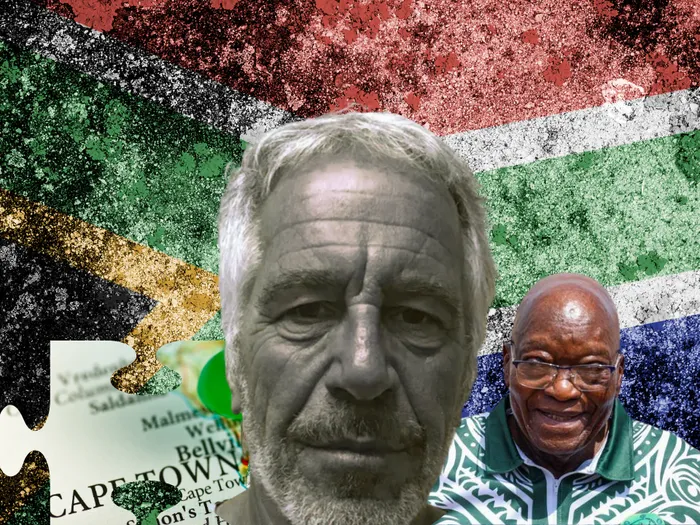
As journalists, researchers and content creators pore over newly released US court documents linked to convicted sex offender Jeffrey Epstein, fresh questions are being raised about who is named, why the documents were released, and what their timing means.
Image: IOL Graphics
As journalists, researchers and content creators continue to examine newly released US court documents linked to convicted sex offender Jeffrey Epstein, questions have emerged regarding the 'who, why and when' of the documents.
We look into why South Africa appears in some of the files and how frequently the country is referenced compared to others.
South Africa’s footprint in the files appears to be limited when compared with other countries.
Ireland, for example, appears more than 1,600 times in one analysed tranche of documents. This is largely due to legal, corporate and correspondence records.
The United States and United Kingdom also appear many times by volume, and this reflects Epstein’s residence, legal proceedings and primary social networks.
South Africa appears only sporadically, with no evidence so far of sustained correspondence or repeated operational activity linked to the country.
Reporting based on document excerpts shows that South Africa appears in the Epstein files for three primary, non-overlapping reasons. It is worth noting that none of these constitutes allegations of criminal activity in South Africa itself.
1. References to model scouting and travel
One set of emails contained in the released files refers to travel to South Africa, including Cape Town, in the context of international model scouting. The exchanges form part of broader communications around modelling agencies and talent placement, which appear frequently in Epstein-related records due to his long-documented involvement in elite social and modelling circles.
These references describe intended or past travel, not confirmed activities, and do not allege illegal conduct in South Africa.
2. A social event involving former President Jacob Zuma
South Africa is also mentioned in connection with emails arranging a private dinner in London in 2010 for then-President Jacob Zuma during an official overseas visit. The emails show logistical planning for the event and were authored by individuals linked to Epstein’s social network.
The correspondence does not allege or describe unlawful behaviour.
Furthermore, the Jacob Zuma Foundation has publicly rejected any suggestion of connection, stating that a reference in an email does not imply a relationship or wrongdoing.
3. South Africans employed abroad
A smaller number of references relate to South African nationals who worked on Epstein’s private island in the Caribbean. These mentions relate to employment history rather than criminal investigations.
A mention of a country or individual does not amount to an allegation, let alone proof of wrongdoing.
The files reflect Epstein’s global social reach, not criminal activity by every person or place referenced.
Many records are administrative, social or contextual, including diaries, travel discussions, event planning and third-party correspondence.
To date, no South African institution or authority has been implicated in the Epstein investigation, and no findings have suggested that crimes were committed in South Africa as part of Epstein’s operations.
IOL