

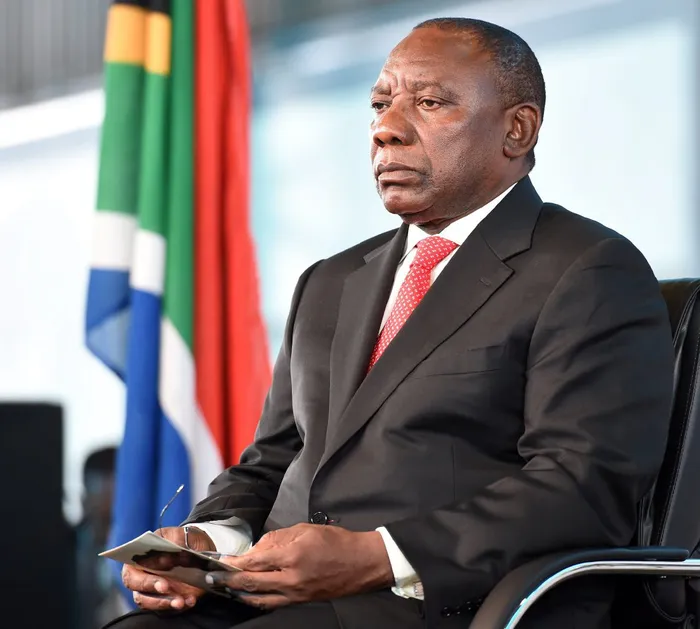
President Cyril Ramaphosa has been accused of failing to keep his 2018 promise to reduce the size of the cabinet.
Image: GCIS / DoC
President Cyril Ramaphosa has been accused of failing to keep his promise of reducing the size of the cabinet, a promise he made during his first State of the Nation Address (SONA) eight year ago.
Opposition parties and political analysts also described this as a form of political management by the President, adding that these large executives are designed to balance coalition partners, factions, and alliance pressures and not ease the burden on the taxpayer.
In his February 2018 State of the Nation Address (SONA), Ramaphosa promised to reduce the size of his cabinet to cut costs and improve government efficiency, responding to long-standing criticism regarding excessive spending.
While he later reduced the number of ministers from 36 to 28 following the general election in May 2024, the overall executive remained large, with later additions in 2023 causing criticism.
This was after he expanded his cabinet by adding two new ministerial portfolios to the Presidency - Minister in the Presidency for Electricity, led by Dr Kgosientso Ramokgopa and Minister in the Presidency for Planning, Monitoring and Evaluation, which is led by Maropene Ramokgopa.
Following the 2024 general election and the formation of the Government of National Unity (GNU), the cabinet again grew significantly, consisting of 32 ministers and 43 deputy ministers.
This reportedly costs taxpayers an estimated R239 million to R670m annually in salary, support staff and related perks. The cost is expected to increase after Ramaphosa recently approved a 3,8% salary increase for ministers, deputy ministers and members of parliament, effective from April 1, 2026.
In his SONA this month, there was no mention of the bloated cabinet or any indication that it will be reduced.
Build One South Africa (BOSA) leader Mmusi Maimane has been a consistent critic of the size of the cabinet, advocating for a smaller and more efficient government to reduce wasteful expenditure.
The party said it was disappointing that eight years after Ramaphosa’s promise, a bloated cabinet, excessive ministerial perks, VIP security details and underperforming departments continue unchallenged.
He said this is despite clear public opposition, adding that no reforms have been announced to right-size the executive or cut waste.
“Citizens pay billions of rands each year in salaries, blue light brigades, VIP security details, luxury cars, business class flights and ministerial houses,” said spokesperson Roger Solomons, adding that BOSA’s stern position is a leaner and more efficient government structure to reduce unnecessary expenditure while improving coordination and effectiveness.
“Merging Small Business Development with Trade and Industry, eliminating duplication and inefficiencies - saving R2.4 billion. Eliminating the Department of Planning, Monitoring, and Evaluation, as its functions can be integrated into existing governance structures - saving R1 billion. Abolishing Deputy Minister positions, which add unnecessary costs without clear benefits, saving R500m annually,” Solomons said.
Although Ramaphosa during SONA this year detailed several measures to cut wasteful government spending, such as phasing out underperforming programmes and removing “ghost workers” from the payroll, he was also expected to address the size of his cabinet, btu did not despite ongoing public and political criticism.
Asked whether there are intentions to address the issue, his spokesperson, Vincent Magwenya, did not respond.
Political analyst Zakhele Ndlovu said it does not make sense to have such a bloated cabinet, adding that this is a classic example of wasteful expenditure.
“The US executive branch is much smaller than ours. The US cabinet consists of 15 secretaries plus seven other members of the cabinet. Mind you, our population is a quarter of the US population,” said Ndlovu, who added that the formation of the GNU was used as an excuse to expand the size of the cabinet.
“Ramaphosa has sought to dispense patronage by giving ministries to smaller parties such as the Inkatha Freedom Party, Freedom Front Plus, Pan Africanist Congress of Azania and Patriotic Alliance. The coalition was supposed to be between the ANC and the DA, but the ANC was scared to be perceived as going to bed with whites, the DA,” he said.
Another political analyst, Professor Sipho Seepe, said Ramaphosa has had serious difficulty in keeping many of his promises and reducing the size of his cabinet is among those.
“He owes too many people in the ANC who supported his presidential campaign. In addition, he has to ensure that he accommodates competing factions in his party. Having done so, he had to accommodate members of other political parties in the GNU. This is a self-created crisis. He lacked the courage to see through his promises,” said Seepe, adding that Ramaphosa could have rejected salary increases for members of the executive.
Meanwhile, ActionSA’s Alan Beesley said the recent approval of salary adjustments for ministers and deputy ministers was made despite persistent service delivery failures and economic hardship faced by millions of South Africans, further illustrating the GNU’s disconnect from the lived realities of ordinary citizens.
manyane.manyane@inl.co.za