

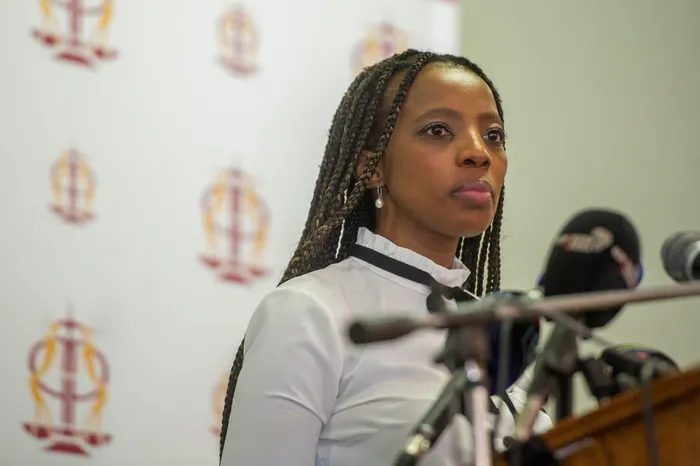
Public Protector Kholeka Gcaleka has recused herself from the ongoing investigation into the salary increase of Parliament Secretary Xolile George.
Image: Armand Hough / Independent Newspapers
Despite Public Protector Kholeka Gcaleka’s recusal from the ongoing investigation into the salary hike for Parliament Secretary Xolile George due to an alleged romantic relationship, some analysts have voiced their opinion that the recusal may still create a perception of institutional compromise.
Gcaleka recused herself from the investigations following the DA’s complaint regarding salary increases for George, implemented by Parliament’s former presiding officers, which reportedly had risen by 88% since his appointment in 2022.
The party launched a complaint with the office of the Public Protector.
Recusing herself from the matter, Gcaleka said her functions in this matter will be performed by Dube.
Gcaleka’s spokesperson, Ndili Msoki, said she had taken this course of action to avoid a conflict of interest.
Political analyst and governance expert Sandile Swana said the DA will now have to scrutinise Gcaleka’s actions with regard to this probe.
Msoki said there is nothing untoward in the Public Protector’s course of action in this matter, taken in order to avoid any association with a case where her personal interest may be perceived to compromise her impartiality.
He described this as being similar to a situation where the law allows for the recusal of a judge by withdrawing from presiding over a case due to potential bias, conflict of interest, or any reason that may be perceived to impede their impartiality.
Msoki added that the core principle behind judicial recusal is to uphold the integrity and fairness of the process, ensuring that justice is not only done, but is also seen to be done.
“The Public Protector’s conduct in this matter is also governed by the Public Protector Act 23 of 1994, particularly the provisions dealing with the management of interests that may give rise to a perceived conflict, and the delegation of powers and functions.
“Section 3(14) provides that no person may conduct or assist with an investigation in ‘respect of a matter in which he or she has any pecuniary interest or any other interest which might preclude him or her from performing his or her functions in a fair, unbiased and proper manner’. Section 3(15) deals with the disclosure of such interests and the necessary recusal of such a person to ensure a fair, unbiased and proper investigation,” he said.
Gcaleka was appointed as the Public Protector in November 2023 and she released a report clearing President Cyril Ramaphosa of wrongdoing in the Phala Phala farm scandal, which involves allegations of money laundering, corruption and a high-level cover-up following a burglary at Ramaphosa’s home.
Opposition parties, including the DA and the EFF, opposed her nomination, arguing that she was not a suitable candidate and was “politically expedient” due to her past roles. - following the report that cleared Ramaphosa.
According to the parties, they cited her investigation into the Phala Phala farm scandal as evidence of her being soft on the executive branch.
Another political analyst, Zakhele Ndlovu, alleged that Gcaleka does not “enjoy credibility” due to her handling of the Phala Phala matter, adding that although she recused herself in the ongoing probe against George, he is concerned that her presence could influence her deputy and compromise the process.
Professor Ntsikelelo Breakfast claimed that the removal of the former Public Protector, Busisiwe Mkhwebane, was a political move to protect Ramaphosa from facing the Phala Phala probe, alleging that Gcaleka’s report was questionable.
Msoki said the issue related to the Phala Phala matter has been dealt with at length in the past, adding that the report is currently the subject of high court litigation.
“(We) trust that the process will bring finality to the matter,” he said.
He said Gcaleka has introduced various layers of quality assurance mechanisms within the investigative process in the last three years, ‘to ensure the production of investigations that are of a high standard and capable of judicial scrutiny, and are conducted in line with the institution’s constitutional mandate and the law’.
manyane.manyane@inl.co.za