

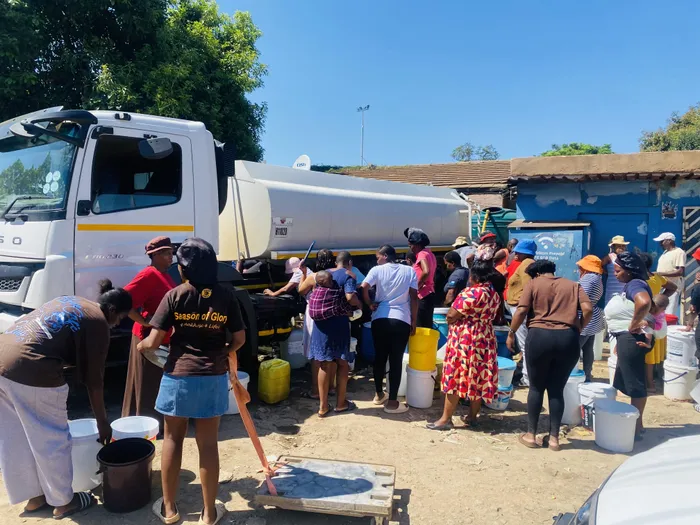
An expert says that South Africa must deal with the construction mafia and water mafia to attract engineering skills back to the public sector. Pictured are residents queuing for water from tankers in Johannesburg.
Image: Simon Majadibodu / IOL
South Africa needs to develop technologies to recover, recycle, and reuse water if it is to cover the 25 cubic meters water shortfall within the next decade to avoid a revolution of unmet expectations.
This was revealed by Dr Anthony Turton, an environmental advisor and research associate at the University of Free State, who highlighted the need to deal with the construction mafia and water mafia to attract skills back to the public sector.
Turton had, in 2008, penned a paper titled ‘Three Strategic Water Quality Challenges that Decision-Makers Need to Know About and How the CSIR Should Respond’, while under the employ of the Council for Scientific and Industrial Research (CSIR).
He warned about the current water supply issues, among other things.
Turton said South Africa has a total of 38 billion cubic metres (BCM) per annum of available water resources, according to the National Water Resource Strategy (NWRS), and subsequent iterations.
He added that 63 BCM is what is needed to create full employment by 2035. This, he said, leaves the country with a shortfall of 25 BCM.
“If we subtract 63 (what we need) from 38 (what we have), then the shortfall is 25 BCM. This is about two-thirds of the total volume of all the dams we have at present, and it represents the size of the new water market. This has to be mobilised in the next decade if we are to avoid a revolution of undelivered expectations. It is doable. The technology exists. The capital exists. There are no bankable projects for investors to consider,” Turton stated.
He drew the numbers from the National Water Resource Strategy No 1, published in 2002, and also cited in the 2008 CSIR strategy.
He made an example about Australia, which is the second driest continent on Earth, with a population less than half that of South Africa, but it has over 1,000 desalination plants running, seven of which supply major cities.
The rest, he said, are for small towns of mining operations.
“In terms of water recovery from sewage in Australia, there are around 720 plants in total (slightly less than in South Africa, with more than double the population). Of these, Melbourne reprocesses 90% of the sewage, and in Western Australia (a state the size of RSA and Namibia combined but with less than three million inhabitants), there are 76 recycling plants, Turton stated.
He added that, “Water recovered from waste is banked in aquifers and blended into the desalination water. This shows that it is socially acceptable, economically viable, and technically feasible. There is no trust deficit in Australia. This is an important factor in South Africa, where there is a major trust deficit, so desalination and wastewater recovery in Cape Town is being opposed by activists.”
On stabilising pressure in cities like Johannesburg, where nearly 50% of treated water is lost through leaks, he said it is empirical evidence that systemic failure is close, and throttling is damaging.
Throttling and water shifting are strategies used by municipalities to manage severe water shortages and prevent total system collapse, which entails reducing the pressure and flow in pipelines rather than shutting them off completely.
“The only alternative is to call on the public to use less water. This will merely widen the existing trust deficit and fuel anger. The other alternative is to prioritise interventions and empower a turnaround team to make decisions without political interference,” Turton stated.
The degradation of national-level monitoring systems and the collapse have been known to water sector professionals since 2008, he said.
On preventing the ‘chemical time bomb’ of microcystins and heavy metals from making the country’s remaining water untreatable, he said, microcystins are still present and are even growing, but are mostly unmonitored.
He highlighted that microcystins pale into insignificance when compared with persistent pollutants such as endocrine disruptors and Per- and polyfluoroalkyl substances (PFAS).
PFAS are a large group of thousands of synthetic ‘forever chemicals’ used since the 1940s for oil, water, and stain resistance in products like firefighting foam, cookware, and food packaging. They do not easily break down, leading to widespread, persistent, and toxic contamination in the environment and human bodies.
Turton said this is exacerbated by the near-total collapse of the wastewater treatment systems in South Africa as monitored by the Green Drop Report.
“In my professional opinion, this is now a national catastrophe. Another area of concern is the emergence of multidrug-resistant pathogens, some of which are found in sewage. The famous South African writer Richard William ‘RW’ Johnson lost his leg to flesh-eating bacteria after swimming in a lagoon on the KZN South Coast,” he said.
Turton stated that Acid Mine Drainage (AMD) hasn’t gone away, but it is generally off the public radar because so many other issues dominate.
“The good news is that some scientific evidence exists that the chemistry of AMD decant is stabilising as natural processes provided by nature kick in.”
He added that areas of concern are the Cradle for Humankind, where sinkhole formation is accelerating, with the N14 (Gauteng/North West) at the intersection of the R536 (Regional Route in Mpumalanga) being one of many examples.
This, he said, is probably caused by AMD eroding the dolomite and hastening cavity formation in the area of the Sterkfontein Caves.
“Given that AMD has not been prioritised, the recovery of minerals from waste has not taken place, even though a technology developed by the University of Cape Town (UCT), known as Eutectic Freez Crystallization, has been successfully trialled by Anglo Thermal Coal and BHP Billiton at the Tweefontein water recovery plant near Ogies. The technology works, but cannot be commercialised because the policy environment is not conducive to capital investment,” Turton said.
On creating a ‘Water-as-a-Service’ model where private entities can legally and technically invest in municipal infrastructure without infringing on constitutional rights to water, he said, in South Africa, people are afraid of private capital, an artifact of ideology.
“In my professional opinion, the state is unable to solve this problem alone. Again, we can look at Australia, where much of the water infrastructure is funded by private sector capital, and in many cases, the plant itself is built, opened, and operated by private sector professionals, with a 30-year contract that determines things like performance standards and pricing structure,” Turton said.
He added: “In SA, people are afraid of private capital, an artifact of ideology. This is unfortunate because the state-owned enterprises have demonstrated that they are unable to keep services running at affordable prices. There is much to be learnt from the Australian experience, although there are major differences too. For example, in Australia, water is owned by right and can be traded. This is not possible in South Africa under existing legislation.”
On skills in the sector, he said many of the country’s technical ingenuity is located in the private sector through consulting engineers, national science councils such as the Water Research Commission, Council for Scientific and Industrial Research (CSIR), and the National Research Fund, and universities.
“We might be able to attract back some of the skills via the consulting engineering community, but the construction mafia and water mafia will have to be dealt with first, as they are powerful gatekeepers. The science councils are under-budgeted and are in serious decline. Collectively, this poses a major challenge. In my opinion, we need to revitalise the CSIR, because that is an existing council with deep history and a track record of excellence. This can only be done if the NRF drives it, and if budgets are made available from parliamentary grants. Unless this is done, the skills will continue to haemorrhage,” Turton stated.
Professor Mike Muller, a visiting adjunct professor at the Witwatersrand University’s Graduate School of Governance, said that water is a natural resource, and its use, whether by public or private parties, is what is regulated.
He added that the Water Services Amendment Act will allow the national government to regulate the water business of municipalities more strictly.
This will require them to use providers with demonstrated ability to do their jobs properly, he said.
“So, there is nothing unconstitutional about allowing municipalities to employ private service providers as long as they can pay them. The focus on regulating water providers still leaves the municipalities as the water services authorities, with final accountability for ensuring service delivery. That is still in line with the constitution,” Muller said.
On ensuring that money paid for water is strictly reinvested into water infrastructure, he said, new government grants (R54 billion) will only be given to municipalities that can show that they are using their water revenue to support water services.
“The National Treasury has already started to apply that rule to metros,” Muller said.
gcwalisile.khanyile@inl.co.za