

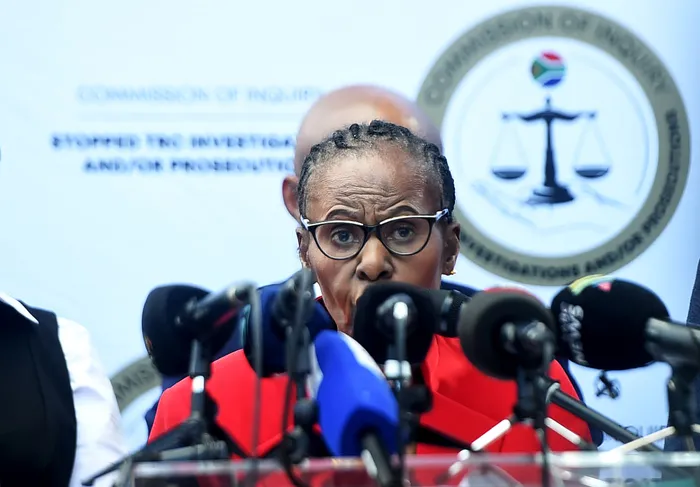
The TRC Cases Inquiry chaired by Justice Sisi Khampepe has heard evidence from Shadrack Ganda, a former activist who worked alongside Joe Gqabi, who was killed in Harare in 1981.
Image: Itumeleng English / Independent Newspapers
The Truth and Reconciliation Commission (TRC) Cases Inquiry has shed light on the harrowing events leading to the tragic death of Joe Nzingo Gqabi, a prominent political activist and anti-apartheid crusader.
Testifying from Australia, Shadrack Ganda, a close friend of Gqabi, revisited the dark chapter of 1981 when Gqabi was brutally murdered by apartheid forces in Harare, Zimbabwe.
Joe Nzingo Gqabi was born in 1929 in Aliwal North, Eastern Cape, and joined the ANC in 1952.
He later joined the underground Communist Party. At the same time, he also joined the Johannesburg-based militant newspaper called the New Age as both a photographer and reporter.
According to media reports, his job of exposing the hidden crimes of apartheid paved the way for a remarkable career as an investigative journalist.
Gqabi is said to have later become one of 2,000 political detainees after the 1960 PAC-led Sharpville Massacre and the consequent State of Emergency in 1960.
Ganda, who now resides in Australia, also reflected on Gqabi's many stints in and out of the country, as well as his incarceration on Robben Island.
He was killed shortly after he was instructed to leave the country in 1981.
According to Ganda, Gqabi was subsequently gunned down by members of the apartheid hit squad on July 31, 1981, and was given a state funeral by the Zimbabwean government.
Ganda said that there were multiple efforts to kill Gqabi due to his political activism, as well as his popularity with the youth and student activists, both inside and outside the country.
Ganda said in their last meeting, there was an issue with securing a safe venue, and they were forced to have a shorter meeting at Gqabi's residence with some of the activists who were travelling back to South Africa that day.
"Due to the many threats and efforts on his life, we had decided that he should no longer sleep at his house. The government of Rhodesia (Zimbabwe) had also refused to arm us, and it was so difficult. On this day, decided on a shorter meeting at our residence. My vehicle was parked behind his, and I reversed out, and he went back to the car. What happened is that after we left, he was attacked as he was reversing. The attackers would have been more than six," he stated.
Ganda further accused the South African government of failing the Gqabi family, saying they have been dragging their feet in as far as investigating the circumstances that led to Gqabi's death more than 30 years into democracy, and 44 years since his assassination.
He added that both Gqabi's wife and the entire Gqabi family were left devastated and frustrated by the lack of urgency to probe the circumstances leading to his death in 1981.
"The advent of going to Harare was ruled out. I was told that the embassy referred the matter to DIRCO, and that the matter became dead in the water. Joe Gqabi was close to our former president Thabo Mbeki, and no one has talked about approaching him or his foundation to get inside information on what could have happened," he told the commission.
The inquiry continues.
siyabonga.sithole@inl.co.za