

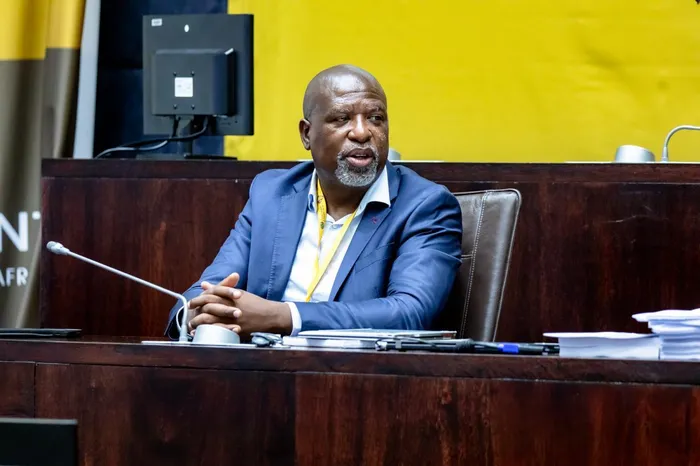
Chairperson of Parliament’s Ad Hoc Committee, Soviet Lekganyane.
Image: ParliamentRSA/Supplied
Chairperson of Parliament’s Ad Hoc Committee, Soviet Lekganyane, shared insight into why they decided to proceed with evidence from businessman Kishene Chetty on Thursday, despite MPs raising concerns, warning that his testimony may prejudice his pending cases before the courts.
Lekganyane said they were not going to be gerrymandering their rules after MPs engaged on the concerns first raised by DA MP Glynnis Breytenbach.
Chetty’s appearance was deferred last week after he spent a day with one of the evidence leaders, Advocate Bongiwe Mkhize, going through the annexures he had submitted with his affidavit.
During his initial testimony on Thursday, the committee heard that Chetty made references in his affidavit to several criminal cases. They also heard that he has been accused along with several other people and companies of charges of theft, corruption, and money laundering.
After MPs voiced their concerns and opinions - some agreeing with Breytenbach’s sentiments - the chairperson ultimately decided to go ahead.
“We are going to proceed with Mr Chetty and let him present what he wants to present,” Lekganyane said. “We are going to proceed. There is no discussion on this matter.”
Breytenbach and her fellow DA member, Dianne Kohler Barnard, said that they would be exempt from participating in the day’s proceedings. When asked later if she wanted to share further comments on their departure, Breytenbach declined.
Her concern stemmed from the fact that with Chetty before them, they would be able to question him on anything, and he would be obliged to answer.
"He may well find himself in a position where he may have to incriminate himself. He is not represented. He has no one to advise him. It is not our job to advise him. I'm concerned about what we're busy doing here today. It is, for me, not quite right, but I am also concerned about his position, in terms of his constitutional rights and his right not to incriminate himself..."
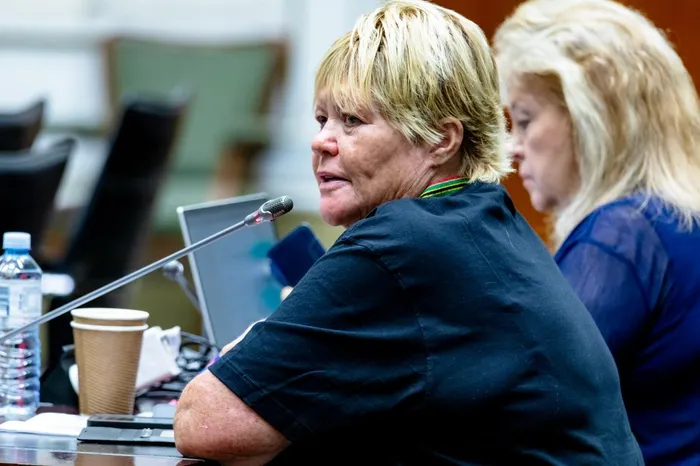
Committee Chairperson, Soviet Lekganyane, said they were not going to be gerrymandering their rules after MPs engaged on the concerns first raised by DA MP Glynnis Breytenbach.
Image: ParliamentRSA/Supplied
Speaking at the sidelines of proceedings, Lekganyane said that there have been two types of witnesses who have come before them - key witnesses and public submission witnesses, Chetty falls into the latter.
“Some of them are raising personal matters that they might have, which relate to conditions of service. And some would raise allegations of abuse of organisational authority. There are also those who will allege corrupt practices within the system.
“The committee has said they must bring their own submissions the way they have crafted them themselves,” Lekganyane said.
“As a leader, you must adhere to principles of transparency and honesty. You can't say no, so that tomorrow we are accused of having changed somebody's statement.
“A submission was made by a relative (of Mr Chetty), and the secretary of the committee went around trying to locate the person… and this is how we got the witness who appeared before us.
“What gives me comfort, and I believe is what will satisfy committee members, is that the witness has been given a chance to make a presentation before the committee and it is up to the committee members to interact with the statement of the witness,” Lekganyane said.
“Parliament is a political institution. The people who are here in Parliament are not sent by committees or by the Speaker. They are sent by their respective political parties. And sometimes we may not see things the same way. We may not understand them the same way because context may become too difficult to understand or even to interpret.
“And that is why I say, to me, what is important even before the eyes of the public is that a citizen of the country who wanted to appear before a committee of Parliament, whether justified or unjustified, has been given an opportunity to have his say,” Lekganyane said.
“He's a citizen, he has a right to be heard. The committee has heard him.”
theolin.tembo@inl.co.za