


Chairperson of the Portfolio Committee on Police, Ian Cameron.
Image: ParliamentRSA/Supplied
The Chairperson of the Portfolio Committee on Police, Ian Cameron, has admitted that due to Parliament’s Ad Hoc Committee investigating allegations made by SAPS KwaZulu-Natal Police Commissioner, Lieutenant-General Nhlanhla Mkhwanazi, “important work had to be deferred”.
Cameron was speaking on Thursday as part of the Peace and Security Cluster briefing by several portfolio committees. He touched on the impact of the Ad Hoc committee programme on the committee’s work, crime statistics and the deployment of the South African National Defence Force (SANDF).
The Ad Hoc committee finally concluded its oral hearings in the early hours of Thursday morning after a full day’s session with Lieutenant-General Nhlanhla Mkhwanazi, who had returned to address matters which had arisen throughout many witness testimonies.
While the committee’s oral hearings are complete, they are still expected to have to deal with the issue of conflicting evidence, as they start deliberations and complete their final report, which will have to be submitted to the Speaker of the National Assembly.
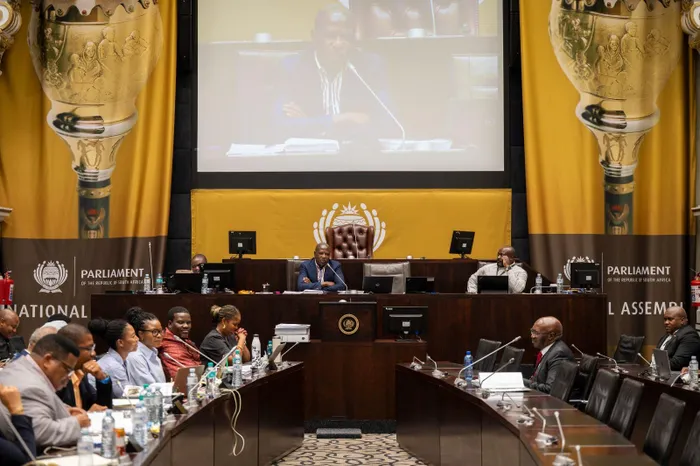
Ad Hoc Committee investigating allegations made by KwaZulu-Natal Police Commissioner Nhlanhla Mkhwanazi.
Image: Armand Hough / Independent Newspapers
At the cluster briefing, Cameron admitted that the urgency surrounding the Ad Hoc Committee “unfortunately affected the work” of the police committee, as several MPs served on both committees.
“This includes processing a National Assembly resolution to conduct an Inquiry into Gang Violence in the Western Cape, the consideration of the committee’s annual report, and the report on the Statutory Rape Inquiry. However, this work has not been abandoned.
“As the lifespan of the Ad Hoc Committee draws to a close, the Portfolio Committee will begin the second term with renewed focus to ensure transparency, accountability and effectiveness within policing,” Cameron said.
“These processes have exposed serious challenges within the justice and security cluster. While uncovering these issues is necessary, it is not sufficient. What is required now is decisive action and real consequences,” he said.
“Without this, public confidence in the police and the broader security system will continue to decline. We have repeatedly raised concerns about individuals in key positions linked to misconduct, yet action has been limited.
“There comes a point where stronger measures are required. We cannot continue to accommodate individuals who pose a risk to institutional credibility and national security,” Cameron said.
On the crime stats, Cameron said that while some reductions in certain categories are noted, overall crime levels remain “unacceptably high”.
“Current policing strategies often emphasise high numbers of arrests without corresponding conviction rates. Operations such as Operation Shanela demonstrate this challenge, where large volumes of arrests do not translate into meaningful prosecution outcomes.
“We need a fundamental shift in policing strategy. This must include a stronger focus on successful prosecution, on targeting high-level criminal actors, and on disrupting supply networks,” Cameron said.
“It is not sufficient to arrest low-level offenders while leaving the leadership of criminal networks intact. Institutions such as the South African Revenue Service must also play a role in addressing financial flows that sustain organised crime.
“On gender-based violence, the continued shortage of rape kits at police stations is deeply concerning. This has been confirmed through oversight visits, where basic resources were found to be lacking,” Cameron said. “This cannot continue, particularly when gender-based violence has been declared a national priority.”
He added that while the SANDF deployment may provide a necessary force multiplier and visible presence to help quell violence, “a military deployment is not a long-term solution”.
“There is a real risk that it becomes a temporary measure, a plaster on a wound that requires surgery. We must be honest about that.
“There are also concerns regarding mandate differences and training. I was informed this morning of tensions already emerging between soldiers and police, including issues around seized equipment from illegal mining operations and discrepancies in reporting,” Cameron said.
“This raises serious questions about the command-and-control structures in these operations. The deployment also raises questions about earlier assurances that SAPS had the capacity to deal with gang violence in the Western Cape.
“It is increasingly clear that this capacity is insufficient. When engaging with operational members on the ground across various units, there is still little clarity on how cooperation between police and military will function in practice, although I have been informed that joint training may begin soon,” Cameron said.
He said that the pre-deployment phase has appeared “poorly coordinated”, and what they have seen in some operations does not reflect the level of precision required.
“Operational coordination remains a serious concern. There are instances where soldiers conducting operations have had to wait extended periods for police support. This is not acceptable in what are meant to be joint operations.
“The timeline is also concerning. The deployment was announced on 12 February, yet Parliament was only formally informed on 13 March. This delay created an oversight gap and undermines constitutional accountability,” Cameron added.
theolin.tembo@inl.co.za