

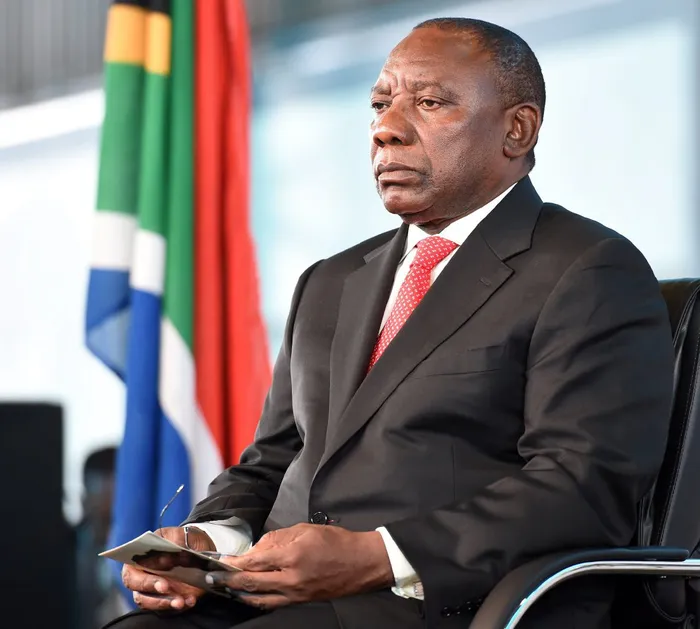
Civil society organisations criticise President Cyril Ramaphosa over his delay in appointing two judges to the Constitutional Court.
Image: GCIS / DoC
Civil society organisations have expressed deep concern about President Cyril Ramaphosa’s delay in filling two vacancies at the Constitutional Court (ConCourt) following the interviews in October 2025.
The organisations added that this is the longest duration any president in democratic South Africa has taken to appoint judges to the apex court.
This comes as the Judicial Service Commission (JSC) is expected to conduct its next round of public interviews to fill various high court and superior court vacancies from 13 to 17 April, 2026.
Following the interviews in October, the JSC recommended candidates for the two vacancies on the ConCourt.
The list included Judges Nambitha Dambuza, Glenn Goosen, Ashton Schippers, Kate Savage, and Adv. Alan Dodson SC.
While Ramaphosa previously indicated that he is “applying his mind” to the appointments, the lack of transparency in the timeline has drawn criticism.
The ConCourt has not functioned with a full complement of 11 permanent judges since 2016, and the organisations, including Judges Matter, Freedom Under Law, and Section 27, added that the ongoing delay exacerbates the issue.
The delay has also forced the ConCourt to rely on acting judges to maintain a quorum.
“Section 174(4) of the Constitution requires the President to appoint judges to the Constitutional Court from a list provided by the JSC, after consultation with the Chief Justice and political party leaders in Parliament. While this provision affords the President a measure of discretion and requires consultation, it does not permit indefinite delay.
“The power to appoint judges is a constitutional duty, not a political option. It must be exercised diligently and without undue delay, consistent with section 237 of the Constitution and its foundational values, including the rule of law and the effective functioning of courts,” the organisations said in a joint statement, adding that Ramaphosa’s failure to make these appointments timeously undermines both the independence and the operational capacity of the judiciary.
However, Ramaphosa’s spokesperson Vincent Magwenya, said the President is still applying his mind, adding that the announcements will be made soon.
The organisations said the continued use of acting judges to fill long-standing vacancies raises serious constitutional and practical concerns.
The organisations added that the frequent turnover in acting appointments undermines continuity, coherence, and the development of shared judicial reasoning.
“The delay in appointing judges to the court must be understood against a concerning broader trend: the Constitutional Court has faced persistent vacancies since at least 2016, largely due to predictable retirements that should have been proactively managed,” said the organisations, adding that the present inaction represents not an isolated lapse, but part of a systemic failure to ensure the court operates at full strength.
The organisations demanded that Ramaphosa make the outstanding Constitutional Court appointments without further delay and publicly explain the reasons for the delay.
They also called on him to commit to ensuring that future judicial appointments are made timeously and transparently, in line with constitutional obligations.
“Delays in judicial appointments are not administratively neutral; they have real consequences for access to justice, the development of the law, and public confidence in the judiciary.”
Political analyst Sandile Swana said the delay is unfortunate, especially after the selection process and the recommendations appear to have been thorough in its attempt to weed out dubious candidates.
Swana added that Ramaphosa should clarify the reasons for the delay.
manyane.manyane@inl.co.za