

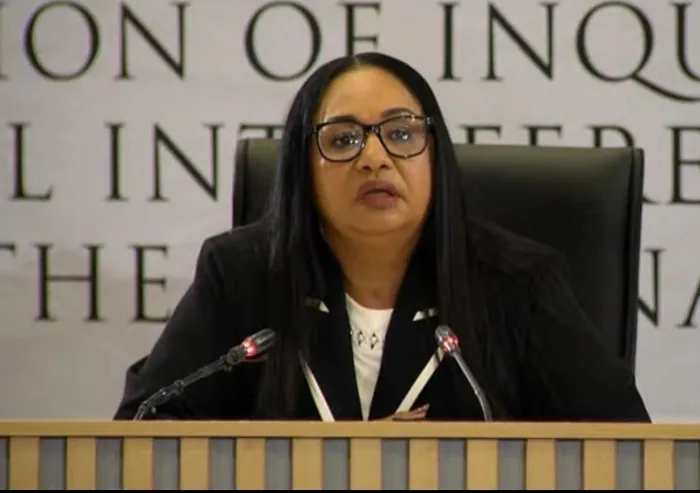
Chief of Police at the Tshwane Metro Police Department (TMPD), Commissioner Yolande Faro, testified before the Madlanga Commission.
Image: Screenshot
The abuse of ad hoc security services meant for emergency security needs came under the spotlight as the Madlanga Commission of Inquiry heard that at some point, the Tshwane Metro Police Department (TMPD) had 43 sites requiring the ad hoc services.
Ad hoc security services are designed to tackle immediate threats and unexpected events while addressing short-term capacity gaps in municipal infrastructure security, employee safety, or public event protection.
Commissioner Yolande Faro, TMPD police chief, said she became aware of the ad hoc security services in the city after an email from suspended Deputy Commissioner for Support and Administrative Services, Umashi Dhlamini, informing her that TMPD has 37 additional sites that require ad hoc security services.
Faro said that she only became aware of the request for additional funding or an extension of the existing budget relating to additional sites from an email from Dhlamini to Deputy Commissioner for Asset Protection and Security Services (APSS), Revo Spies, on March 12, 2025.
“This email from Dhlamini stated that the deployment of ad hoc security guards had grown exponentially, and indicated that an extra 37 sites were added in January 2025, with a further six sites added in February 2025. In total, it came to 43 sites. I was copied in this email, and notably, it attached invoices for ad hoc services for January and February, 2025,” Faro stated.
She explained that upon receiving this communication, she became aware of the cost and the fact that there was no clarity regarding the procurement of the ad hoc security services. It was also apparent that there was no proper procedure in place.
She added: “I instructed Deputy Commissioner Revo Spies to stop all the ad hoc security services as it was not clear how it came about and may lead to audit queries and greatly affect the City of Tshwane as a whole due to this unexplained and unauthorised expenditure.”
Faro highlighted that she also instructed Spies to initiate a new control measure, specifically related to the deployment of ad hoc security guards, and to launch a full investigation that will lead to consequence management.
Among the measures put in place, she said, they have since put controls and processes in place on how to acquire ad hoc services to eliminate the abuse of these services.
“Now, when you make a request, you fill in a form, TMPD will do an assessment, and then authorise services,” she said.
Faro stated that “if you do not have a good reason to request ad hoc services, you will not be able to do so because the form requires that you motivate your request.”
She said that since implementing new services, TMPD has received two ad hoc security services requests in over a year.
She stated that TMPD is currently building its in-house capacity to eliminate reliance on outsourcing.
Faro added that after stopping the ad hoc security services, a smear campaign started against her, including allegations that she misrepresented her qualifications and that she received a R450,000 voucher.
She added that a forensic investigation cleared her name.
Asked why she was unable to detect ad hoc services spending in early stages despite holding monthly meetings, she said: “You could only pick up the ad hoc services if they are not done in the correct way, and there are proper procedures.”
The inquiry continues.
gcwalisile.khanyile@inl.co.za