

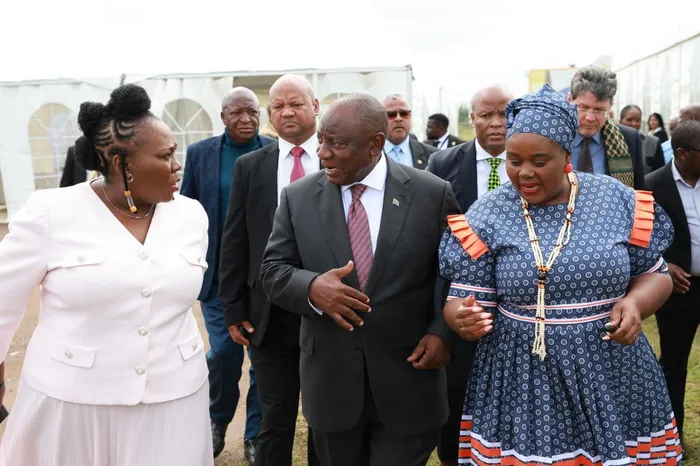
President Ramaphosa hands over R40 million in symbolic cheques to 220 verified TRC beneficiaries in Ndwedwe, affirming that reparations and housing support are essential for restoring dignity, safety, and belonging.
Image: Gcis
Nearly 30 years after the Truth and Reconciliation Commission (TRC) hearings, victims of apartheid-era violence in Ndwedwe, KwaZulu-Natal, are set to receive state housing assistance.
President Cyril Ramaphosa announced on Tuesday that 220 verified TRC victims in Ndwedwe will benefit from the long-awaited reparations programme, which includes once-off housing grants or the construction of new homes.
The announcement follows the implementation of housing assistance regulations published in January 2026, designed to give effect to longstanding commitments to restore dignity to victims of gross human rights violations under apartheid.
Ramaphosa said the handover of symbolic cheques representing R40 million in cumulative assistance marked a significant milestone in South Africa’s journey towards justice and reconciliation.
Of the approved beneficiaries, 114 have already received approximately R21 million through the President’s Fund, which covers the cost of the reparations.
“Truth alone is not sufficient to repair the harm that was done. Reconciliation cannot be enduring without reparations,” Ramaphosa said, emphasising that housing is a cornerstone of dignity, safety, and belonging for victims and their families.
Ndwedwe was among the areas hardest hit by political violence during the late 1980s and early 1990s.
Homes were burned, property destroyed, and many families were displaced or lost loved ones. The TRC documented hundreds of cases from the area, formally recognising survivors as victims of gross human rights violations.
“Many of those recognised as victims were elderly at the time of the TRC hearings, and some are now in their eighties and nineties,” Ramaphosa said/
Ramaphosa noted that housing assistance is a vital component of reparations, along with medical benefits, once-off grants, and community rehabilitation measures recommended by the TRC.
“The provision of reparations is not just an act of goodwill. It is a moral obligation and a vital part of restoring people’s dignity,” he said.
Housing, Ramaphosa added, is central to the Constitution’s commitment to human dignity, safety, and security. The democratic state may not be responsible for past atrocities, but it is tasked with decisively breaking from the injustices of the past.
Representatives of traditional leaders received the symbolic cheques on behalf of beneficiaries to respect their safety and privacy.
The programme is nationwide, and applications have been received from victims across the country.
Ramaphosa praised the community of Ndwedwe for their patience and acknowledged the work of traditional leaders, community representatives, and the Department of Justice and Constitutional Development for guiding the process.
“As we commemorate 30 years of our Constitution, we affirm that our future is built on remembering our past and correcting the injustices that were committed,” he said.
The President also highlighted the international significance of South Africa’s TRC process, which has influenced truth commissions in other countries by emphasising narrative truth, restorative justice, and public participation.
He noted the African Union’s Decade of Reparations, which calls for the completion of restoration efforts begun with political liberation, and referenced the United Nations General Assembly’s landmark resolution of 25 March 2026, which declared the transatlantic trafficking and racialised enslavement of Africans as the gravest crime against humanity.
“The handover of these symbolic cheques today affirms our belief that reconciliation and reparations must be concrete and tangible,” Ramaphosa said.
“As we celebrate 30 years of the Constitution, we are reminded that political liberation was never the final destination. It was the beginning of a longer journey towards social justice. The task of building a truly united, just, and equal society continues.
“We will not rest until all our people can live in peace, in security, and in comfort.”
hope.ntanzi@iol.co.za
IOL News