

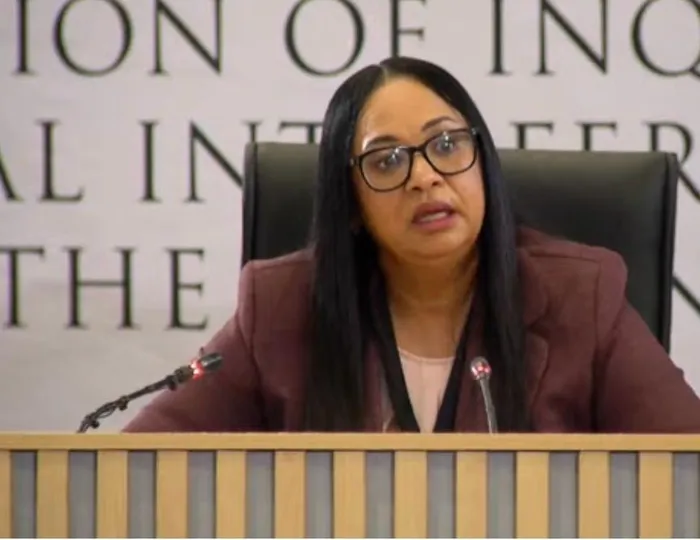
Commissioner Yolande Faro, the chief of police at the Tshwane Metro Police Department (TMPD), testified at the Madlanga Commission on Wednesday.
Image: Screenshot
The brotherhood between Gauteng Organised Crime Unit officer Sergeant Fannie Nkosi and City of Tshwane Chief Financial Officer Gareth Mnisi came under the spotlight at the Madlanga Commission of Inquiry, as WhatsApp chats revealed the duo shared the city’s confidential tender information.
This was revealed during the testimony of Commissioner Yolande Faro, the chief of police at the Tshwane Metro Police Department (TMPD), on Wednesday.
In the chats, Mnisi and Nkosi communicated a lot about Tshwane’s internal matters in relation to the security services tenders, including the circulation of preferred service providers. It was also noted that the same was true of Umashi Dhlamini, the suspended TMPD deputy chief commissioner for support and administrative services.
The commission’s evidence leader, Advocate Mpilo Sikhakhane, said that “What we have established within the evidence of this commission is that the relationship at the very least between Nkosi and figures like Matlala, is close.”
At the centre of controversy is the R2.9 billion TMPD 02-2016/2017 tender, which included two components: monthly payments for watchman services covering the 22 security companies and ad hoc services assigned as needed to suit the requirements of various municipal departments.
It was revealed that the Ngaphesheya Security Services (a company owned by Nkosi’s brother) bid had shortcomings, which were flagged by Dhlamini. However, the company was assisted in qualifying and got a share of the tender.
The chairperson of the commission, Justice Mbuyiseli Madlanga, remarked that, while some people are actually involved in criminality, impropriety, and bid rigging, others, while not directly involved, will be complicit in the sense that they do not actually look for what they should be looking for, which makes corruption, bid rigging, etc, easy.
“It seems to me that with some of the things that happened during the entire process, the people involved in the process just go along with whatever agenda is pushed. Let’s take the example of Ngaphesheya (Security Services)... there is an email from Mr (Umashi) Dhlamini, where he is pointing out the shortcomings of the Ngaphesheya bid,” Madlanga said.
He added: “So, that should tell the people involved in that procurement process that this is how the Ngapgesheya bid looked at the time it was submitted. But this is how it looked at the stage of adjudication. It should tell those involved in the process that there was a change somewhere in between. That’s not even a red flag; it actually tells you that something improper has happened, somewhere between submission and adjudication.”
He noted that Section 217 of the South African Constitution, which mandates that all government procurement of goods or services must occur through a system that is fair, equitable, transparent, competitive, and cost-effective, was now being used by the government to the disadvantage of the public.
Faro said: “We are looking at the entire system, including tenders. We are looking at whether it is possible to have all the TMPD services in-house.”
She said tenders would be cancelled if found to have been awarded irregularly.
Faro added that the investigation is under way, and there will be consequence management, reforms, and systems in place.
gcwalisile.khanyile@inl.co.za