

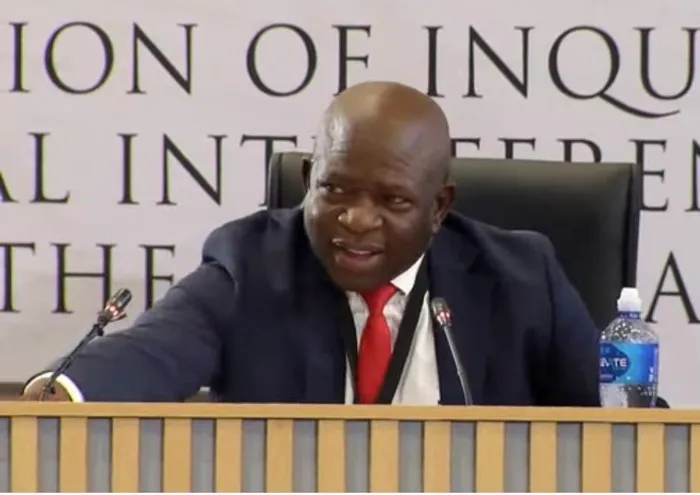
Tshukudu Malatji, a Director for Asset Protection Services at the City of Tshwane Metro Police Department (TMPD), testified before the Madlanga Commission on Thursday.
Image: Screenshot
The Madlanga Commission of Inquiry heard that the City of Tshwane may have paid for security services not rendered by service providers due to capacity issues in monitoring sites as per the Service Level Agreement (SLA).
Tshukudu Malatji, a director for Asset Protection Services at the City of Tshwane Metro Police Department (TMPD), told the Commission that the SLA required that all sites guarded by service providers be monitored at least twice per month; however, this was not adhered to.
These payments relate to the now-controversial R2.9 billion security tender, TMPD 02-2016/2017, which included two components: monthly payments for watchman services covering the 22 security companies and ad hoc services assigned as needed to suit the requirements of various municipal departments.
The City has 1,216 sites, including reservoirs, substations, and pump stations, among others. However, of these, only 545 sites are protected through the contracted security services providers.
The security service providers provide a total of 2,559 security guards at 545 sites to safeguard the infrastructure assets of the city against theft and vandalism.
An amount of R800 million has been proposed for the 2024/25 Indicative Budget, with the Watchman Services estimate amounting to R567m for the same year.
Malatji said: “In practical terms, it (monitoring of sites) will not always be easy to cover every site daily or twice a day, given the shortage of personnel that is there to conduct the specific function. But we have been doing what we could to ensure that the monitoring is in place. It continued to be in place, which makes me believe that it is still in place, because I wouldn’t think of any reason why we cannot have service providers monitored around the clock. Even though we wouldn’t be able to be at each and every site, given the shortage of personnel.”
Explaining the monitoring process, Malatji said, Inspection Reports are completed on-site and brought to the office. “We go through them, check them, and make sure that the monitoring team is doing its work.”
The Commission’s evidence leader Advocate Mpilo Sikhakhane asked Malatji if he could accept the possibility of insufficient monitoring of sites and the acceptance of these findings from internal audit that perhaps there could have been a situation where invoices that were submitted by service providers could not have been verified.
Malatji said, “I think it could be. Yes.”
Sikhakhane further probed how often Malatji reconciled or double-checked the invoices from service providers on his part as a director.
Malatji said: “We have a schedule for each security service provider, and every time they submit an invoice, my team would make sure that this invoice is in respect of all the sites which are allocated to the specific service provider before it is brought to my office to certify that indeed the services were rendered as per the allocation.”
Sikhakhane further asked that, with each invoice submitted, if Malatji signed off after having made sure that the services were rendered, to which he replied, yes.
Sikhakhane told Malatji that he could not agree with an internal audit finding that he failed to monitor the sites, and then claim that he ensured that invoices matched the work done by service providers.
Malatji conceded that “it is probable that some invoices were paid for services even though they should not have been.”
The testimony continues.
gcwalisile.khanyile@inl.co.za