

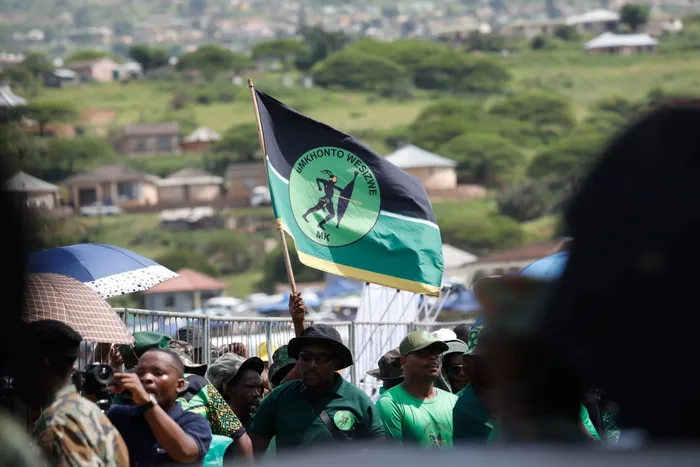
The MK Party has become the latest party to call on President Cyril Ramaphosa to reconsider the appointment of Roelf Meyer as the Ambassador to the US.
Image: DOCTOR NGCOBO Independent Newspapers
The MK Party has become the latest party to reject the appointment of veteran politician Roelf Meyer, who served as a key National Party Minister during the apartheid era, as South Africa’s Ambassador to the US.
The party said that while it does not reject individuals based on race or past political labels alone, historical responsibility and political accountability cannot be ignored when determining who should represent the democratic will and aspirations of the people of South Africa on the global stage.
President Cyril Ramaphosa announced the appointment on Tuesday night.
The President confirmed the appointment on the sidelines of the National Local Economic Development (LED) Summit in Boksburg on Wednesday.
The appointment sparked significant criticism and debate across the political spectrum.
The EFF also condemned the appointment as “deeply offensive” and “politically tone-deaf”, citing Meyer's history as a former apartheid-era minister, while the African Transformation Movement (ATM), described the appointment as a “spit in the faces” of those who suffered under apartheid, adding that it undermines the sacrifices made during the liberation struggle.
Meyer was a member of Parliament from 1979 to 1997.
As the Minister of Constitutional Affairs under F.W. de Klerk, Meyer was the lead negotiator for the National Party. He developed a close, pragmatic working relationship with Ramaphosa as the ANC's chief negotiator to end apartheid and pave the way for the 1994 democratic elections.
The 78-year-old held several significant posts in the National Party government, including Minister of Defence from 1991 to 1992 and Deputy Minister of Law and Order. These roles have remained a point of controversy for critics who highlight his involvement in the security apparatus of the late apartheid era.
In a statement issued on Thursday, the MK Party said Meyer’s appointment cannot be divorced from the political relationship between him and Ramaphosa.
The party said this decision reflects not national consensus, but the extension of favour and familiarity between negotiating partners of the past.
The party added that the appointment also reflects continuity with the politics of compromise rather than the courage of transformation.
“It reinforces the perception that the ANC leadership remains more comfortable with familiar negotiating partners of the past than with advancing a bold new direction for the future. The MK Party therefore rejects the appointment of Meyer as ambassador to the US in the strongest possible terms,” said spokesperson Nhlamulo Ndhlela.
This appointment comes after the Trump administration last year denied Mcebisi Jonas a diplomatic visa and rejected his credentials, following the expulsion of former ambassador Ebrahim Rasool.
The rejection was reportedly due to past critical remarks Jonas made regarding President Donald Trump being a “racist” and “narcissistic right-winger”.
Former diplomat Kingsley Makhubela said that the announcement of Meyer’s appointment shows the US is likely to accept his credentials.
Makhubela, who also served as ambassador to Portugal between 1996 and 2001, said it was 'obvious that the US had accepted Meyer following Ramaphosa’s announcement'.
“The process is that you submit your credentials to the receiving state. And once you start making an official announcement about who you have appointed, it means they (US) have already accepted that,” he said, adding that this is the usual process.
Asked if the announcement means the US has already accepted the appointment, Ramaphosa's spokesperson Vincent Magwenya said there are still administrative protocols to be fulfilled on the US side.
"Hence, he is South Africa’s Ambassador designate to the US,” he said.
The appointment is widely seen as a strategic move to stabilise relations with Trump's administration, which has recently targeted the ANC government with economic and diplomatic sanctions.
This is after Trump recently cut all financial assistance and implemented a migration program for white Afrikaners. He accused the ANC government of allowing a “white genocide” against the Afrikaner minority, a claim the South African government has repeatedly denied.
The US has threatened to sanction senior ANC leaders and government officials under the Global Magnitsky Act for alleged corruption, human rights abuses, and foreign policy alignment with US adversaries.
Political analyst Sandile Swana said Meyer’s appointment is premised on the ideological alignment between the current US executive and past American administrations that supported the apartheid government in South Africa, of which Meyer was a member.
He added that accepting Meyer, “an architect” of the 1994 negotiation deal, confirms that the transition (from apartheid to democracy) was designed to protect white privilege and wealth, rather than provide true liberation for the Black majority.
Swana said the deal was a compromise that 'gave just enough to the Black majority to end the war'.
manyane.manyane@inl.co.za