

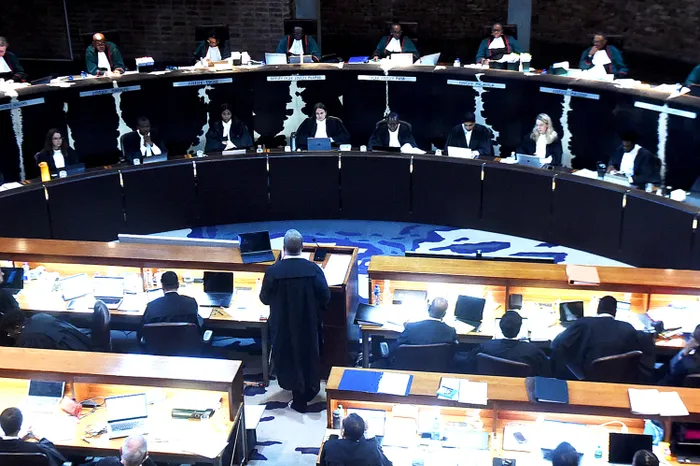
During the ongoing Constitutional Court proceedings, the Health Minister asserts that the public was adequately involved in the NHI Act's development, challenging the Board of Healthcare Funders' allegations of inadequate consultation.
Image: Itumeleng English / Independent Newspapers
Counsel for the Minister of Health maintains that, despite the kickback from the Board of Healthcare Funders (BHF) regarding the purported lack of diligence for a meaningful process of public participation for the creation and passing of the NHI Act, public participation had taken place.
This argument, according to the Health Minister, was demonstrated by the National Assembly’s Portfolio Committee on Health, which embarked on a process of involving the public in the making of the NHI.
The matter is being heard further on Wednesday at the Constitutional Court, where the apex court will hear the case from the Premier of the Western Cape.
The apex court will have to rule on whether the National Assembly failed to facilitate meaningful public participation for the National Health Insurance Bill (NHI Bill) rendering the Act unconstitutional and invalid.
On Tuesday, the court heard that after the Health Minister, published the draft NHI Bill in June 2018 for public comment, it provided for the public from “every corner of the country to make submissions”.
This challenged the BHF’s argument that there was “no information” given to the public about what the NHI Act would entail.
Parliament held that in their first step, they had directly invited written submissions from the public and in response it received about 338,000 written submissions.
Further to this, between October 26, 2019, and February 24, 2020, the portfolio committee held public hearings in all nine provinces. This involved some 33 hearings, with up to four in a province. Over 11,500 people attended and over 950 oral submissions were presented, they argued.
And in its third step and as a result of the Covid pandemic, the committee held 29 virtual meetings, with approximately 114 stakeholders making oral submissions (along with written presentations) from May 2021 to February 2022.
On this basis, the Health Minister said public views did filter through by multiple channels despite the urgency of it having been passed following the minimum of the eight-week cycle.
Parliament's counsel, Ngwako Hamilton Maenetje SC, in his arguments told the apex court that there are no finalised or detailed guidelines on the specific tax rates or exact funding mechanisms for the NHI.
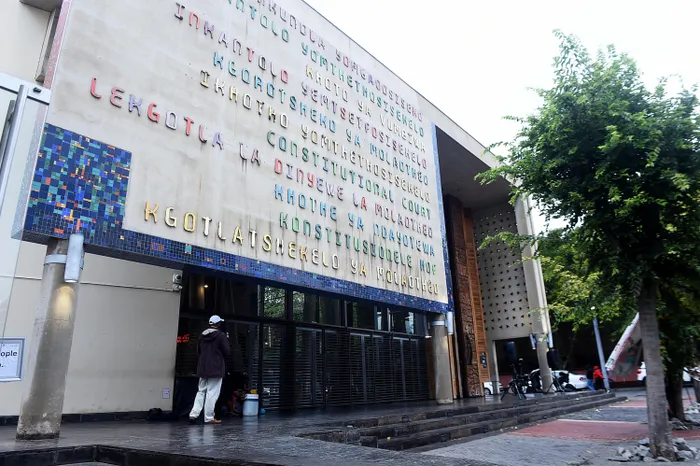
In a pivotal court case, the Health Minister defends the public participation process in the creation of the NHI Act, asserting that significant input was received from citizens despite criticisms from the Board of Healthcare Funders. The matter is being heard at the Constitutional Court before a full bench.
Image: Itumeleng English / Independent Newspapers
Regarding the massive funding gap in which no concrete financial planning is yet available, Maenetje SC conceded and addressed the full bench on BHF’s argument that there is absence of information of costing and funding.
“They (BHF) are saying that failing to conduct that feasibility study disabled the public to meaningfully engage in the public participation process…We submit that in this case, from the information provided, the public understood that this was a radical intervention that would have cost implications and there would have to be additional funding. The issue is ‘did you give a number?’ and that is what we say sufficient information was not granted.”
Responding to a question from Acting Justice Nambitha Dambuza, zoning in on where the funding for the NHI will exactly come from, Maenetje SC said that until the fund is established, these questions are yet to be answered and will be a budgeting issue and will be debated in the budget process.
“The memorandum tells you in exact figures the funding for the first three or four steps of implementing NHI. So they can tell you we will have to engage in the improvement of public health facilities, where we can say it will cost us this much. We can say we will introduce a programme for proper management of data, and it will cost us this much. Until we have done that, we can’t even start purchasing services.
“They can tell you about existing funding that can be redirected, but what we can’t tell today is what the department will ask in the form of a money bill to fund a particular stage in the NHI, which may be reached in five years,” said Maenetje SC.
Parliament maintained its argument that meaningful public participation had been fulfilled.
Advocate Kameshni Pillay SC, counsel for the Minister of Health and the Director-General of the Department of Health, addressed the court, responding to several issues, including that the public participation process had inadequate information on costs and funding, and on the basket of services.
Pillay SC also dealt with BHF’s complaint that parliament had a closed mind, that the process was predetermined, and that the NHI has a vague operating model.
“When you see that the NHI establishes an NHI Fund as a single purchaser and a single payer of healthcare services, the reason behind that becomes clear. The fund will negotiate contracts, it will pay accredited public and private providers on behalf of the entire population. What it will do is to pool funds between public and private to eliminate disparate parallel financing streams and duplicated capacity,” argued Pillay SC.
Dealing with BHF’s complaint that parliament closed its mind, Pillay SC and citing from case law (Merafong matter), heard by the same court, said that such a “heavy-handed complaint cannot be made without one iota of facts to support it” and described BHF’s complaint as egregious.
chevon.booysen@inl.co.za