

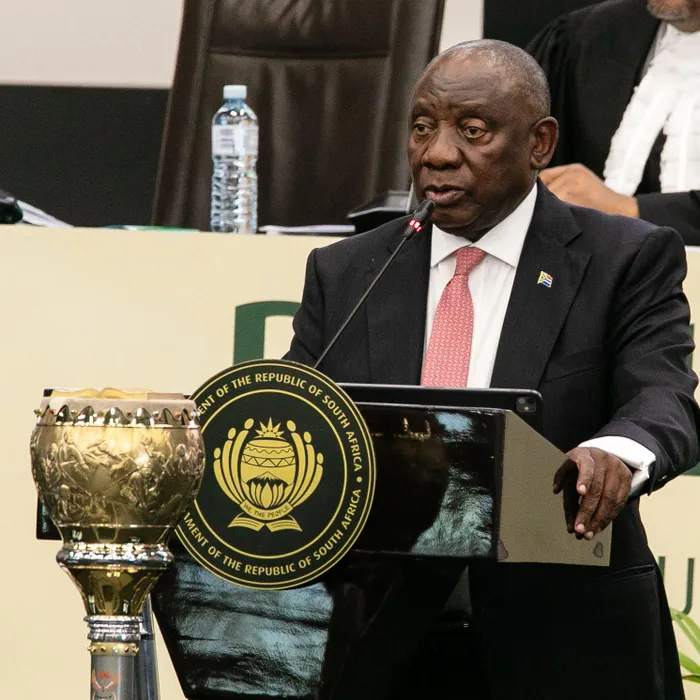
President Cyril Ramaphosa has been urged to allow the parliamentary impeachment inquiry to proceed without the threat of legal action.
Image: Zwelethemba Kostile / Parliament of RSA
President Cyril Ramaphosa has been advised to allow the parliamentary impeachment inquiry to proceed, rather than trying to stall or block the process by challenging it in court.
This is according to political analyst, Lukhona Mnguni, who said while Ramaphosa has the right to exercise the legal mechanisms available to him, he is likely to be seen as someone who does not want to be held accountable.
Ramaphosa recently indicated that he would launch a judicial review to challenge the Section 89 independent panel report, which found prima facie evidence that he may have violated his oath of office and the Constitution regarding the Phala Phala farm scandal.
He also intends to file an urgent court interdict to halt the establishment and operation of the 31-member parliamentary impeachment committee.
His decision follows a Constitutional Court (ConCourt) ruling that set aside Parliament's 2022 rejection of the report and ordered it to be referred to a new parliamentary impeachment committee.
Mnguni was one of the speakers on Wednesday at a Webinar, hosted by Defend Our Democracy, that focused on the Phala Phala farm scandal following the ConCourt ruling.
Mnguni said it would be fair for Ramaphosa to allow the process, that is in the best interest of the public, to proceed and put the Phala Phala saga to rest.
Mnguni said this will also prove that there is accountability.
“This is for the citizens to say this incident once occurred in our lifetime, but there were enough safeguards, whether the President is eventually found to have committed any wrongdoing or not,” he said.
The Phala Phala saga began in June 2022 when former State Security Agency (SSA) Director-General Arthur Fraser filed criminal charges against President Cyril Ramaphosa at the Rosebank Police Station in Johannesburg.
Fraser's affidavit alleged that on February 9, 2020, robbers colluded with a domestic worker to steal over $580,000 in undeclared foreign cash hidden in a couch at the Phala Phala game farm in Limpopo. The charges included money laundering, kidnapping suspects, and defeating the ends of justice through a covert, off-the-books investigation of the burglary.
Political pressure mounted, leading to several investigations by the Public Protector, the South African Revenue Service (SARS), and the South African Reserve Bank (SARB). Parliament appointed the Section 89 Independent Panel, chaired by former Chief Justice Sandile Ngcobo, to investigate whether there were grounds to remove the President. In late November, the panel released a landmark report concluding that there was prima facie evidence that Ramaphosa may have committed serious violations of the Constitution and misconduct regarding his handling of the farm theft.
Despite the independent panel's damning report, the National Assembly convened on December 13, 2022, and voted 214 to 148 against adopting the report. The ANC used its parliamentary majority to block the establishment of an impeachment inquiry, sparking widespread accusations of political interference and the erosion of accountability.
Following the parliamentary vote, the EFF and the ATM challenged the National Assembly's decision directly in the Constitutional Court. After years of intense legal battles, the ConCourt ruled that the National Assembly's December 2022 decision to block the inquiry was unconstitutional and invalid.
It ordered that the Section 89 panel report must be officially referred to a parliamentary impeachment committee, which resulted in the National Assembly Speaker Thoko Didiza initiating the process to establish a 31-member Impeachment Committee.
Mnguni warned that the delay towards accountability begins to open up room for conspiracy theories to take center stage.
He said this also gives a perception that “something is wrong here”.
“And potentially there are issues of guilt that are at hand that you know are being covered up. And of course, if you look at the processes undertaken, particularly by Major-General Wally Rhoode (head of the Presidential Protection Unit (PPU) and Bejani Chauke (Ramaphosa’s former principal political advisor), there seems to have been an attempt to cover up the issues,” Mnguni said.
Mnguni said that although state resources were used and abused, there is still no sense of agency to hold Rhoode to account, adding that he remains head of the PPU.
He said this also gave the impression that Rhoode was not acting on his own accord, but at the behest of the President.
Mnguni added that when looking at things in sequence and logically, there were instances where foreign currency was stolen from the State Security Agency offices and it remains unknown where the money ended up.
“We also have instances where there are allegations of people who are laundering foreign currency into the country for purposes of financing political activities,” he said.
manyane.manyane@inl.co.za