

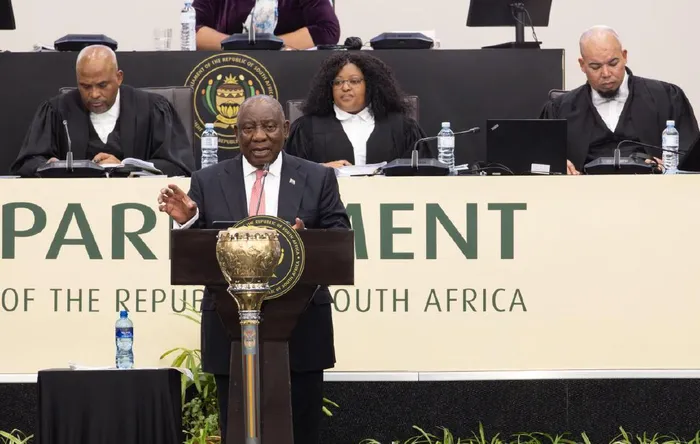
The African Transformation Movement (ATM) has accused President Cyril Ramaphosa of evading the law following his threat to launch an urgent interdict should the National Assembly continue with the impeachment process.
Image: GCIS
The African Transformation Movement (ATM) has accused President Cyril Ramaphosa of attempting to evade accountability, following his decision to seek a judicial review of the Section 89 independent panel report regarding the Phala Phala farm scandal.
This is after Ramaphosa demanded that Parliament’s impeachment process should be paused while the court reviews the panel report, which found prima facie evidence that he may have committed serious violations of the Constitution in connection with the Phala Phala farm scandal.
Ramaphosa made this demand in his court papers filed at the Western Cape High Court, seeking to set aside the independent report.
The Phala Phala scandal erupted after the former State Security Agency (SSA) Director-General Arthur Fraser filed a formal criminal complaint against Ramaphosa in 2022.
Fraser submitted a 12-page affidavit accusing President Ramaphosa of money laundering, bribery, kidnapping, and concealing a crime.
He alleged that between $4 (now declared as $580,000) in undeclared foreign currency was stolen from inside a couch at the farm, claiming that instead of reporting it to the police, Ramaphosa used a private presidential protection unit to illegally track, kidnap, and interrogate the Namibian suspects, bribing them to keep quiet.
Ramaphosa in his court papers, threatened that he would launch an urgent application should the National Assembly continue with the impeachment process.
This comes after the Constitutional Court (ConCourt) ruled that Parliament’s December 2022 vote blocking an impeachment inquiry against Ramaphosa was invalid and unconstitutional, ordering that the independent panel report must be reviewed and referred directly to an impeachment committee.
The judgment was triggered by the applications from the EFF and ATM, who argued that Parliament failed in its constitutional obligation to hold Ramaphosa accountable.
Following the ruling, Parliament speaker Thoko Didiza announced a 31-member impeachment committee to reconsider evidence linked to the Phala Phala farm scandal.
The committee is expected to conduct a formal inquiry into the Phala Phala scandal to determine if there are sufficient grounds to recommend President Cyril Ramaphosa's removal from office.
In his papers, Ramaphosa stated that while he accepts that the matter is urgent, it would be 'intolerable and a travesty, should the National Assembly proceed with the impeachment process during his judicial review'.
“In the unlikely event that the National Assembly insists on proceeding with the impeachment process while this application is pending, I shall be compelled to launch an urgent application to this court for an interdict precluding it from doing so,” read the documents.
The ATM said described Ramaphosa's court action as 'a continued attempt to evade accountability'.
The party added that Ramaphosa, as the drafter of the Constitution and a lawyer, is familiar with the law.
“He intentionally did not account,” said the party’s spokesperson Zama Ntshona.
Ntshona added that Ramaphosa should have reported the burglary at his Phala Phala farm as prescribed by Section 34(1) of the Prevention and Combating of Corrupt Activities Act (PRECCA).
“When it came to issues of responding to 31 questions by former Public Protector Busisiwe Mkhwebane, he suspended her instead of answering the questions. And he used his majority to evade answering when it comes to Parliament,” said Ntshona.
Ramaphosa, in his court papers said that the process followed by the panel and its conclusions are flawed, adding that this resulted 'in irrational recommendations that are contrary to the principle of law'.
Ramaphosa argued that the panel unlawfully accepted hearsay information and speculation, specifically pointing to submissions made by Fraser.
He said that the panel fundamentally misunderstood its mandate by trying to establish a prima facie case, rather than determining if there was “sufficient evidence” to justify impeachment proceedings.
Political analyst Sandile Swana said the matter was not about hearsay, but whether there is a case worth investigating, regardless of how the information came about.
“To say that the information came from hearsay is irrelevant because the amount of time and powers given to the panel were never enough to do an investigation, which is supposed to be done by the impeachment committee. So the argument is misguided, and this is likely to be considered irrelevant,” he said.
manyane.manyane@inl.co.za