

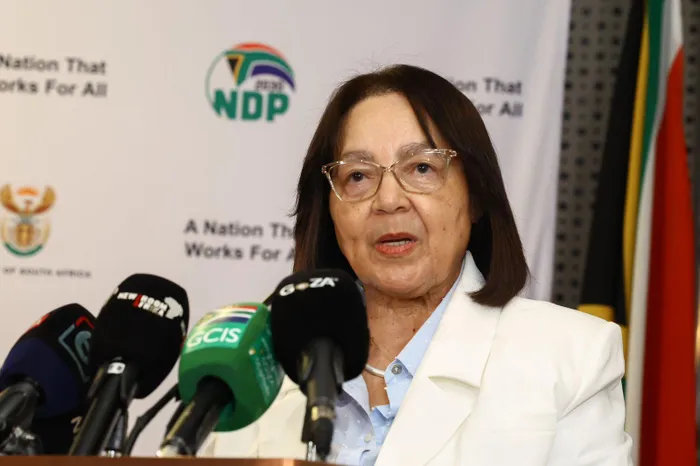
Tourism Minister Patricia de Lille highlights tourism’s role in supporting 954 000 jobs and positioning the sector as a key driver of employment and economic growth in South Africa.
Image: Supplied
South Africa’s tourism sector has cemented its status as one of the country’s most powerful employment engines, supporting 954,000 direct jobs and driving the government’s ambitions to expand the industry to 1 million direct jobs by 2030, Tourism Minister Patricia de Lille said on Tuesday.
Tabling Budget Vote 38 in the Good Hope Chamber, De Lille told Parliament that tourism is no longer a supplementary sector but a central pillar of economic policy, job creation and inclusive growth.
“Tourism is not only about travel. Tourism is about jobs. Tourism is about small businesses. Tourism is about dignity. Tourism is about economic inclusion. Tourism is about putting food on the table,” she said.
She said the sector’s contribution to employment has reached a critical scale, with Statistics South Africa data showing that tourism supported 954 000 direct jobs in 202*, equivalent to “1 in every 18 jobs in South Africa.”
De Lille added that the sector’s impact extends beyond direct employment, noting that “for every 13 international tourists who arrive in our country, one job is supported,” underscoring tourism’s multiplier effect across the hospitality, transport, retail, and small-business ecosystems.
The minister said South Africa’s tourism recovery has gained momentum, with the country welcoming 10.5 million international arrivals in 2025, while the first quarter of 2026 recorded more than 2.9 million inbound travellers, a 12.6% increase over the same period last year.
Domestic tourism continues to underpin the industry, with spending reaching R111.6 billion, slightly ahead of international spend of R102.2 billion, reinforcing what De Lille described as the “bedrock” role of local travel in sustaining jobs and businesses.
Tourism contributed 4.9% to GDP in 2024, outperforming several traditional sectors including agriculture, construction and utilities.
De Lille used the Budget Vote to outline the government and industry’s joint Tourism Growth Partnership Plan, which she described as “not another strategy document gathering dust on shelves” but a “working compact” with measurable targets and shared accountability.
The plan aims to achieve by 2030:
“Tourism policy is economic policy,” she said, adding that implementation would be tracked through a dedicated dashboard supported by the Tourism Business Council of South Africa.
A key pillar of the strategy is improving ease of access. De Lille confirmed that the *Electronic Travel Authorisation (ETA) system is now live in China, India, Indonesia and Mexico, allowing travellers to receive visa outcomes within 24 hours.
“This is no longer a vision. It is happening,” she said, adding that full rollout could generate *80 000 to 100 000 jobs.
She also highlighted expanding air connectivity, including new routes between Johannesburg and Perth, Cape Town and Mauritius, and upcoming services linking Johannesburg and Madrid.
Bilateral aviation agreements, including a breakthrough deal with Angola, were also expected to boost passenger and cargo movement.
De Lille said global perception has become a decisive factor in tourism competitiveness, with social media now shaping travel decisions more than traditional advertising.
“When English singer Dua Lipa posts photos from her Kruger National Park vacation… she becomes an authentic ambassador for our country,” she said, adding that such visibility translates directly into bookings, spending and jobs.
She said government would increase investment in digital destination marketing, describing South Africa as “Insta-ready”.
On tourism safety, De Lille extended condolences to the families of Dina and Ernst Marais from Mossel Bay following a fatal incident in the Kruger National Park.
While stressing that crime prevention falls outside the Department of Tourism’s mandate, she said government continues to work closely with law enforcement through the National Tourism Safety Forum.
De Lille highlighted major tourism infrastructure investments aimed at spreading economic activity beyond major cities.
Projects include:
Private sector investment is also accelerating, with:
“We are seeing confidence in the tourism sector,” she said, adding that the government has established a Tourism Infrastructure Facilitation Unit to remove investment bottlenecks.
The minister said tourism remains a major entry point for youth and women into the labour market. More than 800 TVET students were placed in workplace training programmes last year.
She also highlighted the Tourism Hackathon initiative, where 48 students from 21 institutions developed AI-based solutions for the sector.
Business events are also contributing to job creation, with the South African National Convention Bureau securing 66 international conferences expected to generate more than R1.2 billion between 2025 and 2030.
De Lille confirmed that government has received more than 6 700 submissions on the Draft Code of Good Practice for Short-Term Rentals, which is being reviewed before finalisation.
She also announced the launch of a new podcast, Tourism Talk, as part of efforts to modernise communication with stakeholders.
De Lille said that tourism is now firmly embedded in South Africa’s economic transformation agenda, linking jobs, investment and inclusion.
“Tourism is part of South Africa’s growth engine in action,” she said.
“The cradle of humankind. The cradle of culture. The cradle of possibility. And to the world, we proudly say: Welcome Home.”
IOL News