

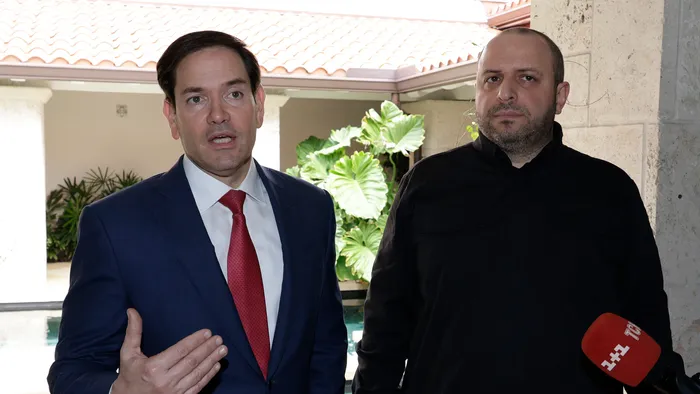
US Secretary of State Marco Rubio, left, and national security council secretary Rustem Umerov talk to the media, November 30, 2025, Hallandale Beach, Florida.
Image: VCG
The United States and Ukraine opened a new round of negotiations in Florida on Sunday over Washington's proposed framework to end the Russia-Ukraine conflict, even as the emerging plan continues to spark controversy on both sides of the Atlantic.
The talks, held near Miami, brought together senior US and Ukrainian officials for what both sides described as a constructive but unresolved exchange.
The US delegation included Secretary of State Marco Rubio, special envoy Steve Witkoff, and Jared Kushner, the son-in-law of President Donald Trump. Ukraine was represented by national security council secretary Rustem Umerov, who led Kyiv's team.
Rubio said after the meeting that discussions with the Ukrainians were "very productive," but stressed that there's "more work to do."
Trump, speaking aboard Air Force One, also struck an optimistic tone, saying "there's a good chance we can make a deal." He alluded to Ukraine facing "some difficult little problems," without elaborating.
Umerov said both sides discussed all the matters "important for Ukraine, for Ukrainian people, and the US was super supportive."
The renewed diplomacy follows the leak of a 28-point peace proposal drafted by the White House on November 20. The plan, widely criticised in Kyiv and across Europe as overly favourable to Russia, prompted intense revisions during a US-Ukraine-EU meeting in Geneva on November 23. The updated text has not been made public, though Trump recently claimed Kyiv had agreed in principle to the modified draft. Several sticking points reportedly remain.
With Witkoff expected to meet Russian President Vladimir Putin on Monday, analysts say Washington's push to insert a set of US-Ukraine understandings into the talks has become a central point of contention as it seeks concessions from Putin. However, after Kyiv succeeded in pushing the US to soften elements of the original 28-point plan, the Kremlin has grown more skeptical about accepting the terms.
Putin reiterated Russia's territorial demands last week, declaring that Moscow was "ready in principle" to "fight to the last Ukrainian."
"If Ukraine's troops leave the territory occupied, then military action will stop. If they won't leave then we will achieve that by armed force," he said.
As the conflict grinds on and Western fatigue grows, analysts say Trump is seeking a rapid ceasefire to showcase diplomatic success ahead of next year's midterm elections. Critics argue the administration is prioritising speed over substance. Senator Mark Warner has warned the initial draft would mean "complete Ukrainian capitulation."
Others note that Trump appears intent on freezing the conflict – reducing US financial and security burdens while preserving leverage over Europe and Russia. The strategy, they say, is designed to give Washington an adjustable pressure point in future geopolitical dealings.
Meanwhile, the timing of US pressure on Kyiv is seen as deliberate. Ukrainian officials are grappling with what observers call the biggest political crisis since the conflict began: a sweeping corruption scandal implicating several senior officials and business allies close to Zelenskyy. The scandal has weakened the Ukrainian leader as Russian forces advance steadily on multiple fronts.
Washington initially pressed Zelenskyy to sign a deal before Thanksgiving, hoping to deliver the agreement to Moscow by the end of November and finalise the process in early December. Yet given the deep divides over territory, NATO membership and reconstruction, diplomats say the conditions required for a ceasefire are unlikely to materialise quickly.
CGTN