

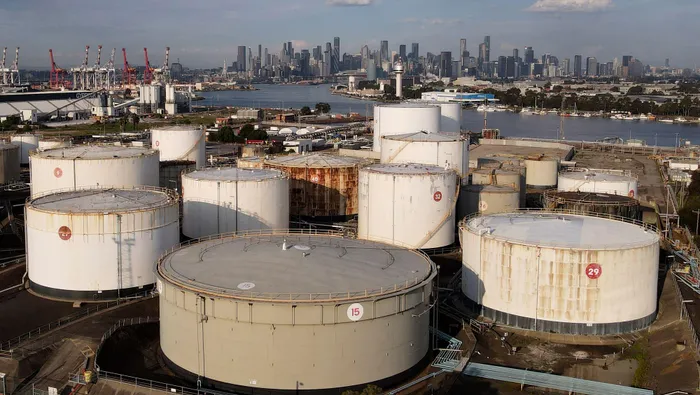
Global oil prices have climbed dramatically since the war began in late February.
Image: William West / AFP
Oil prices rose and equities were mixed Thursday as investors tracked developments in the Middle East war after Iranian officials were said to have replied to US demands to end a conflict that has sparked warnings of an unprecedented energy crisis.
Markets have been buoyed since late Monday after US President Donald Trump backed down on a threat to destroy the Islamic republic's energy infrastructure and said the two sides were in peace talks.
But while crude prices are down from last week and the mood on trading floors has been less dour than most of March, uncertainty and the virtual closure of the Strait of Hormuz — through which around 20 percent of oil and gas passes — continues to cast a dark shadow.
Washington presented a 15-point plan to end the war, including Iran giving up its enriched uranium and opening up the waterway, while Tehran's state-run TV reported officials had put forward their own five conditions for hostilities to end.
Trump on Wednesday threatened to "unleash hell" if Iran did not strike a deal, but Foreign Minister Abbas Araghchi said his country does not intend to negotiate.
However, the US president also said Iran was taking part in peace talks and the denials were because negotiators feared being killed by their own side.
"Pressure on energy prices, shipping flows and broader financial conditions remains one of the few meaningful sources of leverage (Iran) retains," said Saxo Markets' Charu Chanana.
"There is therefore little incentive to relinquish that leverage prematurely, particularly if market stress strengthens its negotiating position.
However, she added: "It would be imprudent to assume diplomacy is absent simply because it is not visible. In conflicts of this nature, public rhetoric and private negotiation often diverge materially.
"Markets understand this dynamic, and they also tend to inflect before the political endgame is formally in place."
With investors holding on to hope that a deal can be struck, oil prices have stabilised this week, with Brent sitting just above $100 and WTI around $90. Brent edged up 1 percent to trade at $103.25 a barrel in the early hours of Thursday. West Texas Intermediate rose 1.2 percent to $91.41 a barrel.
China's top diplomat has said that a "glimmer of hope" has emerged due to moves to stop the war.
China's foreign minister Wang Yi urged dialogue in separate calls with his Turkish and Egyptian counterparts, suggesting that both Tehran and Washington had shown signals they were willing to return to the negotiating table.
The Israeli military said air defences were responding to missile attacks from Iran on Thursday, with sirens activated across central Israel, parts of Jerusalem and the occupied West Bank.
In two separate statements about 20 minutes apart, the military said it had "identified missiles launched from Iran toward the territory of the State of Israel".
"Defensive systems are operating to intercept the threat," the statements said.
Israel's Magen David Adom emergency medical service said there were no reports of casualties.
The attacks came more than 14 hours after the military had previously announced incoming missiles from Iran.
Israel's military said Thursday its forces had carried out a wave of strikes across Iran, including in the central city of Isfahan.
US President Donald Trump insisted that Iran was taking part in peace talks, suggesting Tehran's denials were because Iranian negotiators fear being killed by their own side.
"They are negotiating, by the way, and they want to make a deal so badly. But they're afraid to say it, because they figure they'll be killed by their own people," Trump told a dinner for Republican members of Congress.
The United States has hit two-thirds of Iran's production facilities for missiles and drones, and a similar proportion of its naval production, a top officer said.
Admiral Brad Cooper, head of Central Command, also estimated that Iran's drone and missile launch rates were down by 90 percent, and "we've also removed the regime's ability to rebuild them".
Tehran's Foreign Minister Abbas Araghchi rejected any diplomatic efforts to wind down the conflict.
"At present, our policy is the continuation of resistance," Araghchi said on Iranian state TV. "We do not intend to negotiate — so far, no negotiations have taken place, and I believe our position is completely principled."
"Speaking of negotiations now is an admission of defeat," he said.
Kuwait arrested six people allegedly linked to the Iran-backed Hezbollah group in Lebanon who were planning "assassinations" in the Gulf state, the interior ministry said.
Iran's powerful parliament speaker warned of the possible invasion of an Iranian island with the support of an unnamed regional country.
"Based on some intelligence reports, Iran's enemies are preparing to occupy one of the Iranian islands with support from one of the regional states," Mohammad Bagher Ghalibaf posted on X.
Several Gulf countries as well as Jordan demanded in a joint statement that Iraq act immediately to stop attacks from its territory by armed pro-Iran groups.
The statement was signed by Saudi Arabia, the United Arab Emirates, Qatar, Kuwait, Bahrain and Jordan.
Hezbollah chief Naim Qassem said negotiations with Israel under fire would amount to "surrender".
The Iran-backed group said its fighters launched more than 80 attacks on Wednesday. Lebanon's state-run National News Agency reported Israeli attacks in the country's south, where the health ministry said at least eight people were killed.
The United States and Iran are still engaged in peace talks, the White House said, despite Iranian state media saying Tehran had rejected Washington's plan to end the war.
"Talks continue. They are productive," Press Secretary Karoline Leavitt said when asked about the Iranian report, adding that there were "elements of truth" to media reports on the details of a 15-point US plan setting out demands on Tehran.
US President Donald Trump is ready to "unleash hell" on Iran if Tehran does not accept a deal to end the war, the White House warned.
"President Trump does not bluff and he is prepared to unleash hell. Iran should not miscalculate again," Leavitt told a briefing.
Israeli Prime Minister Benjamin Netanyahu said his country's forces were expanding a "buffer zone" in southern Lebanon as the military pressed ahead with its campaign against Iran-backed Hezbollah.
Netanyahu said the zone would help address the threats of invasion and missile fire from Lebanon.
AFP