

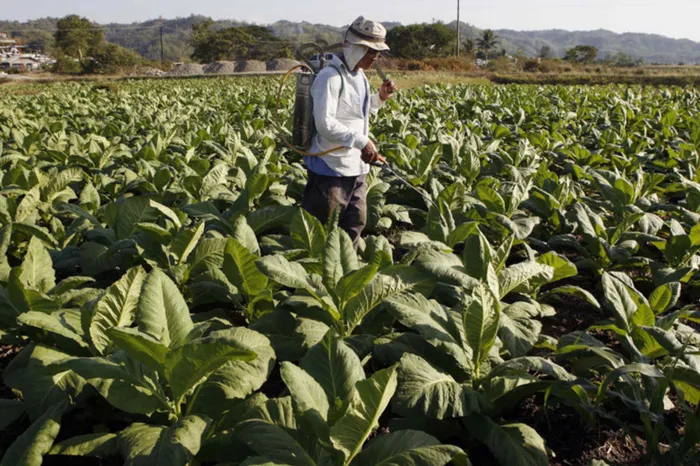
A farmer sprays tobacco leaves with pesticide at a tobacco farm in Candon city, Ilocos Sur province, north of Manila January 23, 2010. The Philippines' northern region, controlled by political allies of President Gloria Macapagal Arroyo, is famous for growing Virginia tobacco for local and foreign consumption. Picture taken January 23, 2010. REUTERS/Romeo Ranoco (PHILIPPINES - Tags: BUSINESS AGRICULTURE) A farmer sprays tobacco leaves with pesticide at a tobacco farm in Candon city, Ilocos Sur province, north of Manila January 23, 2010. The Philippines' northern region, controlled by political allies of President Gloria Macapagal Arroyo, is famous for growing Virginia tobacco for local and foreign consumption. Picture taken January 23, 2010. REUTERS/Romeo Ranoco (PHILIPPINES - Tags: BUSINESS AGRICULTURE)
A REPORT in the Pretoria News, Mercury, The Star and various online news sources (“Report reveals ‘horror’ of tobacco farming”, by Wilma Stassen) displays a misunderstanding of agriculture and the important role investment plays in alleviating rural poverty.
Agriculture, by its very definition, requires working the land and its resources. To accuse tobacco farmers of harming the environment is, at best, sloppy science and, at worst, an insult to those who make their living from the land.
All farming impacts on the environment and tobacco farming, which utilises only 0.3 percent of the world’s arable land – less than half the land given over to coffee – cannot be labelled as “destructive”.
Tobacco-cultivated land has decreased by 14 percent in the past 10 years from 4 646 149ha in 1990 to 3 980 218ha in 2010. This is an area smaller than Switzerland or twice the size of the Kruger National Park (two million hectares).
Stassen says that Malawi, the largest tobacco leaf producer in Africa, uses 183 052ha of land for the crop and calls it “a staggering amount considering the small size of the country”.
What she fails to point out is that this accounts for a mere 10 percent of its arable land and that the crop contributes more than 60 percent of Malawi’s foreign reserve earnings.
The anti-tobacco lobby makes a number of false accusations. First, that tobacco farming ruins the soil and leaves the land useless for other food crops; second, that it requires high quantities of pesticides and inordinately large amounts of water; and third, that it contributes to deforestation.
There are insufficient comparative studies on the amount of plant protection products used on different crops to provide a definitive understanding of whether or not tobacco uses more agrochemicals than other crops.
The US Department of Agriculture conducted surveys on the use of pesticides in 1992, 1997 and 2002 that indicate tobacco uses less agrochemicals than other major crops.
A similar comparison was conducted in 2007 by the Sugarcane Industry Association of Brazil, which described the amount of pesticides used in terms of active substance per hectare on tobacco as one of the lowest among major crops.
We recognise that the regulation of pesticide use in middle- and low-income countries can be poor, but no comprehensive evidence has been found to indicate that the use of pesticides on tobacco is greater, more toxic or persistent than in other comparable agricultural commodities.
Safe handling of agrochemicals is important, but the arguments against tobacco need to be seen in context as the majority of possible alternative or substitute crops face similar challenges.
Tobacco growing is often portrayed as one of the major causes of deforestation, especially due to expansion and the use of wood to cure tobacco. More than half of the tobacco grown worldwide, however, does not make use of wood for curing, and in the cases where it does, there is evidence of wood-lot planting and responsible behaviour by the tobacco growers and the industry.
Deforestation impacts are site-specific and can be mitigated. In Zimbabwe, for instance, a tobacco sector forestry department has been created with the objective of effectively establishing and managing “tobacco energy wood-lots”.
The tree planting projects will facilitate the establishment and management of almost 5 000ha of wood-lots in the next seven years, thereby approaching sufficiency for tobacco crop volumes.
Tobacco growers are not oblivious to the fact that green tobacco sickness (GTS) is an occupational illness for farm workers, who absorb nicotine through the skin when handling wet tobacco. Other occupations also pose threats to workers’ health.
Diacetyl, a flavouring agent used in food plants and found in microwave popcorn, some wines and fast foods can cause a devastating and sometimes deadly disease called bronchiolitis obliterans. Similarly, bakers exposed to flour dust face the risk of developing an asthmatic reaction to enzymes used to alter the consistency of dough.
Simple measures such as using gloves, facemasks or other protective clothing can help to seriously reduce these occupational illnesses, including the incidence of GTS. (It is worth noting that hot peppers, citrus and cashew crops are more frequently implicated as causes of phytodermatitis.)
To state that contract farming “creates a cycle of indebtedness for farmers” is being economical with the facts. Commodity prices – tobacco included –a re unstable and, for governments and farmers, it comes down to short-term price volatility and the long-term need for diversification. This is where the private sector comes in.
Tobacco farmers – and their representative associations – understand that in the long term, diversification away from tobacco will lead to greater income stabilisation. In the meantime, as Nelson Nsiku and Willings Botha state in their report, Tobacco Revenue Management: Malawi case study, tobacco is essential for “generating the savings and providing the additional purchasing power needed to build a diversified national economy”.
They go on to say, “In the short term, resources must be used to improve tobacco production, quality and marketing in order to yield higher returns. Achieving productivity gains and radically reducing transaction costs within the tobacco supply chain would improve and help stabilise incomes”.
Contract farming provides an alternative to the auction system and establishes a forward agreement between farmers and buyers for tobacco leaf at pre-determined prices. It creates an efficient marketing chain where exporters get lower costs and farmers get more money for their crop.
Apart from providing better prices for the farmer, it increases investment and the buyers’ involvement in productivity and the management of commercial risk faced by growers.
Only recently did the world’s population move from being rural to predominantly urban. Naturally, not all regions of the world have reached this level of urbanisation: Asia will get there in 2020 and Africa is likely to reach 50 percent urbanisation in 2035.
Support for those who remain on the land – and farm it efficiently and sustainably – is therefore a crucial component of any nation’s development plans, especially in Africa.
l Francois van der Merwe is the International Tobacco Growers Association’s Africa Region chairman.