

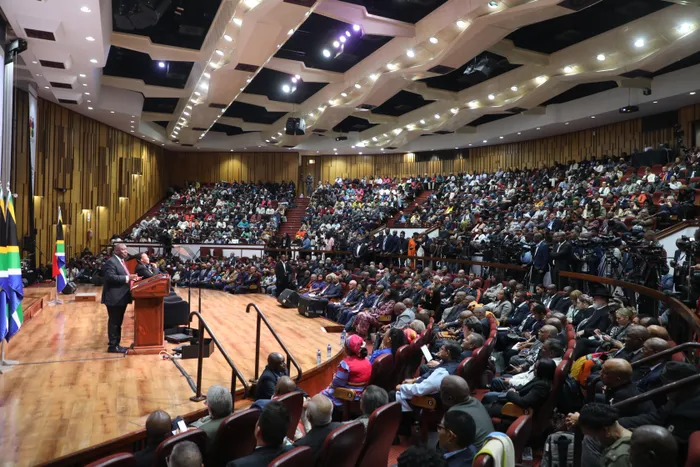
President Cyril Ramaphosa addresses delegates at the national convention, marking the opening of the National Dialogue. The writer examines whether the party can reclaim its values and empower capable leaders.
Image: Oupa Mokoena / Independent Media
I grew up in the corridors of ANC elective conferences. From a young age, I attended these gatherings, either as a guest of the Progressive Youth Alliance (PYA) or as an observer, wide-eyed and hopeful.
I believed in the spirit of democratic contestation and the renewal of leadership guided by principle, policy, and political clarity. But as the years passed, the atmosphere began to shift. The slogans remained the same, but the soul of our conferences changed, from politics to procurement, from values to value chains. Today, it’s no longer about who leads best, but who can afford to lead.
The elective conference has become a lucrative industry. We've built what I now call the “conference economy”, a transactional system where money dictates momentum and influence. In this ecosystem, a candidate without deep pockets or significant financial backers is almost doomed before the nomination process even begins. These days, no matter how capable, loyal, or visionary a comrade may be, if they are poor or unfunded, they simply cannot compete.
Let’s be honest: no one survives a contest without money. From branded T-shirts and paid transport to campaign coordinators and rented operations centres, elective politics today demands a budget that rivals that of a small NGO. Branches won’t take you seriously unless you’ve “invested” in them. That investment comes in many forms, such as food parcels, stipends, regalia, drinks, and, in some cases, outright cash payments. This is not about isolated incidents of corruption or a few “bad apples.” It’s a systemic problem that has transformed the very character of our democratic processes.
It has created a new class of political entrepreneurs—campaign managers who make more during a contest than they do in an entire year of formal employment. We all know the stories: managers who buy cars during campaign season, coordinators who pay lobola or renovate homes, and volunteers who suddenly afford designer clothes, new phones, and nightlife they could never previously afford. When the money flows, the politics slows. It wasn’t always like this. I remember when the old guard spoke of contestation as a space of ideas, not invoices. They talked about building consensus—not coalitions of cash. In those days, struggle credentials and political clarity mattered more than fundraising capacity.
The movement, for all its flaws, was grounded in political education, grassroots mobilisation, and a commitment to values. So how did we get here? The collapse of the broader mass democratic movement outside of formal politics is partly to blame. In the absence of strong civic or labour structures, the ANC became the main vehicle for social and economic mobility. Leadership became less about service and more about access. And that access comes with material benefits—so it’s no surprise that people are willing to spend millions just to get in. Politics has become an investment portfolio.
Branches, once the bedrock of internal democracy and political accountability, are now often reduced to the highest bidder. Some are even “owned” by individuals who fund them year-round and expect loyalty in return. The buying of membership, the renting of delegates, and the harvesting of votes have become an art form. In this model, meaningful renewal is nearly impossible. Because how do you renew a movement that rewards wealth over worth? This is the crisis facing the ANC today, not just a crisis of ethics, but a structural crisis. Renewal cannot simply mean removing corrupt individuals; it must mean dismantling the entire conference economy that sustains them.
We need to ask the hard questions: How did we manage leadership contests before money became a factor? What mechanisms allowed grassroots leaders from rural areas and townships to rise? What role did political education and collective discipline once play? As a young person who still believes in the ANC’s historical mission, I’m disheartened but not hopeless. Renewal is still possible, but only if we fundamentally rethink how we contest for power. We must disarm the conference economy. That means capping campaign expenditure, banning inducements to branches, and enforcing strict transparency in campaign financing. Internal democracy cannot survive in a system where money is king. More importantly, we must rebuild the structures that support capable leaders from disadvantaged backgrounds. Political education must be revived. Mass-based civic and youth organisations must be strengthened. Leadership must once again be seen as a duty, not a deal.
Because if we don't change course, the ANC will continue to be led, not through the eye of a needle, but through the eye of a campaign budget. And in that reality, the poor will never lead again.