

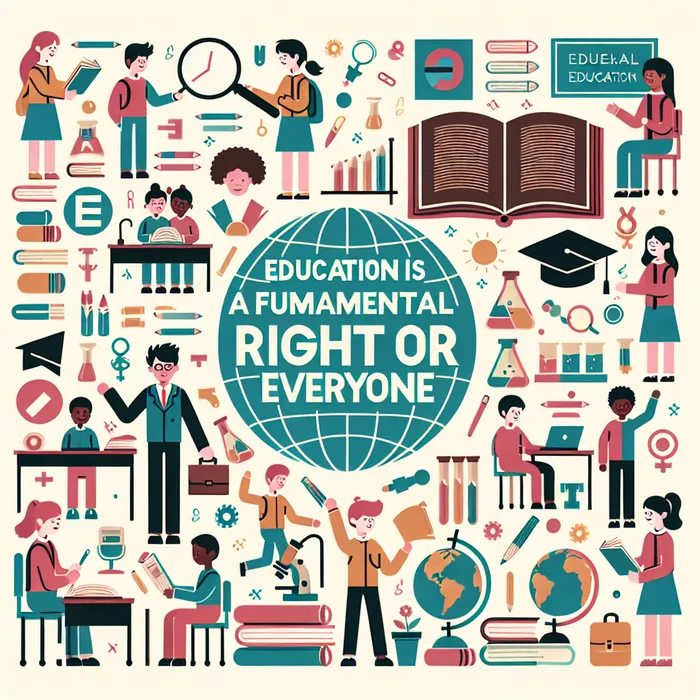
Why education is a fundamental human right and how it empowers individuals and communities from a Bahá'í perspective.
Image: RON AI/Independent Media
September 8th, – observed as International Literacy Day – is a reminder of the great need to ensure that education is provided to all.
Education is a fundamental human right, and no one should be deprived of literacy as the crucial aspect of universal education. It is through education that individuals develop their God-given potential and are enabled to better contribute to the advancement of their communities.
Bahá’u’lláh, the founder of the Bahá’í Faith, compares human beings to a mine containing many hidden jewels, waiting to be discovered and used for the benefit of humanity. He says: “Regard man as a mine rich in gems of inestimable value. Education can, alone, cause it to reveal its treasures, and enable mankind to benefit therefrom”.
According to UNESCO Institute of Statistics, however, despite great progress made in literacy worldwide, at least 754 million adults still cannot read and write, two thirds of them being women, and 250 million children are failing to acquire basic literacy skills.
The education and development of everyone, their personality, talents, physical, and mental abilities and spiritual qualities to their fullest potential, is the right of everyone – whether men or women. And everyone has the right to an appropriate education – an education that would assist them in both their moral empowerment, as well as their intellectual development.
“… Bahá’u’lláh considered education as one of the most fundamental factors of a true civilization. This education, however, in order to be adequate and fruitful, should be comprehensive in nature and should take into consideration not only the physical and the intellectual side of man but also his spiritual and ethical aspects”.
The focus should not be only enrolling individuals to the institutions of learning. There is a need to generate in them a vision of the kind of society they wish to live in – a united and peaceful society, a society in which the development and empowerment of everyone is ensured. Once they have such a vision, they can be assisted to shape their future, and to be the kind of individuals that will bring about such a society.
For education to contribute to individual growth and to the transformation of society, it should aim at cultivating tolerance, understanding, love of humanity, the peaceful resolution of conflicts, and respect for different ethical values.
Serving others is another element of an education that enriches both individuals and society. When individuals learn to serve the best interests of their families, communities and humanity, then education can become an instrument for the creation of a peaceful global society.
Education is a fundamental human right and must be provided to all. The Universal House of Justice, the international governing council of the Bahá’í Faith states: “The cause of universal education … deserves the utmost support that the governments of the world can lend it. For ignorance is indisputably the principal reason for the decline and fall of peoples and the perpetuation of prejudice. No nation can achieve success unless education is accorded all its citizens”.
For feedback please contact: tshwane@bahai.org.za; or call 076 582 3879.
Websites: www.bahai.org, www.bahai.org.za