

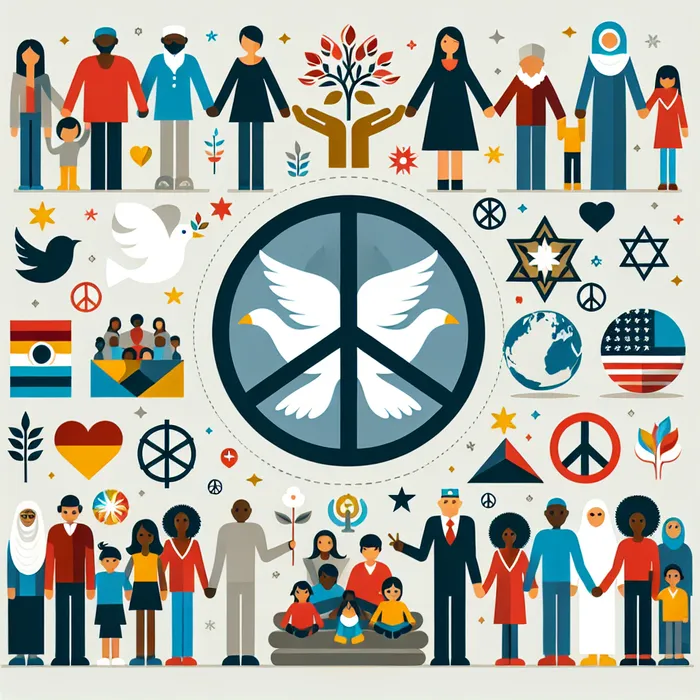
How can family values contribute to global peace? Discover insights from the Bahá'í Faith as we celebrate the International Day of Peace on September 21.
Image: RON AI/Independent Media
As we celebrate the International Day of Peace on September 21, it is timely to reflect on the role of family in the achievement of world peace.
The family is a microcosm of our communities. A unified, joyful, and loving family provides the ideal conditions for the well-being of its members in all aspects of life: physical, spiritual, mental, and emotional. Family is also the foundation for society's cohesion and advancement. Healthy family relationships are of utmost importance to the well-being of the entire human race.
It is within our families where character is developed. It is within the family that one can develop good morals and attitudes towards peaceful co-existence. The family – as a nucleus of society – can have a great influence in the advancement of civilization and the establishment of peace.
According to the Universal House of Justice, the international governing council of the Bahá’í Faith, “The family unit, the nucleus of human society, constitutes a space within which praiseworthy morals and essential capacities must be developed, for the habits and patterns of conduct nurtured in the home are carried into the workplace, into the social and political life of the country, and finally into the arena of international relations”.
It is within the family where values such as loving, caring, and sharing can be developed, and where the values of tolerance, peace and social responsibility can be taught. It is in the family where children can be encouraged to associate with people of all races, nationalities, and religions, and learn to appreciate different cultures and their contributions.
It is in the family that we learn to respect the ideas of others and to have open minds. The moral and social values that are learned at home will apply not only in the context of the family, but outside in the wider world itself.
The Universal House of Justice states: “Children must be so raised as to regard every soul, irrespective of religion, ethnicity, or any other affiliation, as a fellow human being and to hold dear the words that capture the spirit of the age: “The tabernacle of unity hath been raised; regard ye not one another as strangers. Ye are the fruits of one tree, and the leaves of one branch.” … The family unit provides an environment within which such lofty and world-embracing principles can be taught and nurtured. It is the matrix in which generation after generation can be reared in the conviction that the well-being of the individual is inextricably bound to the progress and well-being of others”.
Children need to learn from young ages that in order to build a peaceful world, they must have tolerance of differences and treat everyone with love and respect. An education needed for promoting peace must begin in the family. The family is where children first learn to love humanity, and eventually become the promoters of world peace.
For feedback please contact: tshwane@bahai.org.za; or call 076 582 3879.
Websites: www.bahai.org, www.bahai.org.za