

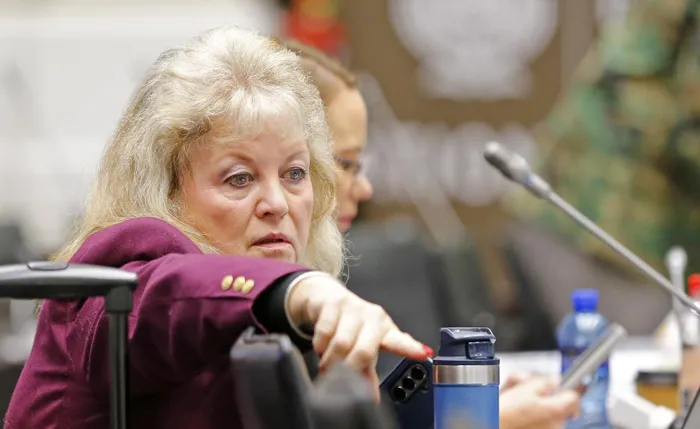
DA MP Dianne Kohler Barnard
Image: RSA Parliament
We must applaud our Members of Parliament for taking the political battle directly to the doorstep of Dianne Kohler-Barnard and the Democratic Alliance (DA).
Their stand serves as an important reminder that South Africans must never become complacent about the persistence of racism and apartheid nostalgia in our democratic institutions. Kohler-Barnard’s re-emergence in national politics — despite her well-documented history of glorifying apartheid’s brutality — should alarm every citizen who believes in genuine transformation and accountability.
For those who may have forgotten, Kohler-Barnard found herself at the centre of national outrage in 2015 when she shared a Facebook post praising former apartheid president PW Botha. The post lamented the supposed decline of law and order under democratic governance and openly called for the return of Botha’s leadership — an individual whose presidency epitomised racial oppression, state-sponsored violence, and institutionalised inequality.
Her action was not an innocent mistake or an impulsive click on social media; it was a deliberate endorsement of apartheid nostalgia, a sentiment that has no place in a free and democratic South Africa. The Democratic Alliance, facing public pressure at the time, responded with what can only be described as a cosmetic disciplinary process. Kohler-Barnard was briefly expelled from the party, only to be quietly reinstated after a superficial appeals process that many rightly called a “sweetheart hearing.”
The DA leadership sought to portray this as due process, but to most South Africans, it was clear that the party’s primary concern was damage control, not moral accountability. The message was unmistakable: racism within the DA’s ranks would be treated as an administrative inconvenience, not as a fundamental betrayal of the democratic values the party claims to uphold. It is, therefore, shocking — but perhaps not surprising — that Kohler-Barnard has resurfaced as an active Member of Parliament and even served on committees where her record of intolerance should have disqualified her immediately. Her presence in these spaces is not merely symbolic; it is corrosive.
It signals to the nation that the DA is willing to rehabilitate figures tainted by racism if it serves their political expediency. This pattern of behaviour is not unique to Kohler-Barnard—it reflects a deeper reluctance within the DA to confront the racial dynamics that continue to define both South African society and its own internal culture. What makes the situation even more disappointing is the muted response from some quarters of Parliament, including the Economic Freedom Fighters (EFF), who once championed themselves as uncompromising opponents of racism and white supremacy.
The EFF’s apparent silence or selective memory regarding Kohler-Barnard’s past undermines the moral consistency that the party has built its identity upon. It is not enough to challenge racism in rhetoric; it must also be confronted in every space where it rears its head — whether in government, the opposition benches, or within committees of Parliament itself. This episode underscores a broader problem in South African politics: the normalisation of racism under the guise of political rehabilitation. Too often, individuals implicated in acts of racial prejudice or apartheid glorification are allowed to reinvent themselves without ever expressing genuine remorse or engaging in restorative justice. When those in positions of privilege are so easily forgiven —without any meaningful accountability — it reinforces the notion that racism remains a negotiable offence in our society. South Africans deserve better. Our democracy is built on the sacrifices of those who suffered under a regime that Kohler-Barnard saw fit to glorify.
Every time a political party shelters individuals who undermine that legacy, it erodes the moral foundation of our hard-won freedom. The DA’s handling of this matter is a stark reminder that the party still struggles to reconcile its liberal rhetoric with the realities of a racially unequal country. It cannot claim to champion nonracialism while harbouring those who celebrate apartheid’s architects. The outrage directed at Kohler-Barnard is not about political point-scoring — it is about defending the integrity of our democratic institutions. It is about insisting that those who represent the people of South Africa must do so with respect for the country’s history, its diversity, and its collective pain. Kohler-Barnard’s continued presence in Parliament is an insult to that history. The EFF and other opposition parties should not forget who she is or what she represents. They owe it to the South African people to hold her — and the DA — fully accountable.
Silence in the face of racism is complicity, and complicity is betrayal. If our Parliament is to remain a beacon of democratic values, it must be purged of those who glorify apartheid, not reward them with power and influence.
* Mayalo is an independent writer and the views expressed here are not necessarily those of IOL or Independent Media