

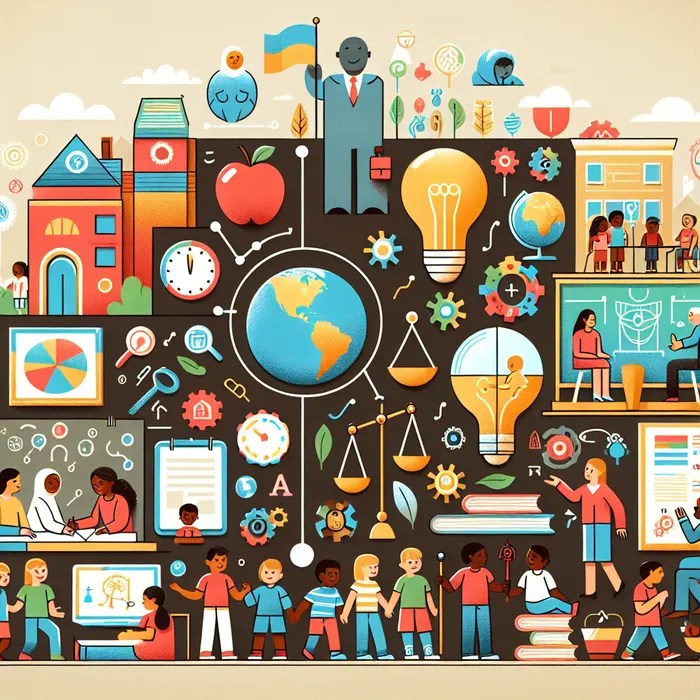
National Children’s Day on 1 November and Universal Children’s Day on 20 November highlight the importance of protecting children's rights and empowering them through education. How can we ensure that every child receives the education they deserve?
Image: Ron AI/Independent Media
We will be celebrating National Children’s Day on 1 November and Universal Children’s Day on 20 November. These milestones remind us of the need to protect the younger generation, and make sure that they are empowered to build a better and peaceful world.
“Future generations will be better able to govern the affairs of humankind and guarantee that the rights of all are respected if the rights of today's children are protected and their full development assured”, states the Bahá’í International Community in its statement entitled ‘Rights of the Child’.
Access to education, for example, is a basic human right. However, according to UNICEF reports, millions of children continue to be denied their right to education. Yet only a small percentage of what the world spends on weapons of war would be needed to put every child into school.
Education, and empowerment of our children, is vital to the development of their potential, as well as enjoyment of their full range of other rights, and must be provided to every child.
According to the Universal House of Justice, the international governing council of the Bahá’í Faith, “The cause of universal education … deserves the utmost support that the governments of the world can lend it. For ignorance is indisputably the principal reason for the decline and fall of peoples and the perpetuation of prejudice. No nation can achieve success unless education is accorded all its citizens”.
Our children must be provided with a balanced education. A balanced education would combine intellectual education with moral and spiritual guidance, and would aim at the development of the child’s personality, talents, and mental and physical abilities to their fullest potential. Educating our children to have a good character and acquiring praiseworthy qualities – such as trustworthiness, love, and justice towards all, in addition to their intellectual education, will help in building a brighter and peaceful future for us all.
The Bahá'í Writings emphasise that, “… from the very beginning, the children must receive divine education and must continually be reminded to remember their God,” and “Schools must first train the children in the principles of religion, … but this in such a measure that it may not injure the children by resulting in ignorant fanaticism and bigotry”.
Children should be given the opportunity to choose a career in which they are interested and for which they have a natural ability, while being encouraged to acquire knowledge which is of benefit to humanity.
Furthermore, we need to nurture in our children an appreciation for the richness and importance of the world's diverse cultural, religious, and social systems, and to work for unity and peace in their communities.
Children must be taught to investigate for themselves all matters, instead of just imitating adults. They should be taught to have high aspirations, and to reflect on the consequences of their decisions and the results of their action.
While teaching our children about their rights is crucial, it is as important that they are made aware of the corresponding responsibilities.
For feedback please contact: tshwane@bahai.org.za; or call 076 582 3879
Websites: www.bahai.org, www.bahai.org.za