

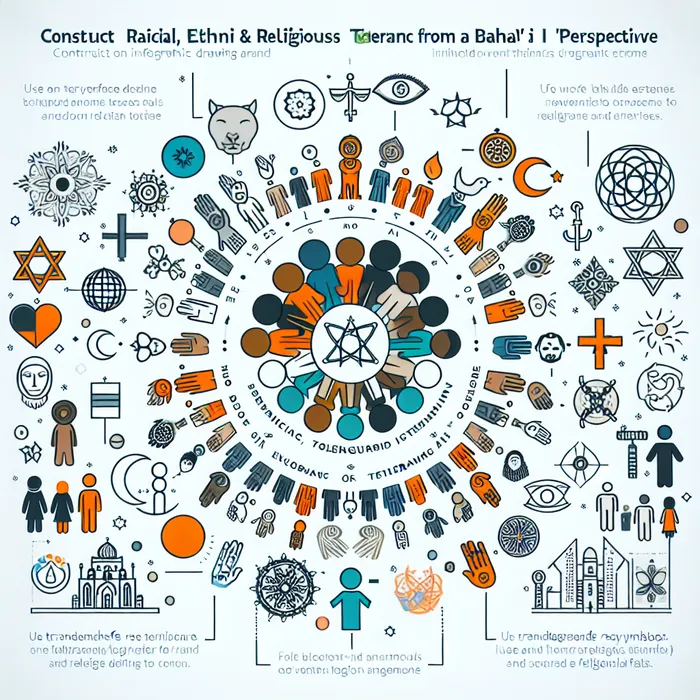
On the International Day for Tolerance, we reflect on the urgent need for unity and understanding among diverse races and religions.
Image: Ron AI/Independent Media
The International Day for Tolerance on 16 November is a reminder of the crucial and urgent need to promote tolerance, mutual understanding, and cooperation among the races, ethnic groups, and religions of the world.
Today millions of people are suffering from the ravages of war and conflict. Discrimination due to race, nationality, religion, or ethnic group is dividing communities and undermining social cohesion. Prejudices, suspicion, and mistrust have created a false sense of superiority and perpetuated violence towards those who are outside one’s own social group.
According to a statement of the Bahá'í International Community, “The coming together of the peoples of the world in a harmonious and creative relationship is the crucial need of the present hour. In the wake of advances in human knowledge which have deepened bonds of interdependence and contracted the planet, the central task now before all its inhabitants is laying the foundations of a global society that can reflect the oneness of human nature”, and that “the task of creating a universal ethos of tolerance is intimately bound up with a process of moral and spiritual development”.
Honouring diversity in the human family, and not making our differences a cause for conflict and contention, requires a new way of thinking, based on the acceptance of our oneness, respect for the rights of every individual, and the observance of moral and spiritual values.
Bahá'u'lláh, the founder of the Bahá’í Faith, states: “Observe tolerance and righteousness, which are two lights amidst the darkness of the world and two educators for the edification of mankind”. He further states: “Close your eyes to racial differences and welcome all with the light of oneness”, and that "The purpose of religion, ...is to establish unity and concord amongst the peoples of the world; make it not the cause of dissension and strife”.
The role of religion is to civilise human character, to define human identity, as well as promoting social order. According to the Bahá’í Writings, “there is no credible replacement for religious belief as a force capable of generating self-discipline and restoring commitment to moral behaviour”.
While religion is a vital force for creating a peaceful and prosperous global society, religious intolerance and fanaticism have a great destructive impact on the stability and progress of the world. Eliminating all barriers to the free exploration, acceptance, and expression of religious belief is critical to promoting religious tolerance.
To eliminate the destructive impact of religious intolerance, racism, and xenophobia, there is a need to make a conscious, deliberate and sustained effort. There is a need for genuine love, extreme patience, true humility, and prayerful reflection to prevail over intolerance and to build a united and peaceful world.
“The principle of the oneness of humankind,” in the Bahá'í view, “lies at the heart of the exhortation that we should treat others as we ourselves would wish to be treated. To establish justice, peace and order in an interdependent world, this principle must guide all interactions”.
For feedback please contact: tshwane@bahai.org.za; or call 076 582 3879
Websites: www.bahai.org, www.bahai.org.za