

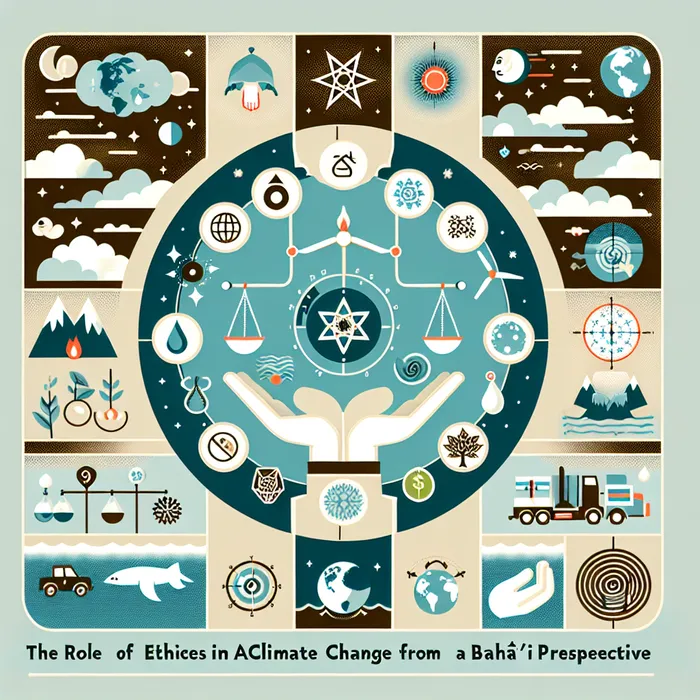
Bahá'í ethics can inspire meaningful action against climate change, as highlighted by the recent COP30 conference in Brazil.
Image: Ron AI/Independent Media
Climate change – a change directly or indirectly related to human activity that alters the composition of the global atmosphere – is now an even more serious matter of concern.
The United Nations Climate Change Conference, known as COP30, which was held from 10 to 21 November in Belém, Brazil, was a reminder of the crucial need to protect our natural world.
According to a report from UNDP, the consequences of a 2°C or greater increase in global temperature will include: coastal flooding displacing 180-230 million people; water shortages affecting 1.8 billion people; and putting 220-400 million people at risk of malaria.
“The current global order”, in the words of the Bahá'í International Community, “has often approached the natural world as a reservoir of material resources to be exploited. The grave consequences of this paradigm have become all too apparent, and more balanced relationships among the peoples of the world and the planet are clearly needed. The question today is how new patterns of action and interaction can best be established, both individually and collectively, through personal choices, social systems, and governing institutions”.
To address climate change and other environmental challenges, there is need for a commitment to higher moral standards. Focusing mainly on the material aspects of environmental problems has been counterproductive to humanity’s long-term well-being. Instead of exploiting the earth's resources without due regard to sustainability, we should be asking how to live with an ethic of respect, care, and justice towards all life and nature.
Genuine solutions to protect our natural world, in the Bahá'í view, will require a globally-accepted vision for the future, based on unity, justice, and willing cooperation among the nations, races, creeds, and classes of the human family.
Bahá'í International Community states that, “For progress on the international stage to be sustainable, it must take place within a framework that promotes the attainment of progressively higher degrees of unity of vision and action among its participants. Each forward step—far from representing a momentary triumph of a single person or faction in an environment of competition—becomes part of a collective process of learning by which international institutions, states and civil society advance together in understanding”.
There is need for justice in utilizing the earth’s resources. Upholding justice implies moving from the self-interest that dominates our world today, to a mode of sharing and caring for our natural resources.
Observing principles, such as economic justice, equality between the races, equal rights for women and men, and universal education, bear directly on attempts to protect the earth’s environment.
Furthermore, it is the Bahá'í view that there is need for a world federal system to enable mankind to arrange its economic, material, and social life with justice for all peoples and reverence towards the earth.
We must remember that future prosperity and the peaceful co-existence of peoples will greatly depend on access to, and conservation of, natural resources abundantly provided to humanity by the Almighty Creator.
For feedback please contact: tshwane@bahai.org.za; or call 076 582 3879
Websites: www.bahai.org, www.bahai.org.za