
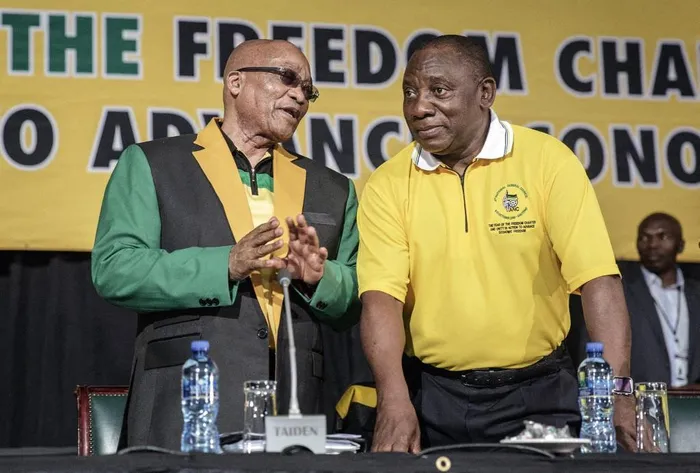
Then ANC president Jacob Zuma in discussion with his deputy Cyril Ramaphosa during the opening session of the party's 4th National General Council held at Gallagher Estate in Midrand on October 9, 2015.
Image: AFP
Zamikhaya Maseti
A cursory review of the African National Congress ahead of the 5th National General Council (NGC), scheduled for 8–12 December 2025 at the Birchwood Hotel and Conference Centre in Ekurhuleni, forces us to return to the essential question of whether the movement still possesses the organisational stamina, ideological coherence, and moral authority to lead a society undergoing profound structural transition.
The NGC convenes at a time when the ANC is simultaneously confronting electoral pressure, governance fatigue, and a shifting public mood that demands results rather than rhetoric.
This year’s NGC takes place within the context of a movement whose majoritarian hegemony has been violently slashed after the humiliating outcome of the 29 May National and Provincial Elections. The 2026 National Local Government Elections now present themselves as an existential threat, a moment of truth that delegates can no longer postpone or rationalise.
Already, reputable polling houses are projecting a national electoral outcome averaging 32 percent for the ANC, signalling a dramatic contraction of the movement’s social base and a profound test of its political durability. This gathering is not an administrative ritual; it is a pivotal moment in the life of a movement standing at a crossroads.
At the heart of the NGC lies the question of organisational renewal: not as a slogan repeated at conferences, but as a substantive programme that must address degraded political education, fractured internal democracy, weakened cadreship, and the erosion of ethical leadership.
The ANC’s ability to recover its strategic centre depends on its willingness to confront the hard truths about how far the organisation has drifted from the disciplined, ideas-driven culture that once anchored its legitimacy.
This gathering is not a symbolic congregation. It is a necessary organisational reckoning, compelled by a shifting political economy that demands clarity, discipline, and ideological coherence.
Delegates must interrogate both the subjective and objective factors shaping this conjuncture, from internal organisational decay to external social pressures, and reflect honestly on whether the movement still possesses the strategic capacity and political imagination required to lead society through this turbulent period.
The sobering reality confronting delegates at the NGC is that their policy recommendations may never acquire institutional life. The internal house rules of the Government of National Unity impose a negotiated terrain in which no policy shift can advance without multi-party consent.
This means that even the most visionary resolutions adopted by the movement may be stalled, diluted, or altogether suffocated within the architecture of GNU negotiations, creating a structural tension between the ANC’s organisational mandate and the constraints of coalition governance.
The 2025 NGC is convened at a time when the South African political economy is shifting beneath our feet. Rising unemployment, persistent energy constraints, a volatile global environment, and the geopolitical realignment of major powers all place significant pressure on the movement to redefine its strategic posture.
The ANC cannot afford to approach these questions with outdated frameworks or ideological complacency. It must sharpen its analysis of the balance of forces domestically and globally and adopt a strategic orientation that aligns with the aspirations of South Africans across classes, regions, and social formations.
Central to these deliberations is the question of the ANC’s strategic centre of gravity. The movement must ask whether it has become too reactive, too trapped in administrative routines, and too disconnected from the mass base that once constituted its foundational strength.
Renewal requires political honesty: a willingness to admit that the movement has allowed factionalism, patronage networks, and declining organisational discipline to displace merit, political clarity, and collective intellectual labour.
The delegates must deliberate extensively on the unfolding events at the Madlanga Commission and the startling claims made by Lieutenant General Sibusiso Mkhwanazi regarding systemic rot and political meddling within the criminal justice system.
These revelations pierce through the national conscience and expose a deep crisis at the heart of state institutions that were once envisaged as guardians of constitutional integrity.
For the ANC, these proceedings cannot be treated as distant legal theatre; they constitute a mirror reflecting the consequences of organisational drift and compromised governance capacity. The NGC must therefore interrogate how these institutional failures intersect with the movement’s own shortcomings, and how the erosion of law-enforcement credibility undermines the broader project of state legitimacy, public confidence, and democratic stability.
The provinces, too, will arrive at the NGC with their own differentiated realities. The Eastern Cape, KwaZulu-Natal, Gauteng, and Limpopo all carry distinct political dynamics that affect the movement’s national posture. Delegates must transcend narrow provincial interests to craft a cohesive national strategy capable of stabilising the organisation and restoring its ideological compass.
The provincial balance of forces will also shape electoral prospects in the 2026 Local Government Elections, making it imperative that the organisation addresses service delivery failures, governance incoherence, and declining municipal capability with honesty rather than political cosmetics.
The internal weaknesses of the movement are unfolding in a broader political moment defined by global turbulence. The international system has entered a period of fragmentation, characterised by escalating geopolitical competition, weakening multilateral institutions, and heightened economic nationalism. South Africa’s position within this shifting terrain requires a governing party capable of analysing global realignments and leveraging them in the national interest.
The ANC cannot approach this conjuncture with formulaic statements or nostalgic references to past solidarities; it must recast its foreign policy posture to ensure that South Africa’s developmental imperatives are not subordinated to external pressures or internal ideological paralysis.
Domestically, the movement faces an electorate that has grown increasingly impatient with incrementalism, bureaucratic inertia, and the widening gap between policy intention and lived reality.
Unemployment remains structurally high, particularly among the youth, while inequality continues to calcify social fractures. Energy insecurity, transport inefficiencies, and the collapse of local economic nodes have further eroded confidence in the state’s ability to drive inclusive growth. These challenges demand a strategic response rooted in developmental logic, industrial competitiveness, and institutional coherence, not symbolic gestures or rhetorical affirmations.
Yet renewal cannot be reduced to internal housekeeping alone. At its core, the ANC must rediscover its historic mission as articulated in the Freedom Charter and reaffirmed throughout the long arc of the National Democratic Revolution.
The Charter’s call that “The People Shall Govern” remains an unfinished mandate not as nostalgic rhetoric, but as a living political project requiring institutional integrity, disciplined cadreship, and developmental governance. The movement must therefore emerge from the NGC with a sharpened focus on state capability, inclusive economic growth, social justice, and the reconstruction of public trust.
The 5th NGC must reclaim the ANC’s strategic imagination. It must reconnect the organisation with its intellectual tradition, rebuild the moral centre that once distinguished it, and reaffirm its commitment to a transformative developmental state.
The historical weight of the moment demands nothing less. South Africa requires a capable, ethical, and ideologically coherent ANC not for the sake of the organisation alone, but for the sake of a nation still in search of economic dignity, social stability, and democratic renewal.
If the NGC of 8–12 December 2025 succeeds in confronting these deep questions with courage and clarity, it may yet set the movement back on a path aligned with the unfinished work of the Freedom Charter and the transformative promise of the National Democratic Revolution.
* Zamikhaya Maseti is a political economy analyst and holds a Magister Philosophae (M.Phil.) in South African Politics and Political Economy from the erstwhile University of Port Elizabeth, now Nelson Mandela.
** The views expressed do not necessarily reflect the views of IOL, Independent Media or The African.