

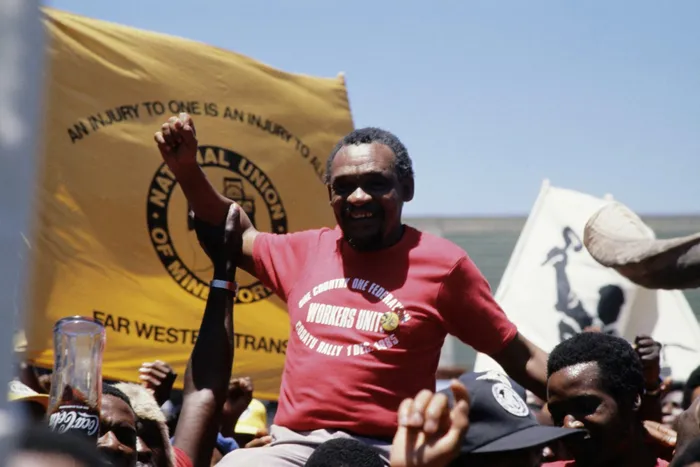
FIRST president of the Congress of South African Trade Unions (COSATU) Elijah Barayi celebrating the launch of the federation during a rally in Johannesburg on December 20, 1985. Forty years after the founding of the federation, its glory has faded, says the writer.
Image: AFP
Reneva Fourie
An erstwhile giant has lost its sway. The Congress of South African Trade Unions (Cosatu), launched in Durban on 1 December 1985, is celebrating its fortieth anniversary.
Its formation represented a consolidation of fragmented unions into a single organisation that drove industrial action and broader societal demands. The federation that once made the apartheid regime and bosses tremble now appears weakened by internal rivalries, fragmentation, and cooptation.
Having drawn on the banned South African Congress of Trade Unions, as well as the independent unions that emerged after the 1973 Durban strikes, Cosatu united a broad range of workers across industry, race, and gender.
It gave the working class the strength to influence national politics through consistent organisation, clear ideological direction, and coordinated campaigns that changed the balance of forces in the country. Its contribution to stayaways and consumer boycotts created real pressure on the political authorities of the period and on the business community.
This sustained mobilisation shaped the progressive labour laws of the early democratic government and confirmed the power of a unified working class. In alliance with the African National Congress, the South African Communist Party, and the South African National Civic Organisation, the federation sought to advance social justice, economic transformation, and ensure the constitutional and legislative protection of workers.
The Labour Relations Act of 1995 and the laws dealing with basic conditions, skills development, and equity reflect this earlier period of organised pressure.
Forty years after the founding of the federation, its glory has faded. Membership, as a percentage of the total workforce, has dropped significantly. Much of Cosatu’s membership now lies in the public sector.
Approximately seventy per cent of South African workers find themselves outside of formal union structures. Most of the labour force is engaged in informal activities, platform-based roles, labour broking arrangements, or fixed-term contracts. These forms of employment do not lend themselves easily to the traditional organising methods of the federation.
Affiliates experience difficulty when attempting to recruit workers in retail, hospitality, security, and logistics. These sectors have grown rapidly since 1994, yet remain largely unorganised. Manufacturing density has weakened as many factories have closed or relocated. The federation has not produced a widely accepted model of community-based or sectoral bargaining that might extend representation to those who work outside stable formal employment.
Organisational cohesion has also declined. The expulsion of the National Union of Metalworkers of South Africa removed a large and influential affiliate, resulting in the formation of a rival trade union federation that shares Cosatu’s objectives. The divisions created have not been resolved. Within the remaining affiliates, leadership conflicts have become common and have drawn attention away from pressing workplace matters.
A further challenge lies in the position of union investment companies. Senior officials sometimes sit on the boards of major corporations through these entities. This creates a direct financial link between representatives of labour and major companies.
Such links have encouraged a more cautious approach to issues such as privatisation, proposed changes to labour regulation, and the growing influence of international financial institutions in shaping economic policy. Public criticism of decisions that favour capital has become more muted as a result.
The long-standing alliance with the governing party has had a similar effect. Positions that challenge limits on public spending, restrictions on public sector wage growth, or proposals that simplify dismissal procedures for small businesses are often softened in order to maintain alliance stability. The federation has issued statements opposing these developments but has not undertaken sustained national campaigns to demand alternatives.
The response to high unemployment has been limited. Unemployment stands above thirty per cent on the narrow definition and approaches forty-five per cent when discouraged workers are counted.
Despite this situation, the federation has not maintained lengthy national programmes calling for public employment, expanded infrastructure projects, or increased income support for the jobless. The influence that once shaped national debates now has difficulty securing outcomes that favour workers on issues such as exemptions from the national minimum wage, the use of temporary contracts, and the outsourcing of critical posts in the public service.
These developments arise partly from a move away from the pro-poor commitment that once guided the federation. Early Cosatu resolutions supported economic arrangements that prioritised working-class interests and the redistribution of power in the economy. Over time, the federation has become less vocal against economic frameworks that place investor confidence and export competitiveness at the centre of policy-making.
Leaders who previously opposed such approaches now participate readily in events with local and international investors. The federation once took positions that questioned the influence of foreign governments and international finance. In recent years, this has faded and has been replaced by leaders who relish being seen fraternising with the global wealthy and powerful.
The federation's revival hinges on reinforcing worker unity through a pro-poor ideological orientation. Such a foundation prioritises the collective advancement of the employed and unemployed alike, recognising that labour's strength derives from encompassing the broader working class.
Historical precedents, from the South African Congress of Trade Unions' integration of migrant workers into resistance, affirm this approach. The current organisation must extend its remit to the marginalised, developing mechanisms like community-based bargaining councils to incorporate informal workers. Ideological renewal, drawing on principles of class analysis and solidarity, would equip the federation to challenge deregulatory agendas without alienating diverse constituencies.
Cosatu’s legacy lies in proving that unified workers possess the agency to reshape the workplace and society, as evidenced by the 1980s upheavals that hastened democracy. Its fortieth anniversary is therefore not only a celebration of past achievements; it is also a call for renewal based on worker unity and a pro-poor orientation.
The federation still has structures and networks that can regroup the working class. It requires a clear return to solidarity, active involvement in mass action, and firm advocacy for those who produce the wealth of the country. Through such unity, the federation can once again become an organisation that shapes national development in the interest of the majority.
* Dr Reneva Fourie is a policy analyst specialising in governance, development, and security.
** The views expressed do not necessarily reflect the views of IOL, Independent Media or The African.