

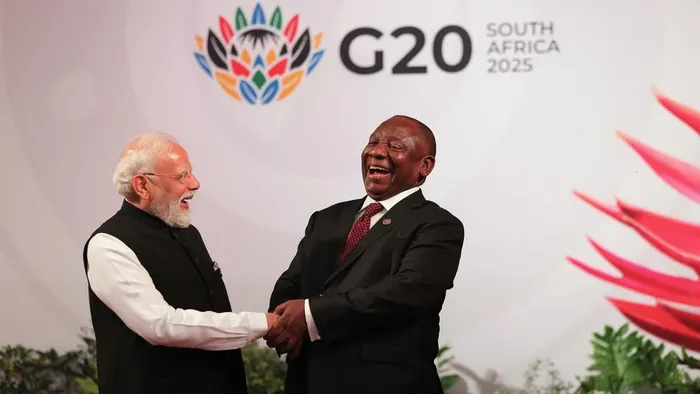
Indian Prime Minister Narendra Modi sharing a joke during the G20 Leaders' Summit in Johannesburg last month. The leaders also took part in IBSA Dialogue Forum meetings aimed at improving cooperation for development between the nations that together with Brazil constitute IBSA.
Image: Supplied
In an emerging new multipolar world, several new political and economic platforms are seeking to champion the development of marginalised countries in the Global South instead of depending on Western-dominated global institutions such as the G7, the International Monetary Fund (IMF) and the World Bank to advance their cause.
BRICS is the most powerful of the blocs challenging the hegemony of the established global institutions, seen to be biased towards the developed world and neglectful of the interests of poorer countries. But several bilateral and trilateral groupings have also emerged to promote specific regional interests.
IBSA (India, Brazil, South Africa Dialogue Forum), formed in 2003, is among the foremost platforms promoting South-South cooperation between three multicultural democracies, spanning three continents - Asia, Africa and South America - with shared global interests.
An IBSA Dialogue on the sidelines of the G20 Summit in Johannesburg in November, between India’s Prime Minister Narendra Modi, South African President Cyril Ramaphosa and Brazil’s President Luis Inácio Lula da Silva, has injected a renewed sense of purpose into IBSA.
This revitalisation has been hastened by what its members see as unfair treatment by Donald Trump. The American president has slapped some of the harshest punitive tariffs of 50% against exports from India and Brazil to the US, and, having falsely accused Pretoria of persecuting its White population, sought to punish South Africa by, among others, boycotting the G20 Summit in Johannesburg last month.
The upshot of Washington’s seemingly bullyboy tactics has been to convince member countries that IBSA must act urgently to become part of the discourse to set the global agenda.
Ramaphosa, who recently took over IBSA’s rotational Presidency, set the tone in his opening remarks at the Dialogue, where he made a call for a more representative and responsive multilateral system, saying: “Our cooperation is grounded in the daily realities of our people. Together, we must champion ambitious reform of the global governance institutions.”
He urged leaders of IBSA to position themselves as co-architects of a more representative and responsive multilateral system: “The structural fault in the global economy – the growing gap between the rich and the poor and deepening poverty and underdevelopment – can only effectively be addressed through a new paradigm of inclusive economic growth.”
Modi, noting that global governance institutions were far removed from 21st-century realities, urged IBSA to send a clear message of “unity, cooperation, and humanity” in a world that appeared “fragmented and divided in many directions.”
He added that global “institutional reform is no longer an option, but a necessity,” and called for official and regular meetings of the national security advisors of the member countries to strengthen security cooperation. Modi also mooted the establishment of an IBSA Digital Innovation Alliance, to contribute to “the creation of safe, reliable, and human-centred AI norms.”
Noting that the IBSA Fund, operationalised in 2006, had completed nearly 50 projects in 40 countries in areas like education, health, women’s empowerment and solar energy, Modi proposed the establishment of the IBSA Fund for Climate Resilient Agriculture.
Da Silva argued that trilateral coordination among Brazil, India and South Africa could “permanently reflect in the UN, the G20 and the BRICS,” thereby strengthening the influence of Global South nations in shaping the international order
The Brazilian leader called for the modernisation and redefinition of IBSA’s global role amid an evolving international landscape marked by an expanded BRICS and a strengthened G20. “The status of major emerging economies of the Global South and major democracies gives IBSA its own identity and capabilities,” he said.
In a bid to ensure that the momentum created at the IBSA Dialogue and the agenda set by Modi, da Silva and Ramaphosa, are taken on board by the rest of the world, an IBSA Summit has been mooted for the near future to ensure that the needs, aspirations and economic development of the Global South and the developing world get the priority they deserve.
Mkhuma is a veteran journalist, former editor of the Pretoria News, and Editor: Higher Education Media Services.