
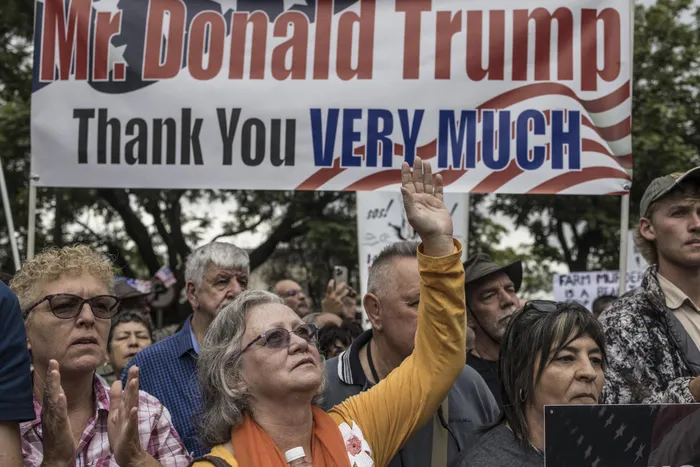
Afrikaners thanking US President Donald Trump for his support of their fake genocide narrative at a protest held outside the US Embassy in Pretoria on February 15, 2025. The fragility of reconciliation was further revealed by the recent actions of 29 Afrikaners who voluntarily exiled themselves to the United States under the false pretext of a looming genocide, says the writer.
Image: Marco Longari / AFP
Zamikhaya Maseti
December 16 is one of the most symbolically dense dates on the South African political calendar.
It is a day that carries the heavy sediment of conquest and resistance, of state violence and popular defiance, of memory that wounds and memory that liberates. It compels us to confront the truth that the present is never detached from the long shadows of the past. That reconciliation must be rooted in historical justice rather than the thin idealism of forgetting.
Under Colonial and Apartheid rule, December 16 was celebrated as the Day of the Vow, sanctifying the mythology of white domination and the divine justification of settler conquest. This ritual attempted to erase African historical agency and replace it with a narrative of providential victory. Yet the oppressed people of this land reclaimed the date and invested it with a very different meaning, one anchored in resistance, dignity, and the liberation struggle.
It was on December 16, 1961 when the African National Congress took one of the most decisive steps in its history. Faced with massacres, bannings, censorship, mass arrests, and the closing of all peaceful avenues of protest, the movement formed uMkhonto weSizwe, the Spear of the Nation, as its military wing. This was not a plunge into adventurism. It was a sober conclusion drawn from the brutality of the minority regime, which understood only the language of force.
When the sharpshooters of the state answered peaceful protest with bullets at Sharpeville, when detention without trial became the norm, when torture supplanted dialogue, the oppressed were forced into a new political grammar. MK emerged as a disciplined politico-military formation, designed not to terrorise civilians but to weaken the apartheid state and create conditions for a democratic breakthrough. It stood as an instrument of historical correction, signalling that the people of this land refused to accept their own dehumanisation.
It was therefore a profound act of political imagination for the democratic state to designate December 16 as Reconciliation Day. This transformation sought to convert a date once draped in the iconography of conquest into a day that might speak to unity based on truth, justice, and transformation.
Reconciliation in this context must be a sustained political programme grounded in honesty, accountability, and socio-economic redress. It is the work of remaking a nation fractured by dispossession and rebuilding a state whose foundations were laid through racial exclusion.
The founding of MK on this date remains a reminder that our freedom was not a benevolent offering. It was secured through sacrifice, clandestine organisation, and collective courage. Reconciliation must therefore confront inequality as the structural afterlife of apartheid. It must challenge us to build a democratic and developmental state anchored in justice. It must summon us to complete the unfinished work of liberation.
However, December 16 is often dishonoured.
Many White South Africans and sections of the Black elite have reduced it to a national Braai Day, a moment of indulgence for the meat and liquor economy, stripped of historical memory. A generation born after 1994 often identifies the day with the braai rather than the solemn work of peace-building.
This trivialisation sits alongside a darker reality, for even as democracy extended the hand of reconciliation, sections of the White population responded with open contempt, carrying forward the resentments and psychologies of an order they believed had ended prematurely.
These resentments acquired a grotesque material form in the brutal treatment of Nelson Chisale, a farmworker in Limpopo, upon whose suffering the most primitive instincts of those resisting reconciliation were inscribed with merciless precision. On 31 July 2004, he was forced into a lion enclosure by two White employers who regarded his life as expendable. Mauled and disfigured, he succumbed to injuries weeks later.
In that same year, another Black farmworker suffered a similarly dehumanising assault when he was forcibly painted white, a symbolic attempt to bleach away his identity and reinstate the racist hierarchies that democracy sought to dismantle. Not long thereafter, the nation was shaken by the now infamous coffin incident, in which two White farmers forced a Black man into a wooden coffin and attempted to seal it shut, an act that echoed the historical burial of Black dignity under apartheid.
Taken together, these acts expose a deep and unyielding dishonesty within certain sections of the White population, who have been relentless in misunderstanding, resisting, and even mocking the national reconciliation project. Instead of embracing its moral call, they have inflicted further pain on the most disadvantaged and vulnerable sections of the Black majority, revealing not merely individual prejudice but a structural contempt for the very idea of a shared and humane national future.
The fragility of reconciliation was further revealed by the recent actions of the twenty-nine South African Whites who voluntarily exiled themselves to the United States under the false pretext of a looming genocide. This fabrication, crafted to provoke sympathy for White victimhood, was seized upon by right-wing media ecosystems abroad. Their narrative served as ideological ammunition for American conservative politics, which thrives on racial fear and the performance of White fragility.
It became a convenient tool for Donald Trump’s Conservative Republicanism, which weaponised foreign policy to reward allies and punish those who confront entrenched global power. Trump’s reciprocal tariffs on South Africa were not the product of economic logic. They were punitive, emerging from geopolitical vengeance after South Africa courageously brought Israel before the International Court of Justice.
In challenging Israel’s conduct, democratic South Africa assumed the role of David confronting a Goliath long shielded from accountability. Washington’s retaliatory stance was therefore a message to the world: hold our allies accountable and you will be disciplined.
Yet these theatrics failed to fracture the nation. The false exile of the 29 did not polarise South Africa. It instead exposed the attitude of the most backward and conservative sections of the White population, who remain committed to undermining the national reconciliation project. Their actions revealed that for some, the Rainbow Nation was never a moral covenant but a temporary performance during the Mandela presidency.
They continue to cling to a worldview in which Black political power is treated as provisional, accidental, and inherently dangerous. Their behaviour is a reminder that reconciliation is an ongoing struggle against the residues of conquest and the delicate architecture of privilege that resists transformation.
As we reflect on this day, South Africans of all creeds, faiths, and national groups must recommit themselves to honouring December 16 with the full dignity that history demands. This day calls for a renewed national discipline, a collective resolve to advance reconciliation not as a symbolic display but as an uncompromising programme of transformation.
We must embed economic reconciliation at the centre of our national consciousness, guided by the understanding that historical economic injustices must be corrected and socio-cultural injuries must be overcome. The country must be anchored on a singular principle, that socio-economic justice is the moral and political foundation upon which a durable and inclusive South Africa must be constructed. Nothing less will suffice.
Our future stability, prosperity, and cohesion depend on our willingness to confront injustice with courage and to build a Nation worthy of the sacrifices that delivered our freedom.
* Zamikhaya Maseti is a political economy analyst and holds a Magister Philosophae(M.PHIL) in South African Politics and Political Economy from the erstwhile University of Port Elizabeth, now Nelson Mandela University.
** The views expressed do not necessarily reflect the views of IOL, Independent Media or The African.