
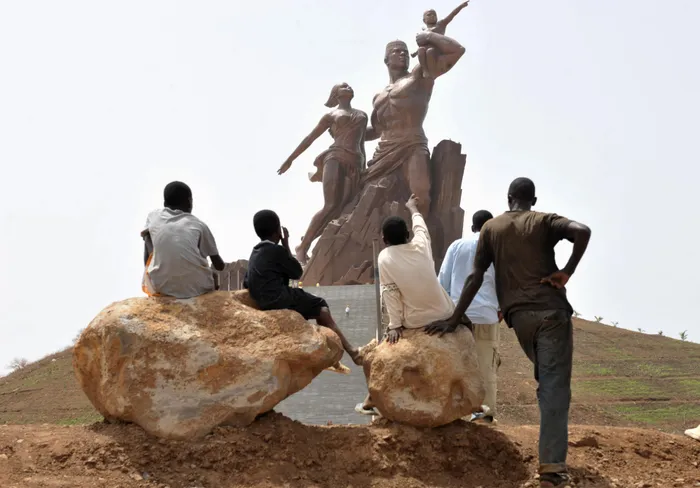
Children look observe the African Renaissance Monument in Dakar, Senegal ahead of its inauguration April 3, 2010. Political power gained through the barrel of a gun is a violent theft of people's power. Africa's dream of peace and prosperity in a post-independence era is not merely postponed — it has been betrayed, says the writer.
Image: AFP
Kim Heller
Africa is a chronic battle zone. Across the Continent, the panorama is riddled by gunfire, the political topography defaced by instability, insurgency, and unconstitutional and military power seizures.
The African Union's flagship initiative, 'Silencing the Guns'—once praised as a powerful continental covenant to build a peaceful, sovereign Africa by 2030— now appears to have lost all its momentum.
Current-day Africa has yet to be liberated from the architecture of colonial violence. The might of imperial economic and political power remains firmly in place, as do exploitative, extractive, and exclusionary economic ecologies. Coups and insurgencies arise from the deep vacuum left by incomplete post-colonial transitions and abysmal post-independence African governance. Insurgency has increased dramatically.
Dangerously, coups, whether military or constitutional, have become the new, almost normalised modality of political change. The crisis is both structural and urgent. Late November 2025 saw Guinea-Bissau fall to yet another successful coup. Two days ago, on 7 December, Benin was rocked by a coup attempt as the nation bore witness to a mutiny by soldiers. Loyalist military forces swiftly ended the coup in concert with Nigerian airstrikes and the rapid-response teams of ECOWAS.
Political power gained through the barrel of a gun or on the inkwell of unconstitutional pens is, in almost all instances, a violent theft of people's power. Africa's dream of peace and prosperity in a post-independence era is not merely postponed — it has been betrayed.Across Africa, tragically, it is insecurity rather than peace that is thriving.
At least twenty-six African countries are embroiled in conflict, insurgency, or constant instability. In 2025, terrorism-related deaths in the Sahel have risen by twenty-two per cent, according to the Africa Centre for Strategic Studies and Armed Conflict Location & Event Data. Jihadist groupings associated with al-Qaeda and Islamic State continue to brutally seize territory in Mali, Burkina Faso, and Niger, causing widespread death, displacement, and destabilisation.
Burkina Faso has been hard-hit with more than two million internally displaced people.Mozambique's Cabo Delgado remains a conflict hotspot. The 8-year conflict continues despite multinational intervention to quell the unrest for commercial reasons. Somalia is facing its most intense al-Shabaab offensive since 2011.
No enduring peace solutions have been found in Sudan or the Democratic Republic of Congo (DRC), where elite interests, state collapse, endless greed for natural resources, and foreign involvement all collide to extend the wave of violence. The Continent is hemorrhaging as conflict becomes structurally embedded in the political economy and governance architecture. In the vociferation of gunpowder, calls for peace are now entirely drowned out.
The epidemic of military coups and coup attempts is alarming. Over the last six years, West and Central Africa have had more successful or attempted coups than the rest of the world. The normalisation of coups, whether military or constitutional, as a means of political change is the most explicit proof yet that state legitimacy has collapsed.
Amid the explosively clamorous gunfire, the AU silence is all but deafening. In Benin's recent coup attempt, the AU, the chief champion and caretaker of continental peace, was little more than a spectator. The African Peace and Security Architecture (APSA), once showcased as a protective shield for the Continent, is now effectively inoperative despite its elaborate framework and ambitious goals. The AU rarely moves with swiftness, command, or consistency. Quick to denounce any governance transgressions or acts of violence, it is often slow to act.
Africa's rapid-response mechanism, the African Standby Force (ASF), is, after two decades, paralysed by logistical shortfalls, political timidity, insufficient member-state commitment, and chronic funding shortages.
Too often, the AU is not the first responder in conflicts. Foreign militaries move in more quickly and exploit security challenges for their own selfish purposes. African nations continue to trade minerals and access to strategic ports for weapons and military support. The very presence of foreign militaries on African soil, arms deals, and the trading of security for resources are part of the re-colonisation of Africa's security and sovereignty.
Insurgency and coups breed and flourish in the cavity of economic desperation, grand corruption, youth despair, and the total breakdown of trust in state institutions. Africa is no longer only a marketplace for economic pickings but also a playground for foreign military interests.
The African Union's Agenda 2063 envisioned a stable, peaceful, and economically strong Continent, built on political sovereignty and a new continental economic and security ecology. Agenda 2063 is very clear that unconstitutional seizures of power will not be tolerated.
However, the AU has observed, without raising its voice, that blatant term-limit manipulations have become a modern-day power grab. The AU has been mute in many cases when elections were marred by state brutality, subterfuge, and illegitimacy. The vision of Agenda 2063 cannot take root in blood-soaked soil.
The AU cannot take all the blame for this. Member states have betrayed their own citizens and failed to uphold their promises and principles. Weak security forces are often structurally unable to prevent the scope, spread, and savagery of insurgencies. In fairness, the AU's peace architecture was designed to manage conflicts, not to correct poor or corrupt governance or to tackle the socio-economic conditions that led to, and eventually exploded into, violence.
The sweep of coups, the swell of insurgencies, and the ominous rise of conflict economies, where conflict and war have been turned into a highly profitable industry, have stretched and exhausted the AU's capabilities. Another considerable strain on the Silencing the Guns initiative has been the rupture of regional bodies, especially ECOWAS.
The guns in Africa are far from being silenced. Instead, they are getting louder and shriller. Terrifyingly, the gun is becoming the primary steward of Africa's political order. Peace is a distant, dull light that is fading fast.
Silencing the Guns by 2030 looks almost impossible, as it did in 2020, the original target date. Time is running out. Once again, the African Union's 'Silencing the Guns' initiative is horribly off target.
* Kim Heller is a political analyst and author of No White Lies: Black Politics and White Power in South Africa.
** The views expressed do not necessarily reflect the views of IOL, Independent Media or The African.