

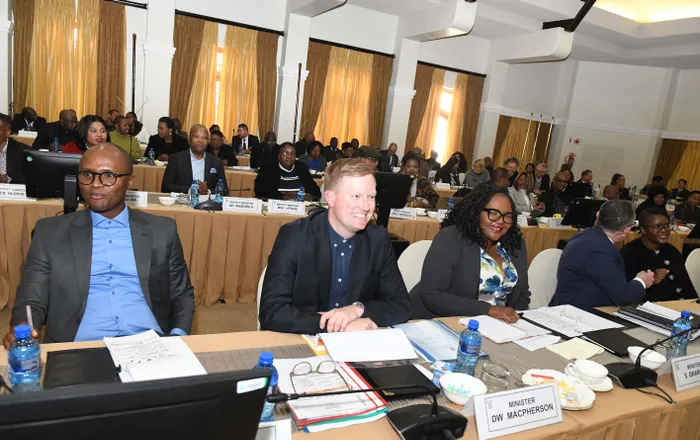
Democratic Alliance Ministers in President Cyril Ramaphosa's Cabinet (from left) Solly Malatsi, Dean Macpherson and Siviwe Gwarube at the inaugural GNU Cabinet Lekgotla held at the Sefako Makgatho Presidential Guest House in Pretoria on July 13, 2024. While it is early days for the GNU, the DA showed its colours by not putting South Africa first by siding with Gwarube when she boycotted the signing of the transformative BELA Act, says the writer.
Image: GCIS
Edwin Naidu
Since the dawn of democracy, the ANC has controlled the country’s education lever with an iron-fisted transformative approach committed to bringing about redress and ensuring access without apparent focus on the return on investment for South Africa.
Gone was the racist apartheid-era spending on children according to the colour of one’s skin. In its place was an amalgamated single education system for all. That is well and good, but missing has been any reflection on whether the nation has been adequately served in terms of getting value for money spent.
Education was chief among the bedrock of the ANC's promise of “a better life for all”, along with social welfare, housing, health, and other competing priorities. But the slow economic growth and high unemployment rate counter the transformative good.
South Africa's education spending since 1994 has seen significant increases, with budgets growing to over 5% of GDP by the 2010s to tackle apartheid inequalities, but faced recent real-term cuts and pressures, especially in basic education, leading to declining per-learner spending despite increased overall government allocation. Post-School Education & Training (PSET) has seen rapid growth (especially NSFAS), but that later slowed, creating funding challenges for universities and TVET colleges by the mid-2020s.
Arguably, three decades after apartheid, more citizens enjoy access to education at schools and the tertiary sector than under apartheid. The sore point is that the schooling system, once consistently lampooned by the Democratic Alliance, until it recently discovered the taste of power via Uber Eats as a member of the ruling elite through the Government of National Unity (GNU).
While it is early days for the GNU, the DA showed its colours by not putting South Africa first, showing it was the party first by siding with Gwarube when she boycotted the signing of the transformative BELA Act.
Thus, the question around the state of education in the first year of the GNU is relevant as the silence of DA on many challenges which remain. It begs the question whether the party that made opposition an art, specifically targeting former long-serving Minister Angie Motshekga, has lost its voice on what matters most for citizens?
There are still far too many challenges in education, but one of the first, which preceded the appointment of Gwarube as Minister, was a report from the 2030 Reading Panel, which revealed that about 80% of grade 3 pupils in South Africa are unable to read for meaning in any language, underscoring a critical literacy crisis in the country. As a legacy issue, she has work to do to change this narrative.
Next up is the annual matric celebration. Motshekga and her predecessors celebrated matric annually despite the fact that more than 300,000 matriculants annually joined the unemployment statistics. If the DA cares about South Africa with the same fervour it shows towards its leader’s family food binge, then expect Gwarube to be the chief cheerleader as part of next month’s matric circus celebrating a flawed education system.
For her part, Gwarube has to deal with much tackling overcrowded classrooms, lack of libraries, desks, and essential supplies, plus the slow eradication of pit toilets. The inconvenience of responding to breaches, like the recent leak of matric exam papers, and strengthening security, was another blight that usually brings condemnation. But don’t expect the DA to have anything negative to say about their own when their mouths are chomping full at the bunny.
On the higher education front, under the GNU, Higher Education was split from Science/Innovation, with Nobuhle Nkabane the new chief in charge following a lengthy Blade Nzimande reign, which proved good for his SACP comrades who were put in charge of SETAs. But her tenure was short and ended in July 2025amid allegations of interference concerning the appointment of Seta Board Chairs.
Step into the hot seat, the long-serving deputy, Buti Manamela. He had a moderate start to his tenure, and he seems measured and decisive, depending on which way you look at his actions. He has had to deal with the ongoing hot potato of the National Student Financial Aid Scheme (NSFAS). The funding agency lost its chairperson and announced it would be facing a R14 billion budget deficit. In any other language, that would amount to a crisis.
No Minister has shown the mettle to find a solution that benefits citizens instead of well-paid administrators. Perhaps the old way of universities managing funding should be considered to avoid corruption. Irregular expenditure in education amounts to R60 billion over four years, thus highlighting urgent restructuring to ensure taxpayer funds yield tangible student outcomes. Manamela must address the elephant in the room.
But he already showed poor leadership when the Sector Education Training Authority (SETA) hot potato fell into his hands. Sadly, it was business as usual under his watch, too. Despite a period of uncertainty in which Seta CEOs were supposedly on the chopping block, they were reappointed anyway.
One of the controversial reappointments was that of his friend Gugu Mkhize, the flamboyant chief executive of the Insurance Sector Education and Training Authority (Inseta), whose reward for years of underperformance, audit failures, and irregularities was another five-year term.
Manamela must like Mkhize to keep her in office despite a pathetic track record, which shows she failed miserably to account for taxpayers' money. Under Mkhize’s leadership, Inseta has received four consecutive qualified audits from the Auditor-General of South Africa. To keep her in the position shows a disregard for governance. She is not alone as a failing Seta leader. But for Manamela to ignore such a red flag speaks to the bond they share.
Mkhize has exposed the Seta to a potential R200 million damages claim and has been implicated in highly irregular procurement practices and allegations of ghost learners, system inefficiencies, delayed learner certificates, and purging of staff who dared to challenge questionable decisions and alleged abuse of power.
With friends like Manamela, why worry or obey the law and account for taxpayers’ monies?
Collectively, Setas have collected R164 billion in revenue for the last 13 years – apart from Mkhize, many a CEO has allegedly squandered money and failed to deliver in light of the Auditor-General’s prescription. So much for ROI when fatcats like Mkhize are enriching themselves – at the expense of skills development.
Pleas from Organisation Undoing Tax Abuse (OUTA) to act on Mkhize and others like her have been ignored. If Manamela is serious about restoring integrity and effectiveness to the SETA system, certainly reappointing CEOs with poor performance records was not a good way to show it.
While the jury remains on Basic Education and Higher Education and Training, with billions thrown towards creating a learning and a learned nation, the GNU has reshaped education portfolios and introduced multiparty oversight. But is South Africa getting a proper ROI for its heavy investment in education?
Gwarube must up her game. Manamela has to do more to ensure that NSFAS delivers, along with the noose around his neck, Setas, for measurable educational outcomes. For the GNU, the challenge is to turn fiscal largesse into student success from school to the tertiary level. No excuses, just accountability. It’s harder when some leaders spend more time on Uber Eats than on education.
* Edwin Naidu is a strategic communications expert in financial services, driving mentoring and dialogue initiatives in higher education through Higher Education Media Services.
** The views expressed do not necessarily reflect the views of IOL, Independent Media or The African.