
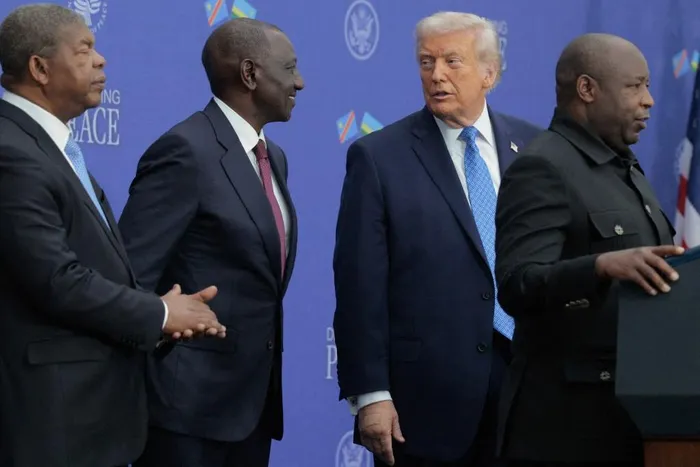
U.S. President Donald Trump with African leaders (from left) Angolan President Joao Lourenco, Kenyan President William Ruto and Burundi President Evariste Ndayishimiye during a peace accord signing ceremony between Rwandan President Paul Kagame and Democratic Republic of Congo President Felix Tshisekedi at the Donald J. Trump Institute of Peace on December 04 in Washington, DC.
Image: AFP
Kim Heller
Donald Trump's second presidential term signals a recalibration of U.S. policy toward Africa that is likely to impact the Continent even more negatively than his first.
The 2025 U.S. National Security Strategy (NSS), released in November, sets out the direction of the new Trump administration. It reveals how Africa is viewed not as a partner in development or stability, but as a geopolitical battlefield on which rivalries with China and Russia will be aggressively pursued. One can expect a more militarised and politically charged U.S. presence in Africa.
Security agreements are framed around U.S. global competitiveness rather than sustainable or African-centred solutions to conflict and insecurity. This orientation was very evident in the Washington Accords of 4 December. This so-called "peace pact" between the Democratic Republic of Congo (DRC) and Rwanda is hardly a genuine diplomatic win or a sustainable peace plan.
Instead, it is an extractive contract that trades security assistance for privileged access to critical minerals and their supply chains. There is something fundamentally wrong about a country, a leader, or a corporation financially benefiting from conflict or conflict mediation. In the twisted transactional playbook of Trump's administration, peace pacts are no longer moral or diplomatic achievements; they are profitable ventures, rather than being critical steps towards conflict resolution and peacekeeping.
The NSS does not shy away from the fact that U.S. security endeavours in Africa are transactional and geared towards resource extraction. The sweet talk of partnership, mutual benefit, and long-term diplomacy has all but been erased. In its place is a stark, calculated approach in which Africa's instability has become an opportunity to secure strategic assets and advance U.S. industrial and defence interests.
In Trump's geopolitical cartography, Africa's mineral wealth is little more than a means to enable and enrich American global dominance. There is no serious interest in an economic renaissance or a goliath industrialisation drive capable of producing African sovereignty and prosperity. Africa is viewed as a perpetual exporter of raw materials and prized minerals.
It is at the bottom rung of global power relations. The rhetoric of development has fallen away, replaced by a distinct fixation on securing the minerals essential to American technology, defence, and energy industries.
It is very telling that the NSS pays scant attention to Africa, devoting less than a page of the thirty-two-page document to the Continent. The reality is that the Continent matters only insofar as it advances U.S. economic interests and counters the influence of China and Russia.
The NSS is crystal clear that U.S. policy is not about "spreading ideology," but rather about partnerships that promote American interests. This is a candid acknowledgement that diplomacy and democracy can easily be cast aside in the ruthless pursuit of power and resources.
The U.S. has sidestepped the African Union (AU) and key regional bodies as it opportunistically advances a highly selective bilateral approach. Division and fragmentation are not accidental consequences. Fragmentation dilutes Africa's collective bargaining power and weakens its capacity to negotiate deals and partnerships on equal terms. A Continent that is not united is easier to control, manipulate, and plunder.
The U.S. has rewarded compliant African states. Those who dare to declare independent foreign policy postures face the wrath of Trump and are subjected to economic, diplomatic, and political punishment. Africa's independence is respected only when it aligns comfortably with Washington's geopolitical prerogatives.
The U.S. boycott of the G20 Summit in Johannesburg and the decision to exclude South Africa from the December G20 Sherpas meeting in Washington illustrate the coercive nature of Trump's foreign policy. Economic, trade, and diplomatic penalties are weaponised to penalise disobedience. Fragmentation has become an ingrained component of U.S. engagement with Africa. A recalibrated map, contoured on division, suits Washington's geopolitical ambitions.
The Sahel region has presented significant challenges for U.S. foreign policy and military strategy. Mali, Burkina Faso, and Niger have ideologically distanced themselves from Western forces, leading to the historical expulsion of Western military forces. There has been a distinct shift towards Russian security partnerships and support.
The United States' National Security Strategy (NSS) has recognised the Sahel as a critical battleground in the broader contest against Russian expansionism and influence. The U.S. is trying to counter Moscow's presence and influence on the Continent by fostering stronger ties with other Sahelian nations.
The NSS identifies the Sahel as a key focus zone for countering Moscow's influence. This has pressed Washington to expand its military footprint through security partnerships in Ghana and Côte d'Ivoire, and to consider the possible establishment of military bases.
In East Africa, the U.S. is pursuing deeper security alliances with Kenya, Uganda, Ethiopia, and Djibouti, driven by an imperative to counter the growing influence of China and Gulf states. This upscaling of militarisation is justified as a safeguard against insurgency.
However, decades of U.S. military engagement on the Continent have done little to deliver long-lasting security or political stability. Instead, militarisation has often exacerbated cycles of violence.
These military manoeuvres demonstrate a broader strategy of using African territories to unsettle rivals while securing access to a treasure trove of natural resources. The U.S.'s tactical exclusion of continental and regional institutions poses a direct threat to Africa's sovereignty. Ceaseless dependence and exposure to external demands sabotage Africa's capacity to develop self-determined, domestically driven policies and programmes.
The Pan-Africanist vision lies in shatters. Africa must recognise its own strength and stop serving as a willing partner in its exploitation. Agenda 2063, the African Union's blueprint for a self-sufficient and prosperous Continent, urgently needs revitalisation, while the African Continental Free Trade Area (AfCFTA) must be vigorously strengthened.
The Continent's future depends on unity and rejecting external agendas; Africa must develop a collective strategy to counter neocolonial influences and reclaim sovereignty.
If Africa fails to do so, it will remain an undervalued and easily discarded piece in a game of monopoly power. What is unfolding is a refreshed, reversioned form of colonialism. Africa is once again a pawn in a geopolitical gambit controlled by others. Until Africa recognises that sovereignty is not a game, but a lifeline, it will remain in the calculated clutch of others.
* Kim Heller is a political analyst and author of No White Lies: Black Politics and White Power in South Africa.
** The views expressed do not necessarily reflect the views of IOL, Independent Media or The African.