

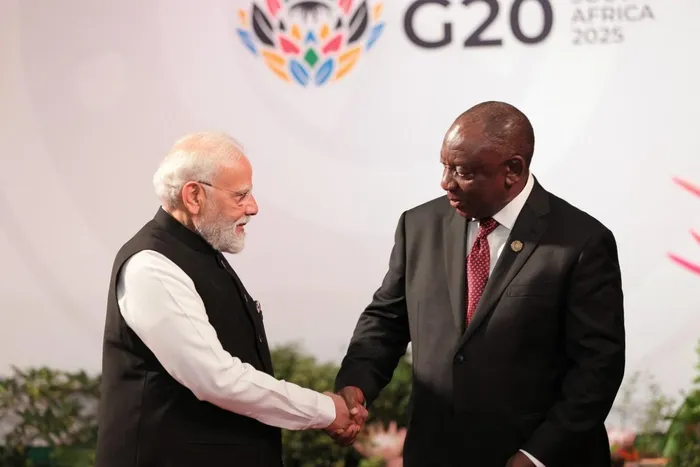
South African President Cyril Ramaphosa welcomes Indian Prime Minister Narendra Modi as he arrives for the opening of the G20 Leaders' Summit at the Nasrec Expo Centre in Johannesburg on November 22, 2025. Modi’s visits to South Africa in November and Ethiopia in December signal India’s strategic autonomy and willingness to uphold principled partnerships despite political and economic pressure from Washington.
Image: AFP
Recent global discussions around the evolving dynamics of multilateral platforms have underscored the importance of inclusivity, dialogue, and respect for the voice of the Global South. Within this context, the role of long-standing partners such as India and South Africa has drawn renewed attention, given their shared commitment to multilateralism and development-oriented cooperation.
India, consistent with its principled foreign policy, has continued to engage constructively with all partners, guided by its longstanding commitment to strategic autonomy, balanced diplomacy, and consensus-based multilateral engagement. It was Prime Minister Narendra Modi after all, who championed the inclusion of South Africa and the AU in the G20 league in the first place.
India and South Africa share deep historical ties and converge closely on issues of development, reform of global governance institutions, and South–South cooperation, including through platforms such as BRICS and IBSA.
In the lead-up to the G20 Summit in Johannesburg in November last year, there was a broader international discourse on the importance of ensuring that multilateral platforms remain representative, inclusive, and responsive to the priorities of developing economies and the Global South. India has continued to pursue a principled and consistent approach, engaging constructively with all G20 partners while steadily strengthening its bilateral relationship with South Africa across trade, investment, and development cooperation. The Prime Minister received a warm reception from South African President Cyril Ramaphosa on his recent visit for the G20 Summit. The visit was followed by high-level engagements in Africa, further reinforcing India’s commitment to deepening partnerships across the continent, including with South Africa, in pursuit of shared growth and development objectives.
As global supply chains shift and new growth poles emerge, India’s rapid economic expansion offers South Africa a natural, reliable, and strategically aligned partner for trade and industrial cooperation.
India today stands among the world’s fastest-growing major economies, recording real GDP growth of about 8.2% in 2023-24 — among the strongest performances globally.
This momentum reflects India’s expanding manufacturing base, sustained policy reforms, and a rapidly maturing digital and innovation ecosystem. For South Africa, at a time when diversification of markets, resilient supply chains, and credible long-term investment partnerships are increasingly vital, India’s economic trajectory presents a timely and strategic opportunity for deeper engagement.
India’s Production Linked Incentive (PLI) schemes have catalysed investments of more than USD 22 billion (approximately ZAR 412 billion) across key sectors including electronics, pharmaceuticals, medical devices, and food processing. These investments have already created over 1.2 million jobs and generated exports exceeding USD 90 billion (around ZAR 1.65 trillion) — underscoring India’s emergence as a competitive and resilient global manufacturing hub.
Regulatory reforms have further strengthened India’s business environment. More than 47,000 compliance burdens have been reduced or digitised, while the National Single Window System has processed over 829,000 approvals, making India’s regulatory ecosystem increasingly transparent and business-friendly. Such reforms signal to global partners — including South Africa — that India is ready for deeper commercial integration.
India’s innovation landscape is also expanding at speed. With over 200,000 recognised startups generating 2.1 million jobs, and domestic patent filings rising nearly five-fold in a decade, India is positioning itself as a major centre of technological advancement. The Open Network for Digital Commerce (ONDC), which has already facilitated 326 million transactions, highlights India’s capacity to scale digital commerce like few nations in the world.
And the country’s infrastructure modernisation, anchored by the PM GatiShakti National Master Plan, is integrating logistics networks, reducing transport bottlenecks, and improving supply-chain reliability. These efficiencies benefit all trade partners — especially those seeking stable long-term arrangements.
For South Africa, India’s economic momentum aligns directly with national priorities of industrial growth, diversification, value addition, and export expansion. The complementarities between the two economies are deep and structural.
India’s rising demand for critical minerals — manganese, chrome, vanadium, and platinum — links naturally with South Africa’s world-leading resource base. As India accelerates renewable energy deployment, electric mobility, and green hydrogen programmes, South Africa becomes a strategic mineral partner for Indian industry.
Long-term supply agreements, beneficiation ventures, and clean-technology collaborations can anchor a new era of India–South Africa industrial partnership.
Agriculture offers another strong synergy. India’s growing middle class is driving rising demand for premium imported produce. South Africa’s citrus, grapes, apples, macadamias, avocados, wine, and floriculture already enjoy a global reputation.
With targeted market strategies, these exports can expand significantly in India, one of the world’s largest and most rapidly modernising consumer markets.
India’s global leadership in pharmaceuticals, diagnostics, and medical devices creates opportunities for South Africa to strengthen its healthcare system with affordable, high-quality imports, while exploring joint R&D, manufacturing, and digital health solutions.
In technology, India’s digital public infrastructure — including digital payments, identity systems, and e-governance tools — offers replicable models for South Africa’s own digital transformation. Partnerships in fintech, cybersecurity, AI, e-commerce, and government service delivery can support South Africa’s drive toward inclusive digitalisation.
India’s automotive and engineering sectors align naturally with South Africa’s manufacturing capabilities. As the world’s third-largest automobile producer, India can partner with South Africa in components, tooling, R&D, and market expansion across Africa and Asia.
Beyond economics, the India–South Africa relationship is anchored in shared democratic values, historical connections, and sustained cooperation in IBSA, BRICS, G20, and multilateral reform efforts. This political trust gives the economic partnership a firm and enduring foundation.
As global value chains realign and new growth centres shape the economic landscape, India stands out as a stable, ambitious, and opportunity-rich partner. South Africa, with its strong resource base, agricultural strength, industrial capabilities, and continental connectivity, is uniquely positioned to engage with India in a transformative way.
Deepening India–South Africa trade relations is not only economically prudent — it is a strategic investment in shared prosperity, industrial renewal, and long-term growth.
In a show of solidarity and further strengthening of ties between India and South Africa, both Modi and Ramaphosa met on the sidelines on the G20 last year, and agreed to work jointly to amplify the voice of the Global South. Ramaphosa also assured Modi of South Africa’s full support to India’s upcoming chairship of BRICS in 2026.
* Mkhuma is a veteran journalist, former editor of the Pretoria News, and Editor: Higher Education Media Services.