

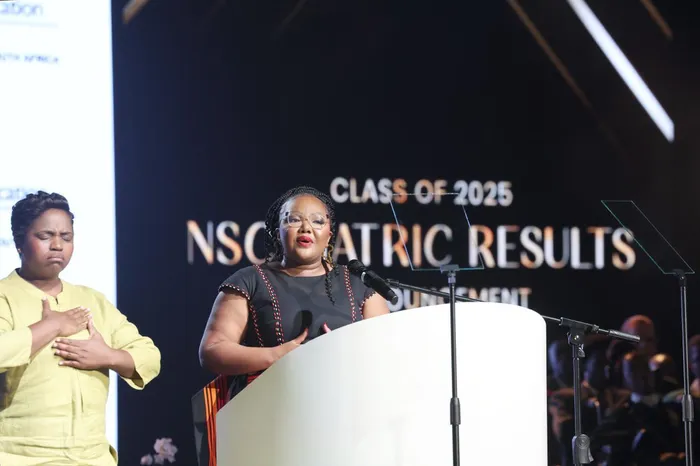
Basic Education Minister Siviwe Gwarube releasing the Class of 2025 matric results on Monday.
Image: GCIS
“Parents and the public need to hear about education and education views from people other than politicians.”
That is a good piece of advice that can be very helpful at this time of the year, fellow South Africans.
With the mechanical regularity of a well-functioning clock, we have once again arrived at this point in time when we pause to celebrate, analyse and engage in debates about the latest cohort of matriculants.
There is nothing wrong in celebrating achievements big and small and by the lucky Lindiwes as well as the not-so-lucky Siphos from underprivileged backgrounds who excel against all odds. And there is also nothing wrong in engaging in debate about the "real pass rates", the state of “our education” and so on. However, there is everything wrong in wasting time on the misguided – or deliberately distorted and populist – 50% versus 30% pass mark debate.
As a journalist whose job it is to tell the truth, spread credible news and generally tell real fact-based stories – record history as it happens and as is, as we say in the industry – this used to trouble me a lot, this “30% pass mark” false debate. That was until some time ago when I heard Professor Mary Metcalfe share the advice she got from a visitor from South America in the early 1990s about who to and who not to listen to on such subjects.
In plain English, the advice is: don’t listen to politicians, or at least listen to only those that are also education experts qualified to enter the arena.
Experts like Metcalfe explain very clearly that “there’s a range of skill and learning opportunities” and the matric exams are “not only about university”. There are “multiple pathways” in our national qualification framework, and, important of all, “there is no such thing as a 30% overall pass mark”.
Indeed, there are many real debates to be had about our education system. Basic Education Minister Siviwe Gwarube spoke of the Lindiwes and Siphos of democratic South Africa on Monday evening. But I didn’t hear her proffer a real cure for the persistent inequality that continues to separate these children and determine their fate more than three decades after democracy.
Each year it seems the more things change, the more they stay the same. And as we celebrate some real achievements at such times, we cannot but lament the wasted potential and deferred dreams of equal and free education.