
Education can be a powerful tool for building global peace, fostering unity among diverse communities, and promoting mutual understanding, says the writer.
Image: SUPPLIED
As we mark the International Day of Education on 24 January, an urgent question confronts us: what role can education play in building global peace?
We often speak of our desire to live in a united community – a community in which people of different backgrounds and classes live together peacefully and enjoy mutual prosperity. How do we create such a community?
At the heart of such an endeavour lies education – understood in its fullest sense. Beyond the transmission of information, or the preparation for employment, education can shape attitudes, values, and patterns of behaviour. It can help individuals see themselves not merely as members of a particular group, but as part of one human family, responsible for the well-being of the whole.
“… Bahá’u’lláh considered education as one of the most fundamental factors of a true civilization. This education, however, in order to be adequate and fruitful, should be comprehensive in nature and should take into consideration not only the physical and the intellectual side of man but also his spiritual and ethical aspects”.
To promote social integration, our educational programs must cultivate mutual tolerance, love, compassion, understanding, humility, and an active commitment to justice.
According to the Bahá’í Writings: “Peace stems from an inner state supported by a spiritual or moral attitude, and it is chiefly in evoking this attitude that the possibility of enduring solutions can be found”.
Our educational systems and programs must encourage unity in diversity. Our school curricula must become an instrument for promoting peace, and the belief in the oneness of humanity must be cultivated in our children throughout their education. Furthermore, our educational programs and activities must be free of all forms of prejudice whether racial, religious, national, gender-based, of class or creed or ethnic group.
To teach our children the concepts of justice and fair-mindedness is an important aspect of an education that contributes to peace. According to the Bahá’í Writings: “Children must be so raised as to regard every soul, irrespective of religion, ethnicity, or any other affiliation, as a fellow human being and to hold dear the words [of Bahá’u’lláh] that capture the spirit of the age: “The tabernacle of unity hath been raised; regard ye not one another as strangers. Ye are the fruits of one tree, and the leaves of one branch”.
Furthermore, education must be examined in light of its contributions to individual growth, and to bringing about transformation in society, which are necessary for the creation of just, peaceful, and harmonious communities.
“The values, attitudes, and skills taught through the various educational programs must also be translated into action”, states the Bahá'í International Community, and that they should “foster an ethic of service to the entire human race, including one's family, neighbours, community, and nation; and provide the practical means for its expression in the education process through service-oriented programs”.
Through serving humanity, the principles that underpin a cohesive society are made visible: compassion, tolerance, understanding, sacrifice, humility, and commitment to justice. Service not only strengthens communities in practical ways; it also forges lasting ties of solidarity and common purpose.
For feedback please contact: secretary.nsa@bahai.org.za or (011) 801 3100
Websites: www.bahai.org, www.bahai.org.za
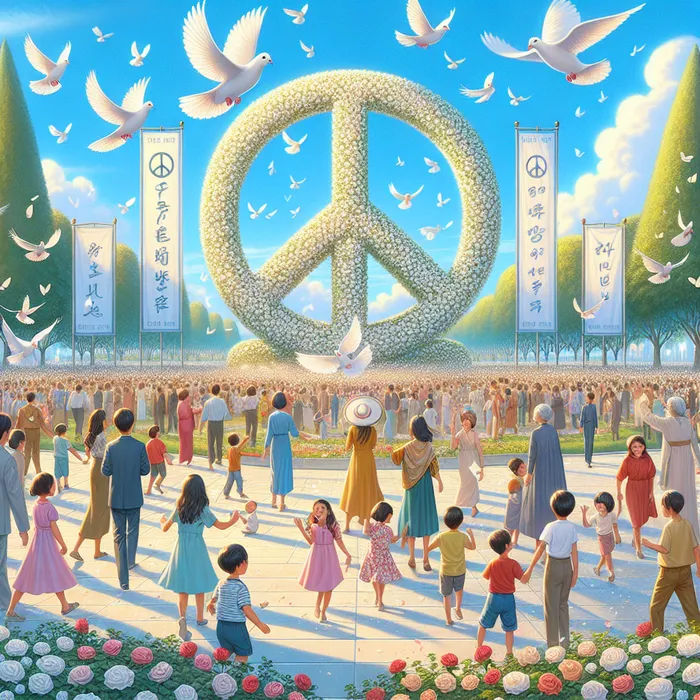
Education can be a powerful tool for building global peace, fostering unity among diverse communities, and promoting mutual understanding, says the writer.
Image: Ron AI/ Independent Media