
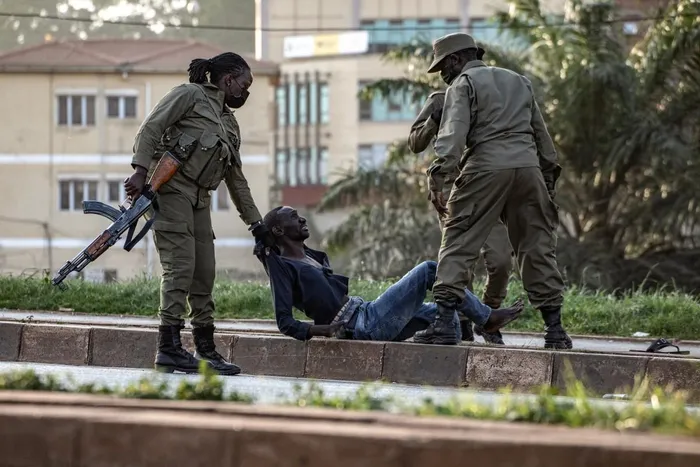
Police officers detain a voter on the ground near a polling station in Kampala on January 15, 2026, during Uganda's 2026 general elections. President Yoweri Museveni was re-elected for a seventh term in office.
Image: AFP
Kim Heller
Most Ugandans are under 30 years of age. They have never known a President other than Yoweri Museveni, who has been in power for forty years. The 81-year-old is one of the world's longest-serving presidents.
With a stronghold over Parliament, his tinkering of the Constitution and a cabinet which includes family members in key and influential roles, it looks like the Museveni name will continue to dominate the political topography of Uganda.
This week, Shola Lawal, writing for Al Jazeera, reported that analysts have warned that Museveni's control over Uganda appears absolute. She also writes that the appointment of his son, General Muhoozi Kainerugaba, as army chief in 2024 has triggered "worries among activists of a dynastic succession plan in the near future".
The outcome of Uganda's presidential election, held on 15 January 2026, brought no surprises. Museveni won 72% of the vote. Major presidential contender Robert Kyagulanyi, a former musician turned politician who is popularly known as Bobi Wine, secured just 25% of the vote. He has dismissed the election results, citing widespread irregularities and acts of intimidation.
The election took place amidst an internet blackout and a hefty military presence. Reports of post-election raids and detentions have fuelled concerns that the election was no exemplary display of democracy. Museveni is a master in the art of managed power. His blatant manipulation of the Constitution has licensed his ever-extending political reign.
In 2005, limits on presidential terms were dismissed, and thirteen years later, in 2018, the age cap for presidents was rescinded. By using its parliamentary majority, the ruling National Resistance Movement (NRM) has subordinated the judiciary in Uganda, turning it into a useful tool for maintaining elite power and incumbency.
Participation in January's presidential election (52%) was the lowest since Uganda recommitted to multi-party democracy in 2006. This level of voter disengagement should be a warning sign for the Museveni regime. Uganda cannot be called a functioning democracy when opposition parties and leaders have to contend with threats of violence and arrest.
Under the cover of darkness and internet blackouts, the ugly hand of oppression is visible. In the lead-up to the election, state security disrupted political rallies of their opponents, harassed and detained activists, and tried to intimidate journalists. These tactics are from the same old playbook used in prior elections, where dissent was violently snuffed out.
The African Union (AU) formally congratulated Museveni on his victory. It urged all parties to accept the outcome. This is a signature AU protocol that prizes stability over democracy. The AU has failed to demand accountability from long-standing leaders who have ushered in constitutional coups and maintained elite power relations.
Global reaction to the election has been almost indifferent. Uganda's importance as an economic and military partner appears to have muted concerns about a compromised election or the nation's overall democratic temperature. For Western players who count on Uganda as a partner in counter-terrorism initiatives in the Horn of Africa, there are too few murmurs about electoral irregularities.
Democracy is treated as an optional extra. As long as stability is maintained for economic prospecting, foreign nations are generally satisfied. The Western world, reliant on Uganda for counter-terrorism efforts in the Horn of Africa, may, from time to time, issue mild calls for dialogue but avoid sanctions that could disrupt alliances.
Markets and investors look favourably on Uganda. They hardly appear to be concerned about electoral unfairness in the 'Pearl of Africa'. They are simply interested in Uganda's geopolitical and economic riches. There are rich pickings.
Production at the Lake Albert basin, which contains billions of barrels of crude, is scheduled for late 2026. Construction of the East African Crude Oil Pipeline, which will connect Uganda's fields to the coast of Tanzania, is set to begin soon. While this is intended to upscale regional integration and economic growth, it is likely to be a windfall for investors first and foremost.
Oil can flow freely, but under the Museveni administration, it is unlikely to be used to uplift ordinary citizens. Every year, almost 700,000 young Ugandans seek employment in an economy that typically creates fewer than 100,000 formal jobs annually. Youth unemployment exceeds 40%, which is a political and economic crisis in the making.
Unless Uganda's oil boom directly translates into jobs and better service infrastructure, particularly in the rural areas, the sorry tale of extraction and unfair distribution will continue. A worthy President would ensure that the country's wealth benefits local people, not foreign interests. Museveni has failed in this respect.
Uganda ranks as one of the world's most corrupt countries, according to the latest 2024 Transparency International Corruption Perceptions Index (CPI), ranking 140th out of 180 countries surveyed.
In this new term, Museveni should focus on restoring institutional integrity and independence and curbing corruption. He is unlikely to do so. A secure President does not fear but encourages a political culture that embraces political dialogue and dissent as critical facets of a working democracy. Museveni has failed this test in his previous terms. It is unlikely he will shift now.
The issue of succession is troubling. Speculation is rife that Museveni's son, General Muhoozi Kainerugaba, could be the party's next presidential candidate. This dynastic transfer of power would undermine the NRM's credibility and betray its liberatory roots. The prospect of family rule could do more damage to the ruling party than any political opposition could.
Uganda's elite-managed democracy will not continue forever. Eventually, a wave of discontent over generational political and economic exclusion will rise. It may not be now. But it is inevitable.
* Kim Heller is a political analyst and author of No White Lies: Black Politics and White Power in South Africa.
** The views expressed do not necessarily reflect the views of IOL, Independent Media or The African.