

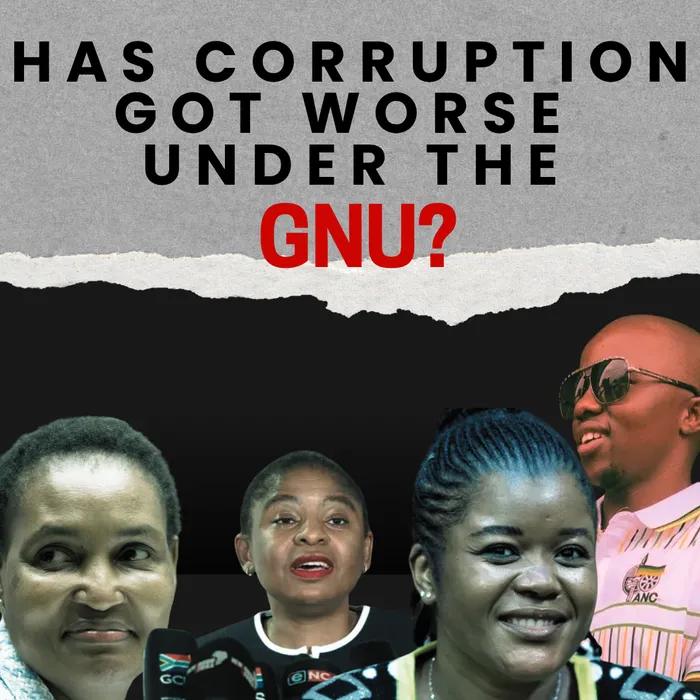
One year after the formation of South Africa’s Government of National Unity, civil society watchdogs say corruption is not only ongoing but worse in some departments.
Image: IOL Graphics
South Africa stands at a crossroads, not because it lacks vision or resources, but because it has gradually abandoned a simple, powerful principle: leadership should be earned. Over time, merit has been replaced by entitlement, performance by symbolism, and accountability by political loyalty. The result is a state where the right to govern is often assumed rather than proven.
Imagine a political system where leadership is not decided by access to money, liberation credentials, demographic categories or factional alignment, but by demonstrated capability. A system where those who rise through the ranks do so because they have delivered results repeatedly, under scrutiny, and over time. Where governance is treated as a serious profession rather than a reward. There are governance models around the world that operate on this logic. In such systems, leadership advancement is slow, demanding and highly competitive. Individuals are tested at multiple levels of responsibility before being entrusted with greater power.
Failure is not romanticised or excused. It is corrected, and if persistent, it disqualifies one from advancement. Success is measured through outcomes, not rhetoric. In these environments, populism carries little weight. Handouts do not substitute for economic growth. Charisma does not replace administrative skill. Identity alone does not confer authority. Leaders are expected to manage complexity, deliver development, maintain institutional stability and improve the material conditions of citizens. Power is conditional, not permanent. South Africa, by contrast, has increasingly confused historical justice with present-day governance. While redressing past injustice remains morally necessary, it cannot become an excuse for poor performance. A transformation that lowers standards is not a transformation at all. It is neglected, dressed in progressive language.
We have normalised cadre deployment over professional administration. Political loyalty has overtaken competence as the primary qualification for office. Representation is often celebrated even when results are absent. This has hollowed out institutions and weakened the state’s capacity to execute its own policies. True inclusion should widen access to excellence, not shield mediocrity from scrutiny. When accountability is suspended in the name of history or identity, the consequences are borne by ordinary citizens. Poor governance does not punish elites. It punishes those who rely on public services, infrastructure, safety and economic opportunity. A culture of entitlement has taken root in politics. Once elected, leaders behave as though office is owed indefinitely, regardless of outcomes.
Failure is externalised, blamed on inherited conditions or global forces long after those explanations lose relevance. Internal criticism is framed as betrayal rather than an opportunity to improve. Merit-based leadership is uncomfortable because it exposes weaknesses. It asks difficult questions. Can you manage public finances responsibly? Can you deliver infrastructure on time and within budget? Can you build capable teams and remove underperformers? Can you grow the economy and create jobs? These questions are politically dangerous in a system that prioritises unity over honesty.
South Africa does not suffer from a lack of capable people. It suffers from a lack of incentives for the capability to rise. Skilled individuals are often marginalised by those with stronger political connections. Over time, incompetence reproduces itself, and institutions decline further. Too often, we celebrate leadership appointments for what they symbolise rather than what they deliver. Age, gender and struggle history are treated as governing credentials instead of social realities. While these factors matter in understanding inequality, they do not manage power stations, fix logistics networks or reform education systems.
A merit-driven political culture would demand measurable targets, independent evaluation and real consequences for failure. It would force political parties to take governance seriously rather than treating the state as a site of patronage. Leadership would become something that must be earned repeatedly, not inherited once. The question is not whether South Africa needs justice, compassion or inclusion. It needs all three. The real question is whether we can continue to choose leaders based primarily on what they represent instead of what they can do. History does not govern. Identity does not administer. Competence does. Until merit becomes non-negotiable, we will continue to recycle disappointment while mistaking it for progress.
*Mayalo is an independent writer and the views expressed here are not necessarily those of Independent Media