

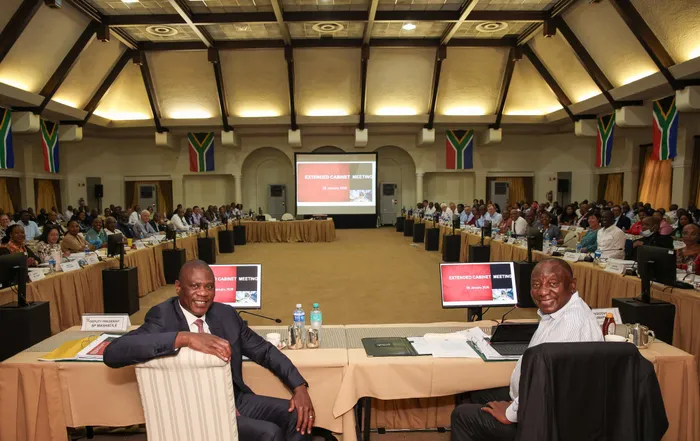
President Cyril Ramaphosa (right) and his Deputy Paul Mashatile at the Cabinet Lekgotla held in the Sefako Makgatho Presidential Guesthouse, Pretoria on January 28. Until ethical leadership is practised as rigorously as it is proclaimed, South Africa will remain trapped in a cycle of commissions, says the writer.
Image: GCIS
Dr. Clyde N. S. Ramalaine
South Africa does not suffer from a shortage of commissions, reports, interim findings, or public declarations against corruption. What it suffers from is something far more corrosive: a deficit of ethical leadership willing to consistently apply accountability, without fear, favour, or political calculation.
President Cyril Ramaphosa’s recent announcement, following the interim report of the Madlanga Commission, instructing the Minister of Police to establish a unit to investigate a limited number of police officers, is, on the surface, a welcome gesture. Yet it is precisely within the gap between the announced action and the withheld accountability that South Africa’s ethical crisis reveals itself most starkly.
Beneath this veneer of responsiveness lies a troubling ambiguity. The public is encouraged to applaud decisive language while being expected to ignore conspicuous omissions. Certain figures, controversial and publicly implicated, remain shielded.
The continued insulation of General Shadrack Sibiya and Police Minister Senzo Mchunu, despite serious allegations aired before the Commission, raises unavoidable questions. Why does accountability stop where political inconvenience begins? Why does a commission reporting to the President appear restrained in its willingness to confront power directly?
Ethical leadership is not the performance of outrage, nor the selective activation of consequence. It is the refusal to shield some while sacrificing others. It is precisely this selective morality that now places a question mark over both the Madlanga Commission’s posture and the President’s ethical compass. This inconsistency cannot be examined in isolation from the governing party that claims moral primacy over the republic.
The ANC and the Claim to Lead Society
Any serious engagement with South Africa’s ethical crisis must begin with the African National Congress’s enduring claim that it is the “leader of society.” This assertion is repeated so often that it is treated as axiomatic rather than interrogated.
But what does leadership of society actually mean? Is it merely an outcome of electoral arithmetic, or does leadership imply moral authority, ethical coherence, and credibility rooted in conduct?
Nowhere is this contradiction more visible than within the ANC’s own internal democratic processes. The party’s invocation of ethical leadership is rendered hollow by its conduct at its most recent Johannesburg Regional elective conference. Despite assurances of a free and fair process, validated by national and provincial overseers, ballot papers were later discovered discarded in a private yard.
What is most troubling is not merely the discovery of the ballots, but the ANC’s reflexive attempt to distance itself from an electoral process it itself staged, managed, and administered. The claim that “the ANC wishes to distance itself from the ballots found in someone’s yard” exemplifies a political art form the party has perfected: the ability to be simultaneously omnipresent and absent, asserting authority when convenient, disowning responsibility when confronted with misconduct.
This duality is not only implausible; it is an affront to logic and a betrayal of democratic accountability, particularly from a party that insists on presenting itself as the ethical vanguard of South African society. Leadership cannot be claimed solely through historical entitlement. It is recognised when authority is exercised in a manner that commands trust, consistency, and moral clarity. A movement that governs through selective accountability forfeits the legitimacy it claims.
What Ethical Leadership Demands
To understand this failure, one must move beyond rhetoric and turn to established frameworks of ethical leadership. Scholarly literature is unambiguous. Ethical leadership is defined not by verbal commitments to integrity, but by demonstrable consistency between values and action.
Thinkers such as Brown, Treviño, Harrisson and Ciulla emphasise fairness, transparency, accountability, and the courage to confront wrongdoing even when it implicates allies. They articulate ethical leadership as ‘the demonstration of normatively appropriate conduct through personal actions and interpersonal relationships, and the promotion of such conduct to followers through two-way communication, reinforcement, and decision-making.’
Ethical leaders do not outsource morality to commissions while reserving discretion to ignore inconvenient findings. Nor do they allow institutional processes to become instruments of political containment. Ethics, in leadership theory, is inherently disruptive. It demands that power be subjected to principle, not the other way around.
Measured against this framework, the present moment is deeply troubling. The Madlanga Commission’s interim recommendations, while procedurally framed, appear politically cautious. South Africans will not know, because the interim report has been deliberately withheld from public scrutiny. The President’s response follows a familiar pattern: decisive where the cost is low, hesitant where the political price may be high. This is not ethical leadership; it is risk management masquerading as reform.
A Pattern, Not an Aberration
This ambiguity does not arise in isolation. It fits into a broader pattern that has long shadowed President Ramaphosa’s ethical standing. From Marikana to Phala Phala, from the missing Covid-19 billions to unresolved questions surrounding the funding of his 2017 ANC presidential campaign, his leadership has repeatedly been accompanied by ethical uncertainty.
Marikana remains an open moral wound, symbolising the lethal convergence of state power and capital, and a failure of accountability at the highest levels. Phala Phala exposed contradictions between the President’s reformist image and his private financial conduct. The Covid-19 procurement scandals unfolded under his leadership as billions vanished while citizens were urged to sacrifice in the name of national solidarity.
Individually, none of these episodes conclusively establishes guilt. Collectively, however, they form a troubling ethical profile: a leadership style that survives not by confronting scandal decisively, but by outlasting it procedurally. Ethics, however, is not measured by legal survivability; it is measured by moral clarity. I fear no reprisal in stating plainly that President Ramaphosa stands as the clearest signpost of this compromised ethical leadership.
The Subservience of Oversight
Perhaps most alarming is the apparent compliance of institutions constitutionally mandated to restrain executive power. A judicial commission reporting to the President cannot afford even the perception of deference. When commissions appear selective in their courage, they erode confidence not only in their findings, but in the broader architecture of constitutional accountability.
South Africans are entitled to ask, plainly and without apology: Is the Madlanga Commission exercising independent ethical judgment, or merely navigating the boundaries of political acceptability?
From the outset, I cautioned against this high risk, pointing to the composition of its leadership and those leading witnesses as reflective of entrenched status quo interests. When implicated individuals remain untouched while others are publicly exposed, the message is unmistakable: justice is being negotiated, not principled. This, too, is the inheritance the ANC’s factional interests have bequeathed to South Africa.
This concern extends into parliamentary oversight. Parliament’s Ad Hoc committees on crucial matters too often descend into performative theatrics rather than principled scrutiny. In the glare of spectacle, accountability is reduced to partisan exhibition, and constitutional responsibility is sacrificed to political point-scoring.
The Need for an Ethical Reset
South Africa stands at a crossroads. The crisis it faces is not merely one of governance, but of ethical imagination. What is required is a reset, one that redefines public office as a site of moral responsibility rather than strategic survival.
This reset demands clear ethical standards for public office bearers, transparent mechanisms of accountability, and the political will to act against wrongdoing regardless of rank or affiliation. It requires leadership that understands that authority is not about managing perception, but about embodying principle.
Until ethical leadership is practised as rigorously as it is proclaimed, South Africa will remain trapped in a cycle of commissions, the establishment of units without consequence, outrage without reform, and leadership without moral authority.
The nation does not need more declarations against corruption. It needs leaders willing to stop choosing who deserves accountability. Only then can the ANC credibly claim to lead society, not by dominance, but by example.
* Dr Clyde NS Ramalaine is a Political Analyst, Theologian, and Commentator on Politics, Governance, Social & Economic Justice, Theology, and International Affairs
** The views expressed do not reflect the views of the Sunday Independent, IOL, Independent Media, or The African.