
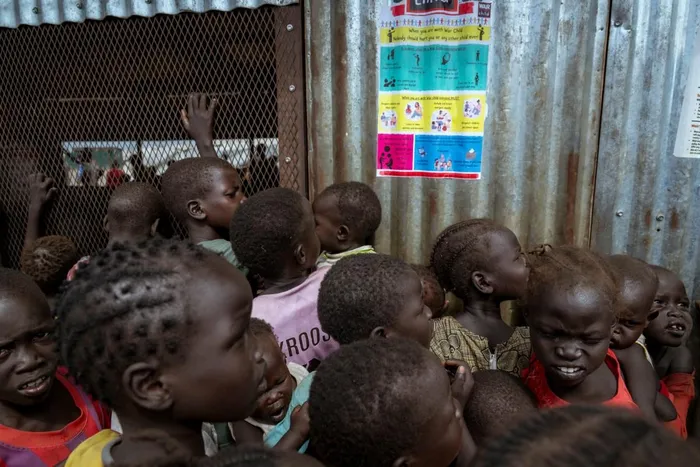
A group of children scrambling to enter a safe-space classroom managed by War Child Holland at the Renk Transit Center in Renk, South Sudan, on November 17, 2025. Millions of young Africans are currently in perilous predicaments, horribly unprotected by AU peace policies and processes, says the writer.
Image: AFP
Kim Heller
This week, the Chairperson of the African Union Commission, H.E. Mahmoud Ali Youssouf, announced the appointment of H.E. Ambassador Jainaba Jagne of the Republic of The Gambia as the AU's Special Envoy for Children Affected by Armed Conflict (CAAC).
To have a dedicated envoy focusing on the pandemic of children caught in the chaos of war and conflict is an important step and long overdue. The African Union (AU) has framed this appointment as a response to the growing recognition and concern that protecting children in conflict zones is both an urgent humanitarian consideration and critical to achieving lasting peace, stability, and economic development on the Continent.
Protracted war and conflict in Africa have been devastating. Millions of young Africans have been robbed of their childhoods. The African Union has been a poor child-minder. They have watched the wreckage for far too long without taking courageous and decisive action against the perpetrators of the carnage.
The AU should be a powerful shield for young, vulnerable Africans. The Continental body should protect the children of Africa with the protective zeal that comes with parenthood or guardianship.
For decades, the children of Africa have been caught in the Crossfire of war and conflict, helpless, innocent casualties of man-made catastrophes.
Millions of young Africans are currently in perilous predicaments, horribly unprotected by AU peace policies and processes. Reports of ongoing abuse are numbing. There are troubling reports of children being recruited into military groups.
Furthermore, accounts of youngsters forced to leave their homes due to ongoing attacks and trapped in the cruel, inescapable cycle of displacement, indicate the scale of the crisis.
In 2024, it was recorded that there were over 14,000 serious violations committed against children in conflict zones across the Continent. It is estimated that 218 million African children (close to one in every three children) live within fifty kilometres of active conflict, according to Save the Children estimates.
For these children, this level of exposure to violence and danger is not periodic; it is permanent and structural. It is alarming that children as collateral damage in a big people’s war, involving local and foreign players, has almost become normalised. The Silencing the Guns project has been a failure. Far too little has been done to protect children in conflict zones.
In Sudan, children continue to be bombed, displaced, and separated from families in a war that appears to have no end.
In the Eastern Democratic Republic of Congo (DRC), there are horrifying tales of children being injured, raped, or recruited as soldiers.
In the Sahel, as livelihoods collapse, children are forced into armed groups as a survival strategy.
In the ever-volatile Cabo Delgado Province in Mozambique, childhoods are spent in displacement camps. Children never know any other home. Nor do they receive adequate education.
In 2025 alone, millions of African children were not schooled as school buildings were either destroyed or hijacked for military use. Slowly but surely, the children of Africa are becoming a lost generation. Forgotten in the cruel horizon of warfare.
In all these instances of children being caught up in armed conflict, preventative and protective measures have been inhumanely inadequate.
The key question the AU needs to address is whether the plight of children in conflict can be appropriately resolved without a broader commitment to peace on the Continent.
The AU's flagship peace initiative, Silencing the Guns, launched in 2016 with an initial promise to end wars by 2020, a deadline that was later extended to 2030, has been worryingly ineffective.
Conflicts have multiplied rather than diminished. Military and constitutional coups have not abated. Children have paid a high price for the AU's lacklustre enforcement of its policies.
The AU's lack of courage in confronting and stopping the powers that profit from the business of war is negatively impacting the future of the African child.
For as long as statements rather than sanctions are the preferred practice of the AU, war will continue, and children will suffer.
Promises have been broken. Agenda 2063 provided a vision of a peaceful and prosperous Africa. It speaks lyrically about how children will be protected from violence and exploitation. However, in the horror of reality, children are "growing up" in the roar of gunfire.
Legal frameworks are in place, including the African Charter on the Rights and Welfare of the Child. What is lacking is political will and courage. Child protection units in peace operations remain under-resourced.
Early warning systems yield detailed reports that do not trigger motion. Ambassador Jainaba Jagne enters this fraught landscape with a high degree of expertise and knowledge. She is now effectively the mother of the children of the Continent. She needs to fight fearlessly for their rights. Military leaders who force children into being soldiers must face the harshest punishment. Arms embargoes need to be fully enforced. Every peace pact has to give pride of place to protecting children.
The effectiveness of the new Special Envoy will depend on whether the African Union is willing to shift from advocacy to confrontation.
Protecting children in conflict zones requires naming perpetrators, including member states, militias, and external actors.
If the AU fails to do this, the organisation is by all accounts culpable in the ongoing atrocities against innocent children. Across Africa, children cannot continue to be the casualties of war.
The future of Africa depends on safeguarding its children. For now, the outlook is gloomy.
* Kim Heller is a political analyst and author of No White Lies: Black Politics and White Power in South Africa.
** The views expressed do not necessarily reflect the views of IOL, Independent Media or The African.