AU Leaders' Summit: Translating Lofty Promises Into Action
AFRICAN UNION
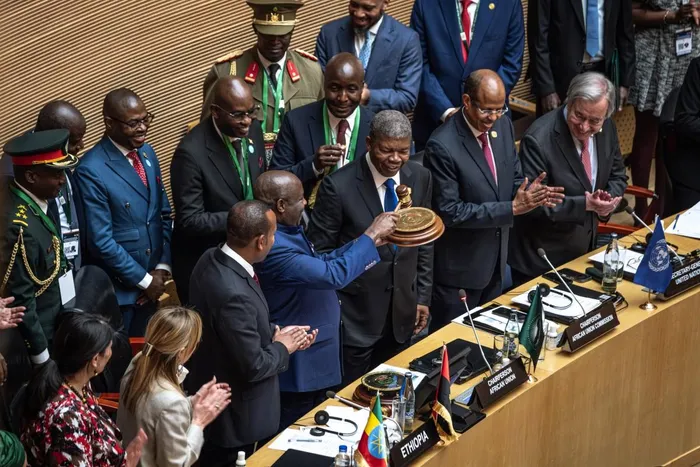
Joao Lourenço (centre), President of the Republic of Angola, hands over the Chairpersonship of the African Union to Evariste Ndayishimiye (centre left), President of the Republic of Burundi, during the 39th Ordinary Session of the Assembly of the African Union at the AU Headquarters in Addis Ababa on February 14, 2026.
Image: AFP
Kim Heller
African heads of state and government gathered in Ethiopia for the 39th Ordinary Session of the Assembly of the African Union on 14th and 15th February.
The Session did well to focus on sustainable water availability and safe sanitation systems. Water availability and access are vital developmental imperatives and are intrinsically linked to achieving the African Union's Agenda 2063. Water scarcity is among the most crucial crises that the African Continent currently faces. It is estimated that 400 million Africans lack sufficient water for their daily needs.
Close to 800 million people across the Continent lack basic hygiene services, with millions dying from waterborne diseases such as cholera and typhoid. Southern Africa is fast becoming a global drought hotspot. The World Bank estimates that water scarcity could cause several African economies to shed close to 6% of GDP by 2050.
The Summit called for greater continental collaboration to marshal resources for water and sanitation, infrastructure, and climate adaptation. The African Ministers' Council on Water (AMCOW) pledged to finalise a continental water policy.
It is envisaged that this policy would include frameworks for investments in irrigation and sanitation infrastructure and would be tabled for approval by the African Union, in preparation for and in alignment with the upcoming United Nations Water Conference.
But there were no binding timelines or dedicated funds set aside for this ambitious project. This should concern all member states, including South Africa, where water systems are under acute strain. As the world enters an age in which water is the new oil, the African Union needs to act with purpose and haste.
Without sustainable water availability and security, poverty, conflict, instability and migration will rise. Systemic water insecurity is a real threat.
Flooded with the usual rhetoric, the Summit was more ritual than resolve. The language of African unity that flowed freely is not novel. It has become routine at these annual gatherings. Ethiopia's Prime Minister Abiy Ahmed spoke of the need to "own the narrative" of Africa's future to drive genuine rather than symbolic sovereignty.
South African President Cyril Ramaphosa stressed the need for continental peace and stability. Zimbabwean President Emmerson Mnangagwa called for Pan-African unity and solidarity. The outgoing chair of the African Union, João Lourenço, and the incoming chair, Évariste Ndayishimiye, also spoke of the need for continental unity and collaboration.
The Peace and Security Council expressed "deep concern" over Continental instability, governance crises, and humanitarian emergencies. There were emphatic calls to "silence the guns" and end unconstitutional government coups. This condemnation has lost its melody and meaning, for it has been a tune sung far too often at previous summits.
A new memorandum of understanding was adopted to strengthen coordination around the African Standby Force. While this is good, what is alarming is that the African Standby Force was conceived more than twenty years ago and has yet to evolve much beyond a splendid vision. This dangerous paralysis severely impacts the state of insecurity across the Continent.
Since 2020, Africa has witnessed a spate of military and constitutional coups. Prolonged conflicts in Sudan and the eastern Democratic Republic of Congo continue to displace millions of people and cause regional rupture and instability. The African Union's repeated declarations of "zero tolerance" for unconstitutional changes of government have never sounded more hollow.
At the gathering, global ambitions were centre-stage. There was a firm demand for two permanent seats on the United Nations' Security Council with veto power for more equitable representation.
The United Nations' Secretary-General, António Guterres, described the lack of African representation as "indefensible" in 2026. The call for two permanent African seats on the UN Security Council with veto power sounds very grand.
However, it is likely to be an empty plea. In principle, it would give Africa a powerful voice on issues related to the Continent. However, the reality is far less potent. Even with these two seats, there is no certainty that Africa will vote as a united bloc. This was evident in 2011 when there was a divided African vote on the fate of Libya.
These two seats are unlikely to be the power thrones the African Union believes they are. There is a sad irony in the African Union pushing so strongly for two seats on the UN Security Council while it fails to rise to the occasion at home.
Africa currently represents over a quarter of the United Nations' membership, yet has been excluded from permanent representation. This imbalance in global governance is part of the legacy of a colonial world order, which has never been remedied.
This is partly due to strong resistance from the current set of permanent members. However, it is also caused by Africa's lack of a unified political strategy on representation.
In an article published in CAJ News Africa on 16 February, Adane Bikila wrote that it is only when Africa acts as a cohesive bloc that Africa can "reshape global norms, champion equitable development, and secure its rightful place in international governance".
For now, the African Union, which should be the major player in delivering a united continent, cannot even deliver binding water frameworks at its own Summit. It has failed to uphold good governance across Africa. It has not brokered peace in Africa's war zones. The African Union needs to exercise political will domestically before it tries to flex its muscle at the United Nations.
The 39th Summit was a lukewarm affair. The air was heavy with expectation and aspiration. However, as always, accountability looks wafer-thin.
* Kim Heller is a political analyst and author of No White Lies: Black Politics and White Power in South Africa.
** The views expressed do not necessarily reflect the views of IOL, Independent Media or The African.