Jesse Jackson's Enduring Legacy in the Fight for Justice and Freedom
TRIBUTE
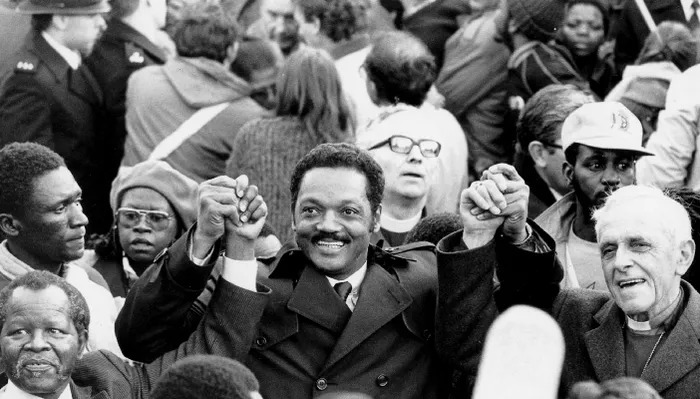
(From left) ANC President Oliver Tambo, US civil rights activist Rev. Jesse Jackson and Anti-Apartheid Movement President Trevor Huddleston at a protest march against the apartheid regime. More than 150,000 people marched from east, west and south London to Trafalgar Square on November 2, 1985 to demand British sanctions against South Africa.
Image: AAM Archives
Dr. Reneva Fourie
The passing of Rev. Jesse Louis Jackson Sr on 17 February represents a profound loss for the global fight for civil rights, human dignity and justice. For South Africans, Rev. Jackson’s death marks the loss of a genuine friend, a fierce opponent of apartheid and an unyielding champion of freedom worldwide.
His life’s work bridged continents and movements, forging connections between struggles against racism in the United States and the fight against apartheid in South Africa. His legacy stands in sharp contrast to leaders such as Donald Trump, whose policies reinforce privilege and division rather than advance justice and peace.
Born into the segregated American South, Rev. Jackson rose from modest origins to emerge as one of the most persistent voices in the civil rights movement. Guided by Dr Martin Luther King Jr, he committed his life to confronting injustice and inequality in every form.
Although his role in the American civil rights struggle is widely recognised, his support for South Africa's liberation occupies a unique and cherished position in the memories of millions here.
From the late 1970s, Rev. Jackson recognised the principled and political urgency of the struggle against apartheid. His commitment intensified following the 1977 death of Steve Biko in police custody, which heightened global awareness of the regime’s ruthless repression and systemic denial of human rights.
In 1979, he travelled to South Africa, addressed audiences in Soweto, and directly criticised the government. His presence and fearlessness underscored his commitment to international solidarity in the fight against racial tyranny.
These visits and statements helped frame apartheid as a moral and political issue for United States audiences. Upon returning, he intensified his campaign to reshape public opinion and policy on apartheid. He organised educational campaigns, rallies, and advocacy to inform United States citizens and broader progressive groups about the situation in South Africa.
A central element of Rev. Jackson's role involved building momentum for economic and diplomatic pressure on the apartheid government. He opposed the Reagan administration’s stance of constructive engagement, which sought to maintain diplomatic ties while purportedly encouraging reform. Rev. Jackson understood that moral condemnation alone was insufficient in the face of sustained state brutality.
Through speeches, protests and political engagement, he steadfastly campaigned for boycotts, divestment and sanctions in support of the ANC’s international solidarity efforts. His actions helped cultivate a climate in which isolating the apartheid state became a moral imperative, laying the groundwork for consequential legislative victories.
The Comprehensive Anti-Apartheid Act, passed by Congress in 1986 over President Reagan's veto, introduced trade restrictions, investment bans and other punitive economic measures.
These sanctions marked a shift in the United States’ international policy. They compounded the economic and political isolation of the apartheid regime and signalled to the world that racial oppression would no longer be tolerated.
Though the collapse of apartheid resulted from innumerable sacrifices, including resistance by South African liberation movements inside and outside the country, and intensified international isolation, economic strain from reduced foreign investment and trade weakened the regime. It contributed to conditions for negotiations in the late 1980s.
Rev. Jackson's efforts also focused on the release of Nelson Mandela and other political prisoners. He consistently supported the ANC in their campaign for Mandela's freedom. When Mandela was released in 1990, and South Africa held its first democratic elections in 1994, Rev. Jackson observed the process as part of international delegations.
Rev. Jackson's influence extended to the post-apartheid era, where he promoted principles of non-racialism and redress for historical inequalities. His advocacy for affirmative action in the United States provided a comparative framework for South African policies addressing economic disparities inherited from apartheid.
On a broader scale, Rev. Jackson addressed human rights and non-racialism across Africa and internationally. He understood freedom as indivisible, recognising that struggles against oppression in the United States were connected to struggles across Africa and the wider world. Appointed in 1997 as Special Envoy for the Promotion of Democracy in Africa by Bill Clinton, he engaged with governments in Kenya, Zambia, Liberia, Sierra Leone, Ghana, and Nigeria.
Globally, he engaged with leaders from various regions, advocating for peace, justice and human dignity. Rev. Jackson applied similar approaches to issues such as the Israeli-Palestinian conflict, where he advocated for negotiated solutions, and responses to health crises like AIDS. His understanding of global liberation movements was informed by his belief in shared humanity and collective action.
This progressive stance stands in sharp contrast to policies advanced under Donald Trump’s second administration, which has aligned with conservative right-wing forces in South Africa to hinder efforts at dismantling the structural elements of apartheid.
Influenced by lobbying from groups such as AfriForum and Solidarity, which promote debunked narratives of white genocide and portray land reform as anti-white discrimination, Trump’s administration cut foreign aid to South Africa, prioritised refugee status for white Afrikaners and excluded the country from the 2026 G20 summit.
These actions reinforce racial divisions by opposing measures to address apartheid’s legacies, such as the Expropriation Act aimed at equitable land redistribution. By framing such reforms as persecution of whites, Trump’s policies echo apartheid-era rhetoric and undermine the non-racial democracy Rev. Jackson helped foster, highlighting a regression from the international solidarity that once pressured the regime to fall.
Rev. Jackson’s legacy demonstrates that progress is not guaranteed and that freedom and justice require vigilance. He combined strategic political action with a vision rooted in universal human dignity.
In doing so, he challenged structures that perpetuate privilege, inequality and exclusion. The contrast with contemporary conservative support for entrenched power in South Africa shows that moral leadership and international solidarity remain critical tools in combating injustice and fostering democratic renewal.
In honouring Rev. Jesse Jackson, South Africans reaffirm the values he championed: courage in confronting oppression, commitment to non-racialism and dedication to building systems that promote justice for all.
His life reminds us that the fight against structural inequality is ongoing and that progressive leadership, grounded in principle and action, is indispensable for creating societies free from the legacies of apartheid and oppression.
* Dr Reneva Fourie is a policy analyst specialising in governance, development and security.
** The views expressed do not necessarily reflect the views of IOL, Independent Media or The African.