
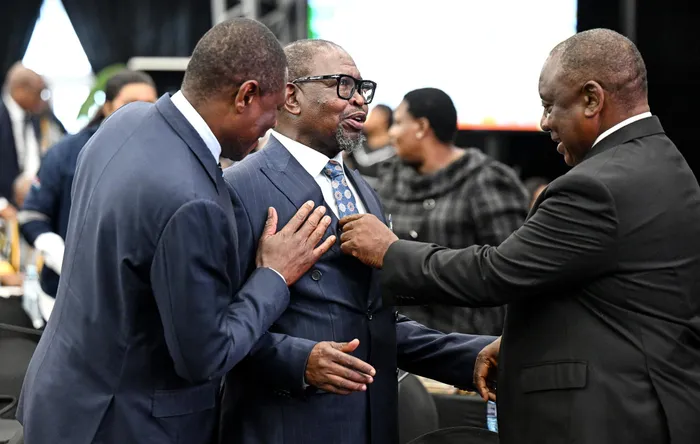
Finance Minister Enoch Godongwana has the final checks to his suit done by President Cyril Ramaphosa and Deputy President, Paul Mashatile ahead of tabling his 2026 Budget. In a society defined by deep inequality, growth cannot be treated as a precondition delivered solely by markets, says the writer.
Image: Phando Jikelo / GCIS
Dr. Reneva Fourie
For most South Africans, the 2026 Budget Vote comes at a time when the need for delivery of affordable, accessible and reliable services supersedes political pacification.
The Government of National Unity represents ideologies that have pulled policy towards market-driven solutions and away from the Constitution's transformative mandate. Yet this year's budget process differs from last year's. Where parties once tore into one another and delayed the budget, the current process has at least produced some measure of consensus.
The economic climate is also more positive than it was a year ago. Debt is stabilising with the budget deficit significantly reduced. Growing the tax base through improved economic activity and compliance, rather than tax hikes, is a positive approach. Although insufficient, marginal GDP growth implies expansion is possible with more productive public investment.
The spending allocation is redistributive. The social wage accounts for over 60 per cent of non-interest spending. Basic education, health and social protection account for 70.3 per cent of the social wage. Of local government funding, R86.9 billion supports free basic services for 11.2 million indigent households.
However, social protection in its current form remains largely palliative. Grants protect against destitution but do not resolve structural unemployment. Without a permanent Basic Income Grant at a dignified level, poverty is managed rather than transformed.
More broadly, the fiscal framework continues to privilege macroeconomic credibility over social need. In a society defined by deep inequality, growth cannot be treated as a precondition delivered solely by markets. Publicly led infrastructure and services have to be the foundation of inclusive growth.
The role of local government in addressing unemployment, poverty and inequality required greater emphasis in the 2026 Budget Vote. President Ramaphosa’s acknowledgement in his State of the Nation Address that many municipalities are weak and governed by patronage rather than technical capacity speaks directly to the lived reality of millions.
Auditor General reports consistently describe a local government system characterised by failing service delivery, poor financial management, weak accountability and institutional instability. These failures translate into broken water systems, unreliable electricity, collapsing roads and deteriorating public spaces.
The evidence shows that the crisis is not rooted in a lack of money. The National Treasury’s report ‘The State of Local Government Finance and Financial Management as at 30 June 2024’ states that the total actual billed revenue in 2023/24 reached over R620 billion.
Yet more than a hundred municipalities adopted unfunded budgets, billions in unspent conditional grants were returned, and unauthorised and irregular expenditure reached alarming levels. More than R80 billion in unauthorised, irregular, fruitless and wasteful expenditure was incurred.
Debt owed to municipalities continues to rise while municipalities themselves owe suppliers substantial sums. Leadership instability compounds the problem, with many municipalities operating under acting municipal managers and chief financial officers.
The instability weakens oversight and opens space for procurement abuse. Audit outcomes confirm the depth of the crisis, with most municipalities in financial distress and clean audits remaining the exception.
The pattern is consistent and revealing. There is enough money, but the systems that translate budgets into services are deeply dysfunctional. At the centre of this dysfunction lies the procurement system. The Auditor General has repeatedly found that the majority of corruption originates in supply chain management. This reflects a structural feature of a delivery model that outsources core government functions.
Electricity distribution, waste management, infrastructural expansion and maintenance and even financial administration are routinely contracted out. This outsourcing model generates lucrative tenders that attract political contestation and rent-seeking behaviour.
As long as essential services are mediated through contracts, there will always be battles over access to these tenders. While these battles play out, projects stall, maintenance is deferred, and communities are left without basic services. Citizens who depend most on public provision bear the greatest cost.
The ideological thrust of the budget continues to rely heavily on agencies and non-state actors to drive core government functions, based on the assumption that they are more agile and cost-effective than public institutions.
The evidence from local government repeatedly contradicts this assumption. Year after year, audit findings locate corruption and failure precisely where outsourcing is most entrenched. Weak rules combined with a delivery model that fragments accountability, displaces public responsibility, and entrenches systemic failure across critical services.
The national government is constitutionally constrained regarding its ability to intervene in local government. Section 139 interventions remain a measure of last resort. The fact that criminal charges have been laid against dozens of municipalities does indicate a growing seriousness about accountability. The forthcoming revised White Paper on Local Government must offer durable solutions rather than stopgap fixes.
Reform efforts, including the review of the local government fiscal framework and changes to infrastructure grants, acknowledge differences in municipal capacity. However, conditional funding regimes risk penalising already distressed municipalities.
What is required instead is direct investment in rebuilding public capacity. Insourcing technical skills and rebuilding municipal engineering and planning capability would strengthen delivery while creating stable public employment.
People-centred and people-driven development at the local sphere cannot be built on hollowed-out administrations. Affordable and reliable municipal services are constitutional rights, not commodities. Fiscal sustainability will not be achieved through tariff escalation but by reducing losses, improving billing and properly maintaining infrastructure.
Adequate resourcing, proper equipping and the depoliticisation of local government are imperative. But these steps are insufficient if the underlying ideology of the budget remains unchanged.
A developmental state does not outsource its core functions. It builds internal capacity, creates public employment and delivers services through accountable institutions rooted in communities.
A genuinely developmental state demands a deliberate break with the neoliberal assumption that the market is inherently more efficient than the public sector. While the GNU may represent a political compromise, it does not absolve the government of the responsibility to pursue transformative outcomes.
Consensus on the budget should be a starting point, not an endpoint. Aligning fiscal policy with the true character of a developmental state means confronting the procurement system, ending the outsourcing of essential municipal services and investing directly in public employment and capability.
* Dr Reneva Fourie is a policy analyst specialising in governance, development and security.
** The views expressed do not necessarily reflect the views of IOL, Independent Media or The African.