
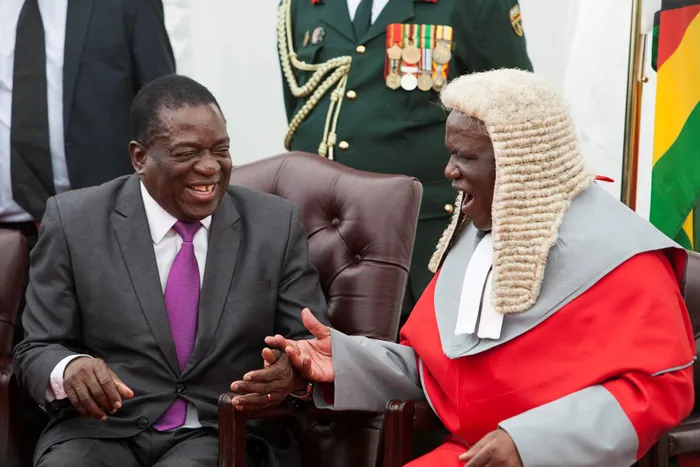
Zimbabwe's President Emmerson Mnangagwa (left) and Chief Justice Luke Malaba in conversation before Mnangagwa's swearing-in ceremony in Harare, on December 28, 2017. For as long as constitutions and elections are used as instruments of elite power rather than tools to empower citizens, flag independence will remain at half-mast, says the writer.
Image: AFP
Kim Heller
Across Africa, the promise of pan-African liberation and decolonised self-governance has been corrupted. Many liberation movements have degenerated into self-serving elites.
The state has become a site of self-accumulation rather than a bastion of the national good. Neo-liberal, neo-patrimonial states have become the political order of contemporary Africa.
Constitutions and elections, often held up as beacons of functional democracy, are failing to deliver popular sovereignty. Constitutions have increasingly become the playthings of powerful politicians, dismantled, distorted, or manipulated to serve personal fortunes rather than the will of the people.
On 16 February 2026, Zimbabwe gazetted Constitutional Amendment No. 3. The Bill proposes extending the terms of the National Assembly and the President from 5 to 7 years. Further to this, the Bill provides for the President to be selected through a parliamentary ballot rather than by popular vote.
This change is significant because it discounts the popular voice. If adopted, these provisions could see Mnangagwa remain in office until 2030. The 2013 Constitution limits Presidential terms to two five-year terms. Opposition voices have argued that this amendment is intended to extend Mnangagwa's reign and undermine democratic accountability.
When Mnangagwa ousted Mugabe in 2017, he promised a "New Dawn" based on sound governance and economic revitalisation. Almost ten years later, there has been little socio-economic renewal. Employment is scarce, driving distress and migration. The Zimbabwean dollar continues to perform poorly, and living costs remain sky-high. Global trade remains limited and largely stagnant.
Zimbabwe's economy remains fragile. Mnangagwa's prosperity blueprint, Vision 2030, has yet to deliver economic recovery or tangible and lasting improvements in ordinary citizens' lives. While the government's "open for business" posture has seen increased investment, particularly with China and Russia, many of these deals primarily benefit political and business elites.
The extractive political economy remains intact, standing as a living monument to the country's colonial legacy. Poverty and underdevelopment, compounded by punitive Western-imposed sanctions, have been further deepened by poor governance.
ZANU-PF-aligned politicians have defended the Bill as essential for "policy continuity" and for completing large-scale infrastructure projects. Justice Minister Ziyambi has argued that longer presidential and parliamentary terms would facilitate more effective implementation of large infrastructure and development projects, free from the disturbance of political electioneering.
Former minister Jonathan Moyo has praised the amendments as a "profound recalibration" of governance structures. If the ruling party was positively impacting the material conditions of Zimbabwe's people, this argument could be entertained. But a continuation of the current regime is unlikely to improve the lot of ordinary citizens.
Opposition leader Nelson Chamisa has called for a referendum and warned that any extension of the incumbent's term violates the spirit and letter of the 2013 Constitution. Similarly, constitutional lawyer Justice Mavedzenge argues that bypassing a referendum on such a fundamental issue represents a serious erosion of democratic norms. He notes that Parliament is unlikely to reject the amendments because many MPs also stand to benefit from extended terms.
War veterans have taken the matter to the Constitutional Court, framing the amendment as a direct assault on the liberation values they fought for. Members of the Citizens Coalition for Change have publicly rejected the Bill, arguing that they cannot endorse changes to the 2013 Constitution that "the people adopted." Zimbabwe Lawyers for Human Rights has described the Bill as "a direct assault on the sovereignty of the people and the supremacy of the Constitution."
Civil society groups are mobilising jointly under the Defend the Constitution Platform. This is even though the civic space in Zimbabwe has shrunk dramatically due to financial shortfalls, pressure, legal and political harassment.
Constitutions are not sacred biblical tablets. They are living, dynamic documents that can and should evolve in line with citizens' needs, new macro-environments, and democratic imperatives. The debate over term limits exposes a deep historical fault line.
Colonial legacies and external pressures shaped many constitutions drafted at independence. Often, these were purposefully engineered to protect existing property relations and elite economic interests. This meant that the colonial economic footprint was preserved even as political power formally shifted.
Constitutions can and should be changed to serve the collective will of the people, not to license the ambitions of ever-greedy political elites. Constitutions across Africa have long been used to underwrite neoliberal notions of justice and, today, to entrench elite power.
Across the continent, constitutional manipulation has become a familiar script. In Uganda, presidential term limits were removed in 2005. In Rwanda, constitutional amendments have secured Paul Kagame's tenure until 2034. In Cameroon, Paul Biya has ruled since 1982 through a series of calculated constitutional plays. These are exercises in constitutional degradation for power retention.
For many liberation movements that have become ruling parties, politics has shifted from an expression of people's power to the preservation of elite interests and personal fiefdoms. The notion of one-party dominance, once defended as necessary for nation-building and consolidation in the early post-independence period, has begun to lose credibility.
Zimbabwe's democratic resilience is once again under scrutiny. The current moment is unlikely to produce an open, transparent national debate. For as long as constitutions and elections are used as instruments of elite power rather than tools to empower citizens, flag independence will remain at half-mast. This is a betrayal of the liberatory vision.
ZANU-PF may have curtailed the voice of civil society and the opposition for now. But that voice will rise again when people remember that the Constitution belongs to them, not to the elites.
* Kim Heller is a political analyst and author of No White Lies: Black Politics and White Power in South Africa.
** The views expressed do not necessarily reflect the views of IOL, Independent Media or The African.